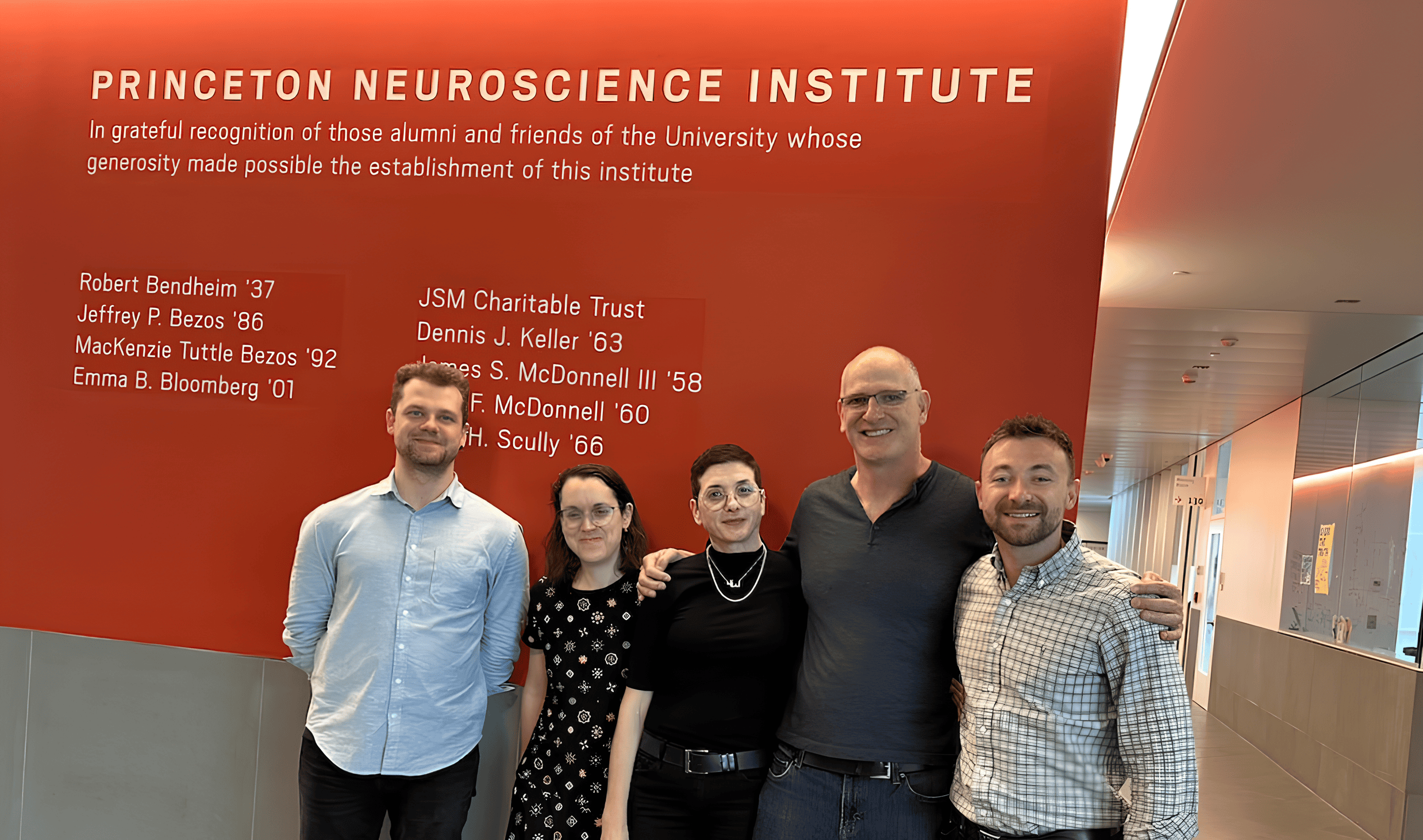
New Jersey, USA, July 28 — Sigma Software Group is highlighting a new preprint from the First 1,000 Days (1kD) Project, co-authored by researchers at the Hasson Lab at the Princeton Neuroscience Institute, Sigma Software engineers, and independent contributors. The study asks a question that sits at the intersection of artificial intelligence, computer science, and human learning: can an AI system learn meaningful language structure from the limited, sequential, real-world input available to a child?
Modern AI systems are often trained on enormous text datasets, processed many times and in shuffled order. The 1kD team took a very different approach. Using dense recordings from children’s everyday home environments, the researchers built learning agents that received child-specific language input over developmental time. The agents were trained incrementally, with curriculum learning and memory-like replay, rather than relying on pre-built linguistic categories or internet-scale data.
For the study, the team modeled data from eight children in the 1kD archive. Each child’s home environment had been recorded across hundreds of days, yielding thousands of hours of usable speech input per child. From this input, the team trained individualized learning agents and tested what conditions were necessary for learning to emerge.
The results suggest that child-scale learning is possible, but not trivial. The agents learned structured speech representations and acquired vocabularies that closely tracked children’s developmental trajectories. But learning depended strongly on the way the system was trained. Sparse input was not enough. Chronological order, sufficient data density, curriculum learning, and replay all mattered.
The science is striking, but for Sigma Software the project was also a rare engineering challenge: helping transform a bold research vision into a system that could actually be run, tested, evaluated, and improved.
Sigma Software’s engineering team, including Marian Faryna, Arkadii Tsyhanov, and Valery Malakhov are co-authors on the paper and helped build the infrastructure behind the preprint. The company’s central contribution was the scalable batch-processing system that makes this possible. The system functions as the engine that applies research inquiries to the archive: for each new question or model, it can process millions of audiovisual segments and generate multidimensional feature and event tables capable of holding the millions or billions of data points produced by large-scale AI analysis.
The 1kD is the first academic human-subject developmental dataset that is supported by an industry-level AI architecture of this kind — a secure data lake connected to scalable batch processing, model validation, and cumulative feature generation. This addresses a key bottleneck in data-intensive behavioral research: making ethically protected recordings usable by many investigators without sacrificing the richness or future value of the archive.
The work shows how close collaboration between researchers and engineers can open new kinds of AI experimentation. Rather than using AI only to analyze data after the fact, the 1kD team used AI as a way to simulate learning processes — asking not only what children hear, but what kind of computational system could learn from that experience.
The study, “The Richness of Experience: Agent-Based Learning Reveals the Mechanisms of Early Language Acquisition,” is currently available as a preprint here.
About Hasson Lab
The Hasson Lab investigates the underlying neural basis of brain-to-brain human communication, natural language processing, and language acquisition in children as they materialize in real-world contexts. Our studies of neural responses to natural stimuli (such as audio-visual narratives) led us to realize that models developed under particular experimental manipulations in the lab fail to capture variance in real-life contexts. Inspired by the success of deep learning in modeling natural stimuli, the Hasson Lab aims to develop new theoretical frameworks and computational tools to model the neural basis of cognition as it materializes in the real world.
About Sigma Software Group
Sigma Software Group is a global IT consulting and software development group of companies with 2000 experts across 42 offices in more than 23 countries. Trusted by over 350 clients — from startups to Fortune 500 heavyweights — the company delivers tailored, high-quality tech solutions, including 25 ready-to-use products and 40+ services. With strong expertise in Automotive, Engineering, Manufacturing, AdTech and a focus on innovation, Sigma Software has been featured by Forbes, CNBC, and Reuters, and regularly ranks among IAOP’s Top 100 Outsourcing providers.