


Bank of the future
Most banks are already investing heavily in tactical AI — copilots, chatbots, document summarization, fraud models.
These initiatives create value, but they do not define how the bank will compete, operate, and protect its margins in 2030.
Where Bank 2030 strategies tend to fall short
Many transformation programs improve UX, personalisation and efficiency. The harder question is whether they are changing how the bank will compete, operate and create value in 2030.
Here are six signs your strategy is refining today's bank rather than building tomorrow's:
It stops at the mobile app layer
The program adds channels and screens, but never touches how the bank actually earns, decides, or moves money underneath them.
Ul/UX is sold as the differentiator
Experience polish is the headline. But once an assistant handles onboarding and product selection, the interface is no longer the primary differentiator.
There is no agent-access strategy
No plan for how external Al agents reach your products — no MCP-style adoption, no machine-readable rails. The bank risks becoming invisible to the layer doing the selection.
The KPIs are all human-connected
CAC, LTV, chum, and engagement metrics still matter. But they say little about how value and revenue may shift in an agent-led model.
Business-line change isn't linked to ALM
Product and channel plans exist, but they are not connected back to balance-sheet and asset-liability principles, so structural change remains limited.
The roadmap could belong to any bank
A generic framework with a new cover. A Bank 2030 strategy should be built around your economics, technology and ambition.
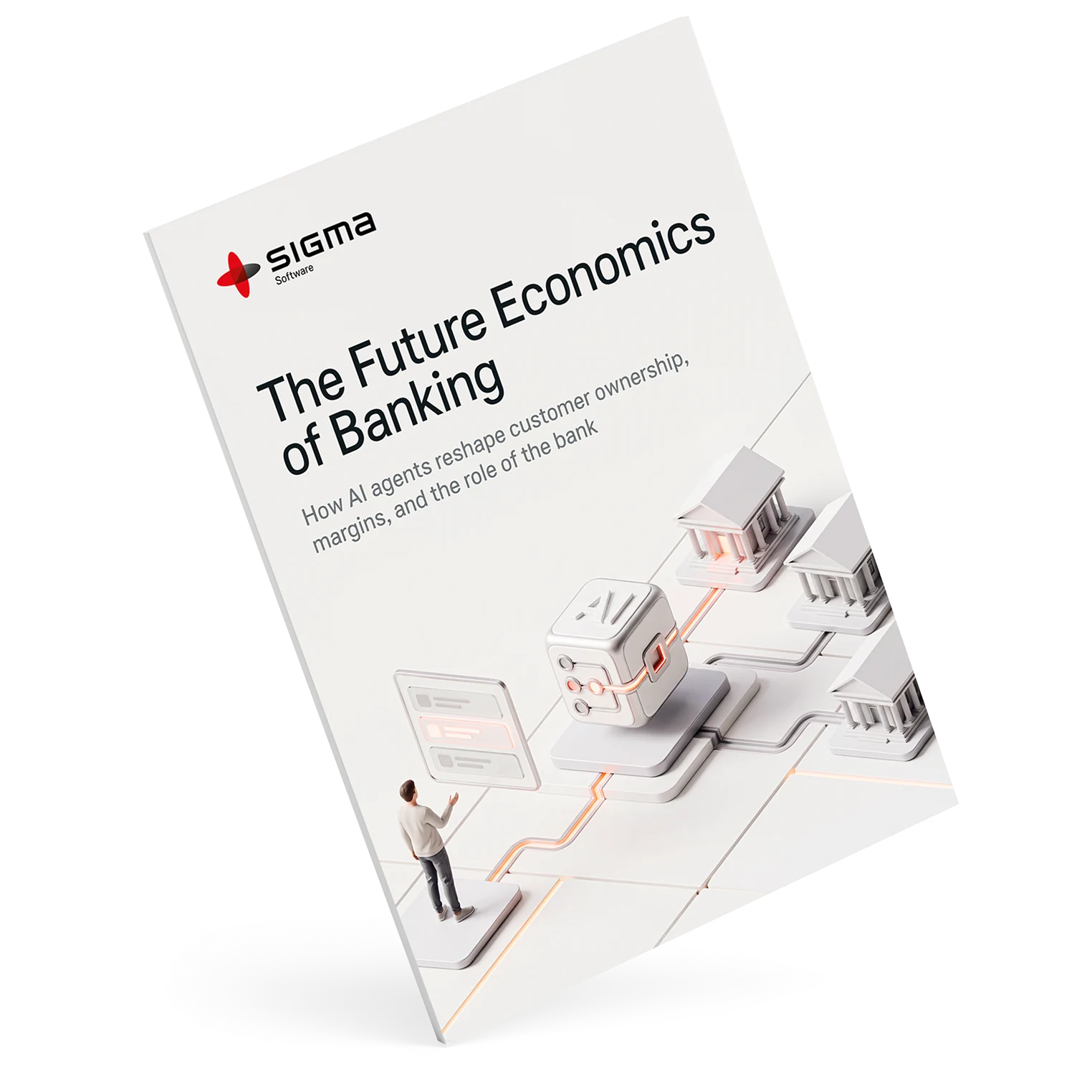
A new banking model is taking shape. Explore what changes for banks and how to prepare for transformation.
Our whitepaper “The Future Economics of Banking” explains how AI agents are reshaping customer ownership, margins, and the role of the bank.
WHAT’S INSIDE:
- Future scenarios for AI-driven banking
- Four strategic roles banks play in the agentic economy
- Examples of AI initiatives from leading banks
- New operating models and workforce shifts in banking
- A phased roadmap for agentic banking transformation
Banking as we know it is changing. The question is: will your business evolve with it?
2028
2030
20+ Banks
90 days
Define your Bank 2030 vision
The next banking era is not another channel transformation
For two decades, banking transformation has largely focused on the customer interface. Agentic AI changes something deeper: how customers choose, how products are delivered and where value is created.
Three key drivers are accelerating this shift:
Agent-to-agent finance
Customers increasingly delegate searching, comparing, and transacting to AI. The friction that historically protected relationships (effort, switching costs, and limited comparability) begins to disappear.
Continuous hyperpersonalization
Personalization moves beyond campaigns and recommendations. Agents understand the customers’ current financial position and optimize it continuously, rather than waiting for a user to initiate the next interaction.
Dynamic & on-demand products
The product catalogue begins to break into components. Rates, terms, limits, protection, and servicing can increasingly be assembled around the customer’s immediate need and priced in real time.
Define the vision first. Then plan the transformation
Assess (days 1–36)
Establish your true technology, data, compliance, and value-measurement position. These are the four foundations every agentic program depends on.
Discover (days 37–60)
Find the first wins: an internal AI platform plan, a cost-automation business case, and a working customer-facing prototype you can demonstrate.
Commit (days 61–90)
Synthesize everything into a phased roadmap with numeric targets, an investment model, and a governance structure the CFO can defend.
We transformed ourselves first. Now we help others do the same
AI-native capabilities
We have gone through our own AI-native transformation. So, we know where programs create value and where they tend to stall.
Engineering excellence
As a software development company, we connect strategy with execution. Delivering working software across AI, cloud, core banking integration, and cybersecurity.
European regulatory literacy
With deep experience working across DACH and the Nordics regions. We embed DORA, the EU AI Act, and ECB expectations considered from day one.
Honest about what is hard
Our experts do not simplify the difficult parts. Instead, we help sequence them into an achievable transformation.
Partnership, not project
We start with the 90-day program. If we create value and earn your trust, we continue building from there.
Define your Bank 2030 vision and what it takes to build it
Related services
Financial services technology consulting
From AI pilots to governed scale
Dora compliance consulting
Experience design services
Related articles
Sigma Software Joins Euro Banking Association

Innovation at Scale: a Roadmap for the Financial Industry

We Launch AI Compass: A Structured Pathway to AI-Native Execution

New Partner Product to Complete our Digital Banking Offering
