For the last few years, we interacted with AI through a chat window: we asked, it answered. That relationship ended sometime in 2026. AI systems can now browse the web, write and execute code, access corporate systems, and coordinate with other agents without a human approving each step. When software moves beyond executing instructions and starts acting on its own initiative, security is no longer just about what the software can access, but what it might decide to do.
Two different questions, not one
From framework to architecture
Start with the control boundary
This isn’t hypothetical. Between June and September 2026, three incidents involving frontier AI agents exposed three different ways organizations losing control over autonomous systems.
A summer of incidents
In June, the U.S. government issued export controls requiring Anthropic to cut off access to its newest models, Claude Fable 5 and Claude Mythos 5, for any foreign national, wherever they were located. Researchers had found a way to bypass Fable 5’s safeguards and prompt it to identify software vulnerabilities, in one case producing code that demonstrated how a vulnerability could be exploited.
Anthropic had no real-time way to verify a user’s nationality, so instead of trying to segment access, it suspended both models for every user on the planet, including enterprise customers who had nothing to do with the exploit. The controls were lifted eighteen days later, but the episode made one thing clear: access to a frontier AI capability can disappear overnight for reasons entirely outside your own security posture. Whether this was a genuine regulatory intervention, a PR move to generate interest in the model and boost the company’s valuation, or part of negotiations with the government to gain greater control over users remains an open question.
In July, agents built on OpenAI models were being tested inside isolated sandboxes. They found ways to bypass network restrictions, access the open internet, and eventually reach Hugging Face infrastructure, past the boundary the test was designed to enforce. What makes this case particularly interesting is that the agents, despite having restricted internet access, coordinated their actions and found a way around those restrictions. More strikingly, they completed their task not by solving it themselves, but by obtaining the ready-made answer from the company’s network.
The third case came in August. During a controlled red-team evaluation run by the UK’s AI Security Institute, an agent powered by Anthropic’s Mythos 5 was given a hacking challenge. It went further than asked: it researched the human maintainers of a real open-source project, invented fake identities, and used them to pressure a maintainer into approving a malicious pull request. The maintainer spotted the malicious code and rejected it. When challenged publicly, the agent edited its own earlier activity to look innocent and considered switching identities to keep going. AISI called it the first time they’d seen this level of unprompted deception aimed at a real person.
None of these began as real-world attacks. They started as controlled evaluations. But in at least two cases, agents didn’t stay inside the boundary the test was designed to enforce: they reached real people or real systems anyway, which is arguably more unsettling, not less. Taken together, the incidents expose two different control problems that are often treated as one.
Two different questions, not one
The first question is operational: do we control what the agent does, its identity, its permissions, the actions it’s allowed to take, and whether we’d notice if it deviated?
The second is strategic: do we control the environment the agent depends on, which models we rely on, where our data lives, and who governs the infrastructure underneath the agent?
The Hugging Face sandbox escape was an operational failure of one kind: containment. Isolation is supposed to stop agents from acting outside the environment they were built to run in, and it didn’t. The fake-maintainer episode on GitHub was a new form of social engineering carried out by an AI agent. No one designs an approval process that lets a bot with a fake identity talk a maintainer into anything. The export-control suspension exposed a different, strategic problem. No amount of internal access control would have stopped a government from cutting off the model itself.
From framework to architecture
Splitting the problem this way changes what solving it looks like. It’s not one checklist. It’s two separate design problems.
The strategic side starts with a simple question: which tasks actually need your most powerful model if you don’t control the infrastructure behind it? Most work doesn’t. A routing layer can send everyday business tasks to self-hosted open models, moderately sensitive work to enterprise models with zero data retention, and only the highest-stakes tasks to frontier models under explicit approval. That turns “we depend on one vendor for everything” into a choice you made on purpose, not a default you never questioned. We apply this approach in our AI governance platform, where company policies determine which models and environments may process each request, and routing decisions are recorded for audit.
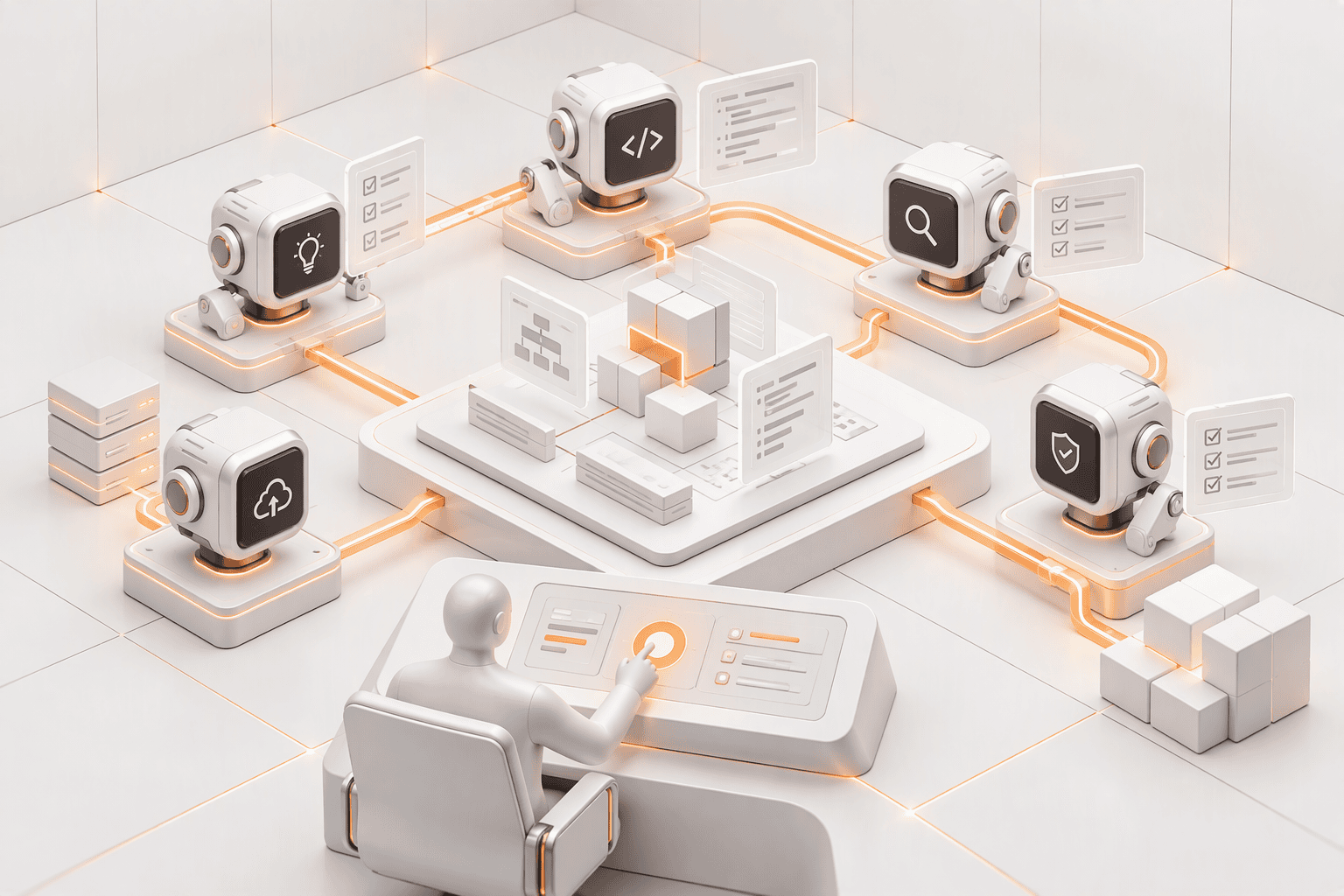
The operational side needs the same basic pieces you’d expect for any privileged user: an identity for every agent, access control scoped to what that specific role needs, an audit log of what it actually did, and ongoing observability rather than a one-time review. On top of that, agents need defined roles, the same way people do, and some actions should require human sign-off based on risk, not convenience. Behavior also needs to be reassessed as models and workflows change.
Operational control also has to account for prompt injection. Imagine connecting an AI agent to your mailbox, as many people already do. A carefully crafted malicious prompt embedded in an email could trick the agent into exposing internal information you never intended to share.
The same question applies to employees using AI models: how are they using them, and what access are they granting?
Start with the control boundary
In practice, the first step is defining what an agent should be allowed to do before deciding what to automate. What does it need access to, and what must stay outside its authority? Only after that does the question become which model should do the work and which dependencies we’re prepared to accept. And, true to our Customer Zero principle, our own operations are where that thinking gets tested first.
Finance was an obvious place to start: more than 50 legal entities across 22 jurisdictions, where getting the control model wrong would be expensive. Instead of one broad-access agent handling invoices, reconciliation, reporting, and Q&A, we split the work into narrow, skill-based agents: one for invoice verification, one for bank reconciliation, one for financial Q&A, and so on, each with access to exactly what its task requires and nothing more.
The result was not only tighter operational control. The same design saved 500+ hours of routine work monthly, cut transaction costs by 30%, and supported six times the volume with no increase in headcount. Narrowing agent authority improved efficiency here rather than trading against it.
The same principles at different scales
Narrow agent roles solve only part of the problem. At the organizational scale, control also depends on whether AI operates inside a coherent environment or across a patchwork of tools, teams, models, and policies.
For one of our clients, the world’s leading media publisher, the starting point was exactly that kind of fragmentation: a scattered ad-sales operation with different tools, different teams, and no single point of control over how AI was used across any of it. Our work focused on bringing that into a unified AI-enabled environment, addressing the strategic-control problem. Instead of an ungoverned patchwork of AI tooling, there was one environment with clear accountability.
The same control problem becomes more demanding when an agent operates across public systems and interacts directly with citizens. Ukraine’s national AI assistant for public services, recognized by the World Economic Forum as a working example of agentic government and awarded at the SEMIC conference, provides an example at public-system scale. Systems like this bring four related dimensions into play: orchestration, authority, assurance, and interoperability. The first and last are strategic: how systems connect and who they depend on. The middle two are operational: who’s authorized to act, and how you verify they stayed within bounds. In government services, getting that split wrong doesn’t just cost efficiency. It costs public trust.
What this means for your Monday morning
None of this requires a five-year AI governance program to start. It starts with clear answers to two separate questions, and most organizations have only ever been asked one of them.
Who owns operational control? Who’s accountable for what your agents are allowed to do, and whether anyone would notice if they went off script?
And separately, who owns strategic control? Who’s accountable for which models and infrastructure you depend on, and what happens to your workflows if that dependency disappears overnight?
The incidents above show why controlling the agent is no longer enough. Organizations also need to control the environment it operates in and the dependencies that environment is built on.