Every major technology shift creates new jobs. AI is no exception. AI Engineers, AI Solution Architects, Agentic Developers, and other new titles are becoming increasingly common.
At the same time, a bigger change is happening inside organizations: even without new titles, the responsibilities of existing employees are changing just as rapidly. The question is whether our traditional understanding of professional roles and seniority still reflects how value is created.
At Sigma Software, we see this across the organization, from software engineering, QA, and DevOps to business analysis, operations, and other corporate functions. In 2026, we updated our competency requirements across roles and seniority levels to reflect how AI is becoming part of everyday work.
This is not simply about adding “AI skills” to existing job descriptions. As AI takes over more execution work, it changes how professional value is assessed, how workflows are organized, what existing roles require, and where new specializations emerge.
How AI Changes Seniority
The debate about AI and engineering careers often focuses on Junior specialists, whose traditional entry-level tasks can increasingly be handled by AI. But why stop at Juniors? If AI can already generate code at the level of a Middle Developer, the question of professional value extends well beyond those just entering the profession.
The distinction is between coding and software engineering. Writing code is only one part of the job. Understanding what a customer actually needs, translating ambiguous requirements into technical solutions, making architectural decisions, and balancing competing priorities have always been essential engineering responsibilities. AI changes how much of this work can be delegated, but it does not eliminate the need for those capabilities.
This brings us to a question that applies to every level of seniority: What value can a specialist create beyond what AI can produce on its own?
Experience still matters, but AI may change which aspects of experience create the most value. A specialist’s ability to execute tasks independently may become less distinctive, while the ability to recognize a flawed approach, question an assumption, or make a difficult trade-off becomes more important.
Our own testing offers a concrete example of where an engineer can create value beyond what AI can deliver independently. We gave AI models six real development tasks from one of our production systems, all previously completed by our engineers. AI-generated solutions for bug fixes, contained features, and a framework migration were accepted in 61–94% of attempts. But for a task requiring a change to the system’s design, the success rate dropped to just 5.6% (3 out of 54 attempts). This is where the engineer’s ability to rethink the design, rather than simply implement it, becomes particularly valuable.
These results come from a small set of tasks in a single codebase and should not be taken as representative of AI performance across projects.
Interestingly, experience is not always an advantage in every aspect of AI adoption. Young specialists may be more willing to experiment with unfamiliar approaches, while experienced colleagues can recognize limitations and risks that are less obvious to newcomers. Bringing these perspectives together can be particularly valuable.
For companies, this raises a question about existing grade structures. The fundamentals of professional maturity remain important, but do expectations within each level still reflect how specialists create value when AI can perform more of the execution work?
How AI Changes Workflows
The impact becomes more significant when AI moves beyond assisting with individual tasks and begins executing larger parts of a process.
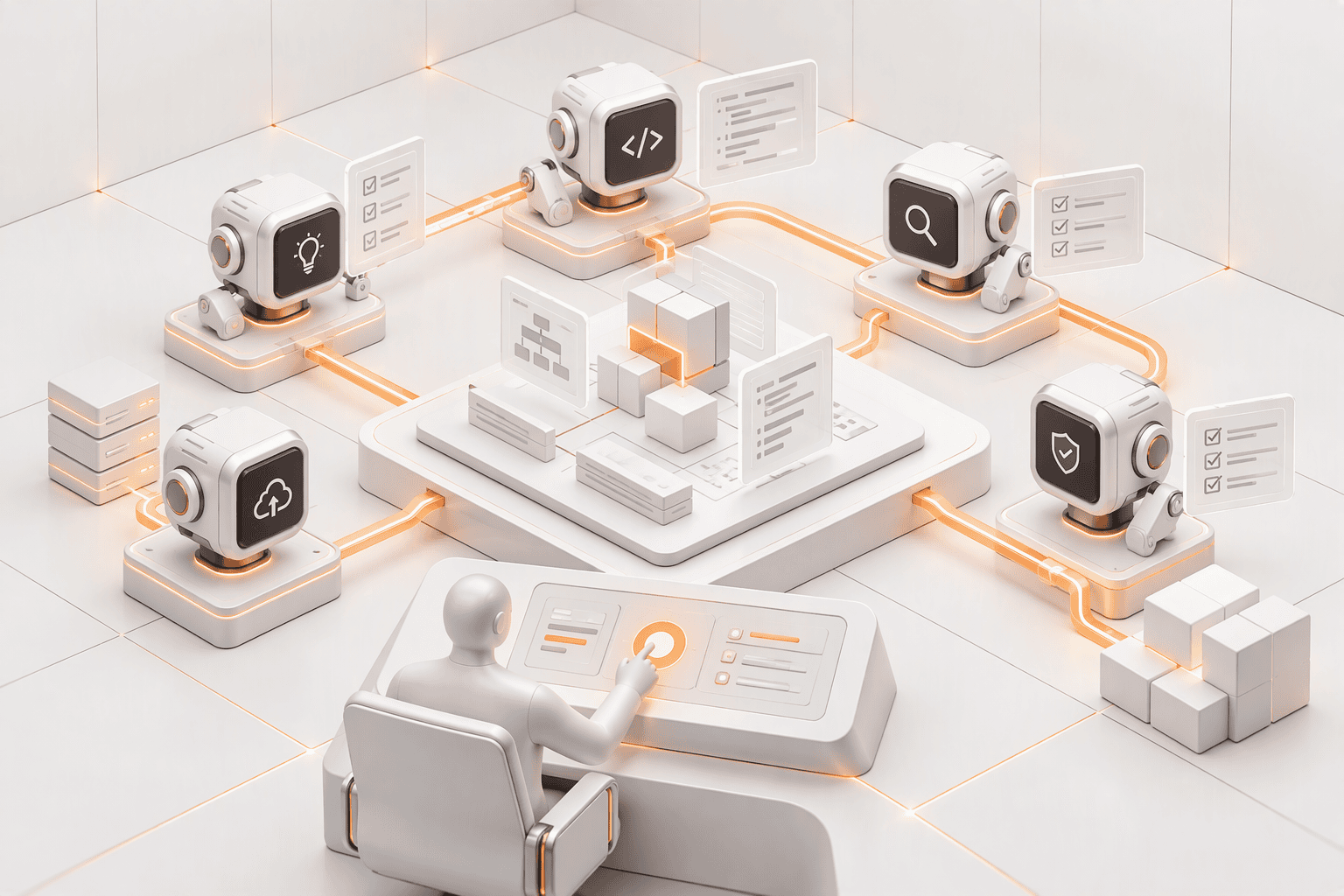
Software development provides a useful example. In AI-assisted development, an engineer remains responsible for the code, using AI to accelerate implementation while reviewing its output. In more agentic approaches, AI can execute sequences of tasks based on a goal, specification, or execution plan, with human involvement concentrated at defined control points.
We saw this in our own work. Changing how tasks were organized and handed to AI raised the share of AI output we accepted from 22% to 61%. It took no bigger model and no new hardware. Just a better process around it.
The difference is not simply how much code AI generates. It is what the team needs to prepare and control in order for the process to work.
Detailed specifications, project context, execution plans, and validation mechanisms become increasingly important.
This also changes where bottlenecks appear. When implementation can be completed much faster, unclear requirements, missing context, or delayed decisions can have a greater impact on delivery than coding itself.
As more execution moves to AI, decisions about what should be built, which constraints matter, and what constitutes an acceptable result carry greater weight.
Even judging the result is not straightforward. When we had borderline AI changes reviewed again, on code that had not changed at all, some results flipped from “accept” to “reject.” Clear failures stayed failures, but the close calls did not hold. That gray zone is exactly where human review still matters.
How AI Changes Existing Roles
As workflows change, so does the division of responsibilities between people and AI. This affects established professions even when their job titles remain the same.
For Software Engineers, the shift is from primarily implementing solutions to taking greater responsibility for defining technical approaches, directing AI-assisted execution, and ensuring the quality of the result. Their role increasingly involves deciding what to delegate to AI and where human intervention is necessary.
QA Engineers face a different shift. As AI generates more code and tests, their responsibility extends beyond executing test cases to designing validation strategies, identifying gaps in coverage, and assessing risks that automated checks may miss.
Business Analysts become more closely involved in preparing work for execution. Requirements must be precise enough to guide AI agents, while still reflecting business needs, constraints, and priorities. We measured what happens when that preparation fails. In one test, the plan given to the AI left out a key requirement: keeping each user’s data separate. The AI wrote around 400 lines of code that passed its tests and looked correct, but the requirement was missing. When the plan named it clearly, the AI built it in both runs. The code was only as good as the task description behind it.
Architects, meanwhile, must account for AI agents and components as part of the systems they design, including their integration, reliability, and governance.
The job title may stay the same. The responsibilities behind it won’t.
When AI performs more of the work, who becomes responsible for defining the right task, challenging the result, and deciding whether it is good enough?
At Sigma Software, we integrated AI capabilities into our skill and grade matrices in 2026, with expectations differentiated by function and seniority. The goal is not to turn every specialist into an AI Engineer, but to reflect how responsibilities and performance expectations are changing within existing roles.
For example, a Middle Business Analyst is now expected to check what an AI agent produces, spot what it missed, and know where a human decision is needed, while a Senior BA designs these flows and owns the quality of the result. In DevOps, the role has taken on whole new areas, from running LLM platforms to managing AI spending, and most Senior engineers are expected to judge when AI is not the right tool at all.
How AI Changes Titles and Scope
Not every change fits within an existing professional profile. As AI takes on more complex work, some responsibilities require combinations of expertise that develop into distinct specializations.
For example, when AI agents execute sequences of engineering tasks, someone needs to design those processes, manage context, and establish controls. This creates demand for AI Agentic Developers.
When AI agents need to act on requirements rather than simply assist people in interpreting them, the quality and structure of those requirements become critical. This is where the Agentic Requirements Analyst specialization emerges, combining business knowledge with AI-enabled delivery expertise.
Other specializations connect AI capabilities with existing technology and business disciplines. AI Data Engineers work at the intersection of data engineering and AI systems. AI Solution Architects address architecture and integration challenges, while Forward Deployed Engineers combine engineering expertise with direct involvement in solving customer problems.
These profiles are not necessarily entirely new professions. Often, they represent combinations of capabilities that previously belonged to different specialists or functions.
A new title can make an emerging capability visible. But it can also create the impression that a company has addressed a need before it has defined what the person in that role should actually own.
The business need comes before the job title.
Given the shortage of specialists who combine AI, engineering, and business expertise, companies need to decide which capabilities to develop within existing teams and where new hires or dedicated roles are necessary.
Need reliable specialists that combine AI, engineering, and business expertise?
The emergence of new AI roles is only one part of a broader shift. What matters is how companies turn AI capabilities into real business value.
At Sigma Software, we are working through this transformation ourselves as Customer Zero. The tests and updated skill matrices described above come from our own AI Champions program. That experience shapes AI Compass, our approach to moving from AI adoption to practical implementation. One of its practices focuses on exactly the questions in this post: how processes, decisions, and team capabilities need to change, and which skills to build within existing teams. If you are working through these questions in your organization, map your starting point with AI Compass or book a Compass Session with our team.