The gap between AI investment and AI impact is the defining business challenge of our time. Here is what the data actually says, and what every C-suite leader should do about it.
The Commitment is Extraordinary
The Results Tell a Different Story
The question is not whether your organization is using AI.
It almost certainly is. The real question, the one far fewer executives are asking clearly, is whether it is working.
Not whether the pilot succeeded. Not whether the demo impressed the board. Whether AI is creating meaningful impact at the point that matters most: the customer experience, and the business results that flow from it.
The evidence suggests a significant gap between the two. And closing that gap is not a technology problem. It is a strategic one.
At Sigma Inspire, this gap sits directly at the intersection of the work we do: customer experience, business transformation, and AI. As part of Sigma Software Group, we can also look beyond the experience itself to the technology and implementation behind it. That makes the question of where AI investment turns into actual customer and business value particularly relevant to us.
The Commitment is Extraordinary
Over the past three years, artificial intelligence has attracted a level of executive attention and capital allocation that few technologies in history have matched. The scale of this investment is visible across industries. Retail offers one particularly well-documented example: generative AI alone is projected to unlock between $240 billion and $390 billion in annual value for the retail sector, equivalent to a margin improvement of up to 1.9 percentage points across the industry. Broader digital AI could turn those billions into trillions.
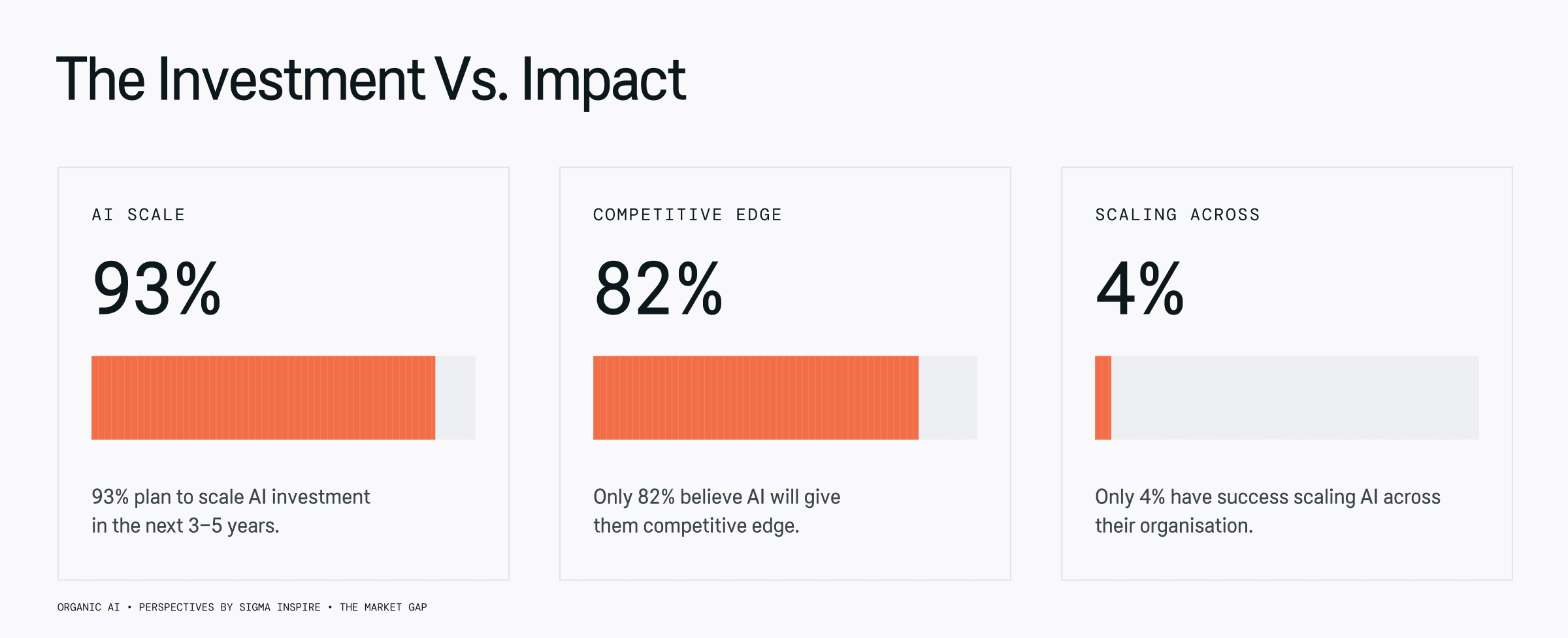
Boards are listening. Budgets are moving. Nine in ten executives plan to increase their AI investments in the coming year, with more than half expecting budget growth of over ten per cent. The Cisco AI Readiness Index found that 59% of executives believe they have one year or less to implement an AI strategy before losing competitive ground. This is not experimentation any more. This is a strategic commitment at scale.
And the early signals are encouraging. In a global survey of retail and consumer goods organizations, 89% reported that AI is positively impacting annual revenue, and 95% said it is helping reduce costs. In retail and consumer goods, at least, the business case in isolated deployments is already visible.
The Results Tell a Different Story
Yet even in sectors where investment and expected returns are particularly high, the gap between experimentation and transformation remains significant. McKinsey surveyed more than 50 retail executives about their generative AI programmes. Of that group, senior leaders from some of the world’s most resource-rich organizations, only two had successfully implemented generative AI across their organizations at scale.
Most companies are pilot-rich but transformation-poor. Hundreds of active deployments. Zero fundamental change in how the business operates.
This is not an isolated finding. Researchers at Harvard Business School and Microsoft, studying the AI transformations of dozens of global organizations, described a phenomenon they called the AI Last Mile Problem: a structural gap between what the technology can do and what organizations can actually deliver to the customer. One global investment bank had documented more than 250 applications connecting large language models to its enterprise systems. A global food and beverage company had launched AI pilots across 185 countries. A global apparel firm had automated more than 18,000 finance processes. None had fundamentally changed their operating model.
The pattern is consistent. AI productivity gains emerge at the individual level: a faster report, a shorter email, a better code suggestion. These gains do not convert into an enterprise-wide transformation. Saved time gets absorbed back into low-value activities. Pilots do not become programs. Technology islands do not become connected infrastructure. The Harvard research team described these as “islands of productivity that are difficult to convert into scaled, trustworthy enterprise systems.”
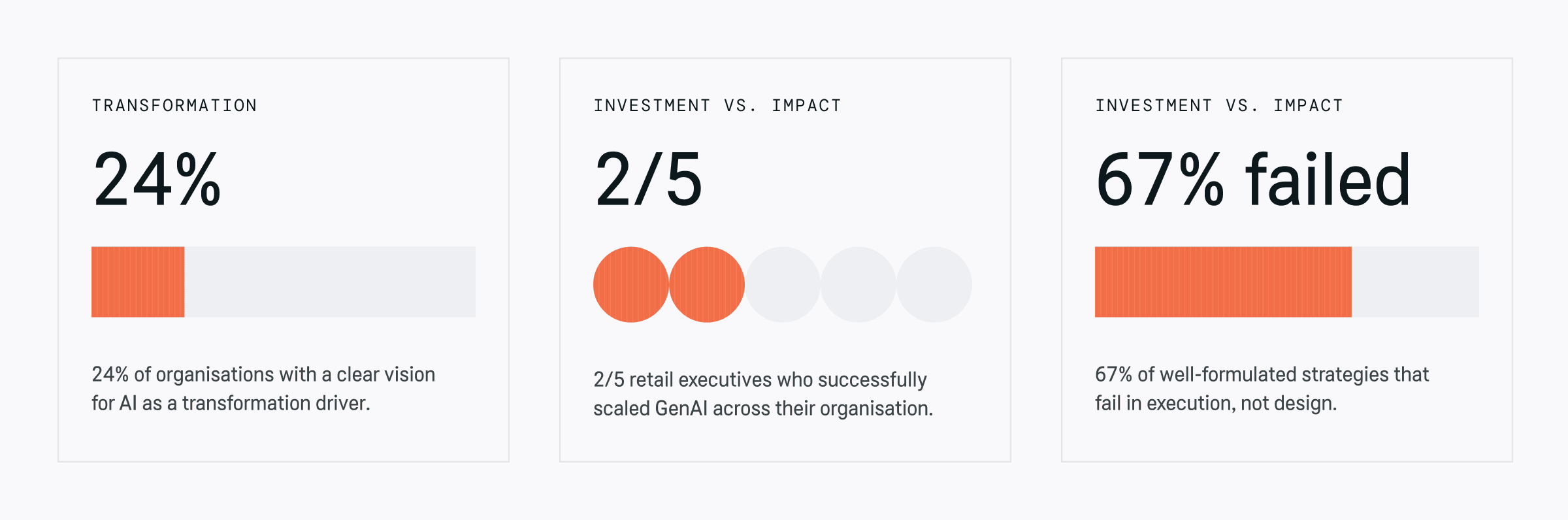
The primary obstacle is rarely the model quality or the data availability. The technology works. The gap is organizational: the distance between what a strategy document describes and what a customer actually experiences.
Why This Is a C-Suite Problem, Not a Technology Problem
It would be comfortable to frame this as an IT delivery challenge, something to delegate downward and revisit at the next quarterly review. The data suggests this is the wrong instinct.
The stakes of inaction are material. Forrester’s 2025 research on customer obsession found that organizations genuinely built around the customer, those who have embedded customer-centricity into their strategy, operations, and leadership, achieve 41% faster revenue growth, 49% faster profit growth, and 51% better customer retention than their peers. Watermark Consulting’s sixteen-year analysis of customer experience leadership found that CX Leaders generated a total stock market return 7.8 times greater than that of CX Laggards and outperformed the S&P 500 index by more than 260 points.
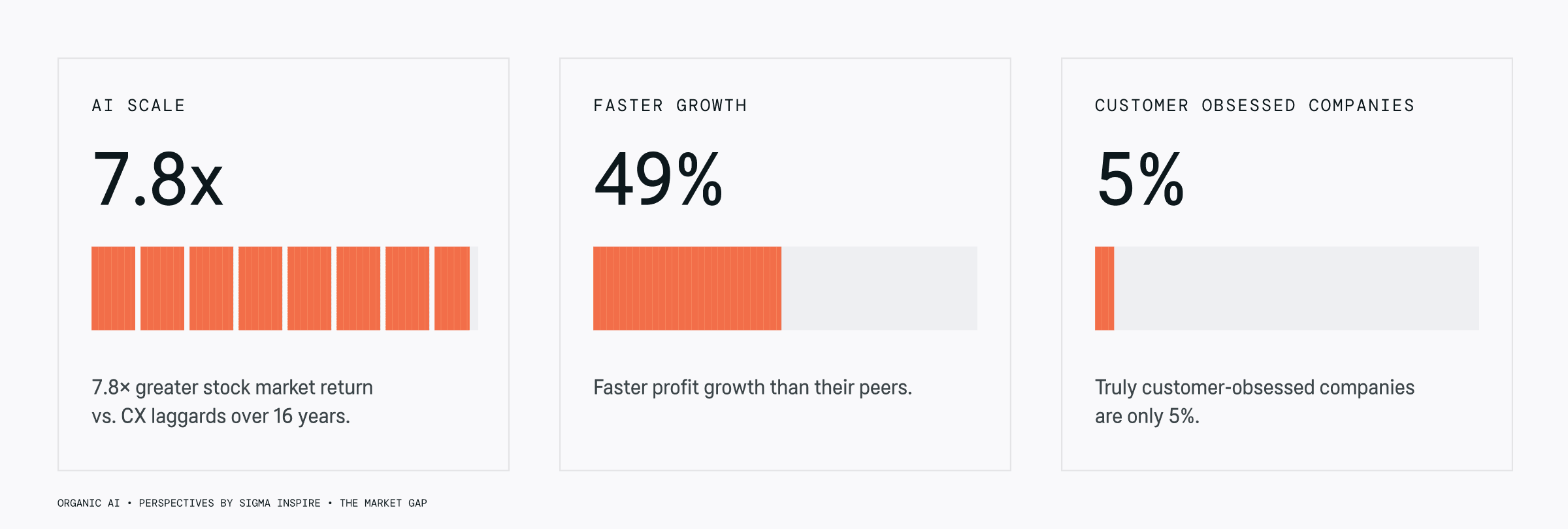
Only 5% of companies are currently classified as truly customer-obsessed. The majority are investing in the language of customer centricity whilst continuing to operate the mechanics of internal efficiency.
AI is accelerating this divide. The 82% of executives who believe AI will create a competitive edge are correct. The edge will not come from deploying AI widely. It will come from deploying it deliberately. From positioning it where it creates genuine customer value, not where it reduces headcount or speeds up an internal process that the customer never sees.
Need professional help with creating real customer value with AI?
The Right Framing for 2026
Consider what the research consistently points toward. The organizations making the most significant progress with AI share a characteristic that has nothing to do with the sophistication of their models or the size of their data estate. They start from a different question.
Instead of asking “where can we apply AI?”, they ask “what does our customer need, and how does AI make that delivery more meaningful?” Instead of layering AI onto existing processes, they redesign those processes from the customer experience inward. AI becomes a structural element of the solution, not a feature added at the end.
The distinction between AI that is designed in and AI that is bolted on is the difference between the companies capturing the returns and the companies accumulating the pilots. Amazon’s recommendation engine does not feel like a feature. It feels like the platform understands you. Apple’s ecosystem does not feel like a product integration. It feels like a coherent experience that was always supposed to work this way.
That quality, AI that feels natural, intentional, and human in its outcomes, is what we at Sigma Inspire call Organic AI. It is not about the technology. It is about where you choose to position it, and in the service of whom.
Explore the Organic AI Series
This article is part of the Organic AI Perspectives series, exploring why AI investment so often stops short of the customer and what organizations that close that gap do differently.
- Chapter 1: AI is Everywhere. But Is It Working? – [read the full version on Medium]
- Chapter 2: The AI Last Mile Problem – [read the full version on Medium]
- Chapter 3: What Organic AI Looks Like – [read the full version on Medium]
- Chapter 4: Organic AI is a Mindset — [read the full version on Medium]
The complete series, including the original version of this article, is available on Medium.
About Sigma Inspire
Sigma Inspire is an independent Customer Obsession Boutique within Sigma Software Group. It connects customer insight, product strategy, experience design, data, AI, and delivery to help organizations turn customer understanding into meaningful experiences and measurable business growth.
About Sigma Software Group
Sigma Software Group is a global technology company with more than 2,000 specialists operating across 20+ countries. The Group combines technology consulting, software engineering, AI expertise, and industry knowledge to help organizations move from business challenges and transformation strategies to implementation at scale.
Together, Sigma Inspire and Sigma Software Group connect customer and business transformation with the technology capabilities required to deliver it.