The shift from fee-for-service to value-based care changes the math for medical organizations. You only get paid when patients stay healthy and avoid unnecessary hospital visits. Operating under this model demands two specific technical assets. First, you need an archive capable of holding years of patient records, claims, and administrative logs. Second, you need an analytics engine that translates those massive datasets into daily clinical insights and predictions.
Why Keep Historical Value-based Care Data?
What a Healthcare Data Analytics Platform Must Deliver for Value-based Care
Health Care Data Analytics, ML, and KPI Operationalization
Governance, Privacy & Compliance for Healthcare Data Analytics Platforms
Problems that a Custom Healthcare Analytics Platform Can Solve
Value-based Care Data Analytics Implementation Roadmap
Procurement Checklist for CTOs: Custom Healthcare Data Analytics Solutions vs. Managed Services
Choosing the Right Healthcare Data Analytics Platform Partner
Recent industry reports show that healthcare executives now view their data architecture as the primary driver of contract success. Still, many IT teams find themselves stuck dealing with disconnected databases, weak governance, and dashboards that clinicians simply ignore. This guide breaks down the exact architecture, engineering patterns, and rollout steps your team needs to build an analytics system that actually works.
Why Keep Historical Value-based Care Data?
Longitudinal outcomes measurement
Value-based contracts last for years. To prove your clinical programs actually worked, you have to track cohorts of patients across long stretches of time. Measuring true value means looking at multi-year cost trends and survival rates.
Model re-training & reproducibility
Machine learning algorithms degrade over time. Data scientists use your historical archives to re-train risk stratification models, test for bias, and catch logic drift before a faulty prediction hits the clinic floor.
Regulatory & contractual evidence
State regulators and insurance payers will challenge your numbers. Keeping the original, untouched raw data alongside your final KPI reports gives your administrative team the exact evidence they need to win contract disputes.
Research, quality improvement, and benchmarking
Old datasets are goldmines for retrospective research. Clinical teams use past performance benchmarks to figure out where current care pathways are failing.
What a Healthcare Data Analytics Platform Must Deliver for Value-based Care
To handle the demands of modern healthcare contracts, the underlying tech stack has to hit a few non-negotiable requirements:
- Durable storage and cataloging: The system needs a raw data lake, a curated lakehouse for clean records, a fast serving warehouse, and a feature store for machine learning. Every piece of data needs clear lineage tracking.
- Governed data products: Your platform must push insights out via secure APIs directly into clinical apps, payer reporting tools, and executive dashboards.
- Analytics and ML access: The architecture needs to support basic descriptive reporting, deep diagnostics, and complex predictive modeling for your data science team.
- Security and provenance: Complete audit trails and strict compliance controls are mandatory.
- Cost-efficient tiering: Cloud storage bills escalate quickly. The system should automatically move older files into warm or cold storage to keep monthly expenses under control.
Recommended Best Practices and Design Approaches for Value-based Care Healthcare Data Analytics Solutions
Source & Ingest layer
Stop writing custom API integrations for every new clinic. Connect data sources using standard FHIR and HL7 interfaces. Your ingestion pipelines need to handle large batch uploads for historical records, alongside change data capture for near real-time updates. Add scripts to standardize timestamps and encrypt patient identifiers at the exact moment data enters your system.
Raw Lake
Never alter the original data upon entry. Keep an immutable copy of all source records in durable storage. If an auditor asks to see an original lab result from three years ago, you need to pull the exact raw message. Set up lifecycle policies to push data older than three years into cheaper cold storage.
Processing & Curated Lakehouse
This is where the engineering team transforms messy raw inputs into query-optimized datasets. Think cleaned EHR tables, normalized claims schemas, and standardized outcome registries.
Serving Data Store & Feature Store
Dashboards require a relational, columnar database so they load fast. Machine learning models need an online feature store to pull variables quickly. Once the data is organized, serve it up via APIs so other clinical applications can actually use it.
Analytics & ML
Provide the compute clusters necessary for batch model training. Deploying these models requires strict approval workflows to ensure safety before any algorithm interacts with patient care.
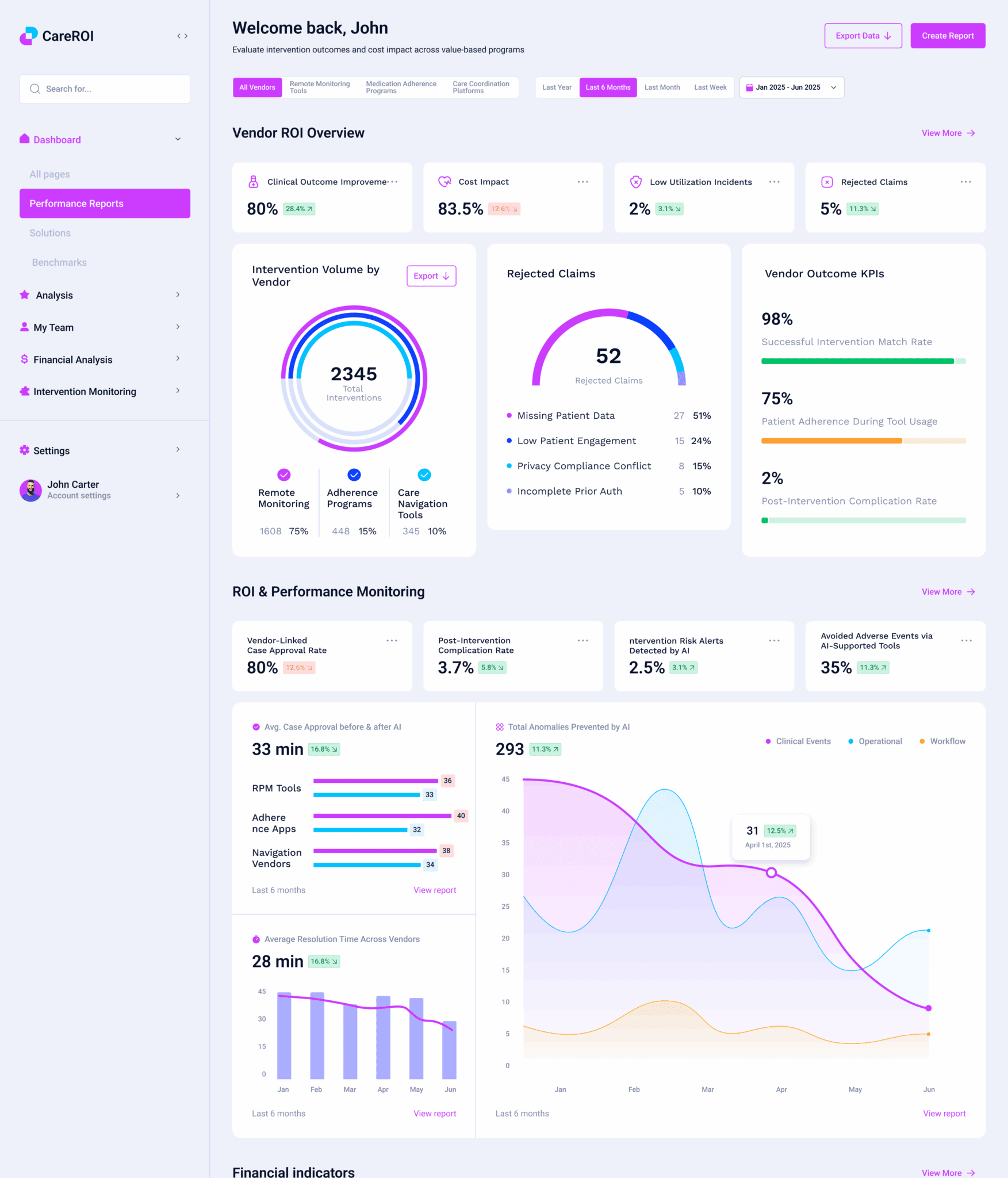
Read more about our service: Custom Value Based Care Analytics Platform
Health Care Data Analytics, ML, and KPI Operationalization
Analytics maturity usually happens in four stages. Descriptive analytics show you what happened (like average length of stay). Diagnostic analytics explain why it happened. Predictive tools calculate what will likely happen next (like readmission risk). Finally, prescriptive analytics suggest what the doctor should actually do about it.
KPI calculus & auditability
Healthcare organizations lose millions because different departments calculate metrics differently. You have to define canonical KPI formulas. Write the code for a metric like “30-day readmission,” store that SQL in version control, and test it against known historical outcomes. This prevents everyone from arguing over whose dashboard is right.
ML lifecycle
You cannot just launch an AI model and forget about it. Teams must continuously validate algorithms using archived holdout data. Require a human to review and approve all model updates before pushing them to the live environment.
Governance, Privacy & Compliance for Healthcare Data Analytics Platforms
Data governance: Build a catalog that links every final dashboard directly back to its original data source. Track your data quality daily, keeping an eye on schema changes and update delays.
Access & consent management: Use strict role-based controls. The system must log every single time an employee views protected health information. Use automated policy-as-code to enforce patient consent boundaries.
Model governance: Version control is not just for code. You need to version your training datasets and your validation results. Set up alerts to monitor the AI for bias over time.
Security: Adopt a zero-trust network setup. Manage your own encryption keys and hire outside firms to run regular penetration tests.
Data management committee: Form an internal group of data stewards and clinicians to oversee data quality and approve new AI tools before they impact patients.
Problems that a Custom Healthcare Analytics Platform Can Solve
- Stopping the endless arguments over inconsistent KPI tracking across different payer contracts.
- Spotting high-risk patients fast enough to actually intervene and prevent an avoidable hospital admission.
- Stopping different hospital departments from redoing the exact same data cleaning work for their research projects.
- Creating highly defensible, auditable reports to guarantee your value-based payouts.
- Controlling the clinical and operational risks of deploying machine learning models.
Value-based Care Data Analytics Implementation Roadmap
- Months 0 to 2 (Discovery): Define your core KPI math, inventory your data sources, and map out exactly who needs access to what.
- Months 2 to 6 (Pilot Ingestion): Hook up your core EHR and claims systems. Load the historical data into the raw lake and spin up the initial data catalog.
- Months 6 to 10 (Curated Datasets): Build the clean database schemas. Write the code for the primary metrics and launch the first BI dashboards for a small pilot group of users.
- Months 10 to 14 (Feature Store & ML): Build the feature store pipelines. Deploy your first predictive risk model and attach active monitoring alerts to it.
- Months 14 to 18 (Scale): Expand to secondary data sources. Automate your governance logs and open up APIs so the data can feed directly into clinical workflows.
Procurement Checklist for CTOs: Custom Healthcare Data Analytics Solutions vs. Managed Services
| Evaluation Area | Custom Build Approach | Managed Services Approach | Key Question to Ask |
| Strategic Fit | You own the entire roadmap and priority list. Time to market is slower. | Fast deployment. Your strategy is tied to the vendor’s product updates. | Does this path support our exact 5-year value-based care targets? |
| Architecture | Uses open standards like Parquet and FHIR. Easy to add new tech later. | Saves engineering time but traps your data in proprietary vendor formats. | Can we connect all our odd data sources without building expensive workarounds? |
| Governance | Complete control over access rules and audit logs. High engineering effort. | Comes with basic certifications (SOC 2). Hard to apply custom, complex rules. | Can we enforce our own specific governance policies beyond the vendor defaults? |
| Security | Build zero-trust exactly how you want it. You manage the testing. | Vendor handles the baseline security. You lose visibility into the raw logs. | Who actually holds the ultimate ownership of the security encryption keys? |
| Data Portability | No vendor lock-in. Moving away just requires internal staff time. | High lock-in risk. Data egress fees to leave the platform are usually massive. | What format will our data be in if we decide to cancel the contract? |
| Cost Structure | High upfront build cost. Lower operating costs over the long haul. | Cheap to start. Operating costs scale up aggressively as you use more compute. | What levers do we have to optimize cloud costs three years from now? |
Choosing the Right Healthcare Data Analytics Platform Partner
Picking an engineering partner dictates the success of your analytics rollout. The right development team should operate under a few core principles.
First, they need to care about the clinical outcomes. Every sprint and database design should tie back to a concrete goal, like lowering cost per episode. Second, they need deep domain expertise. Technical skills do not matter if the developers do not understand how ACO reporting or payer claims actually work.
They also need to build with a standards-first mindset. Relying on FHIR and HL7 keeps your system open and prevents vendor lock-in. Furthermore, security cannot be an afterthought. Your partner must embed PHI tokenization and role-based access into the foundation of the code.
Finally, look for a partner that starts small. Good teams validate their models on a small pilot group before scaling up the infrastructure. They also stick around to provide the training and governance support needed to ensure your staff actually uses the new tools.
Final Thoughts
Data is the infrastructure that makes value-based care possible. By combining clean, interoperable data pipelines with carefully monitored predictive models, healthcare leaders can track patient outcomes accurately over long periods.
The implementations that succeed are the ones that prioritize data quality, strict audit trails, and tight AI governance from day one. Whether you build the platform in-house or hire a development partner, the end goal does not change. You need to put accurate, trustworthy numbers in front of your clinicians and administrators so they can improve patient health and protect the bottom line.