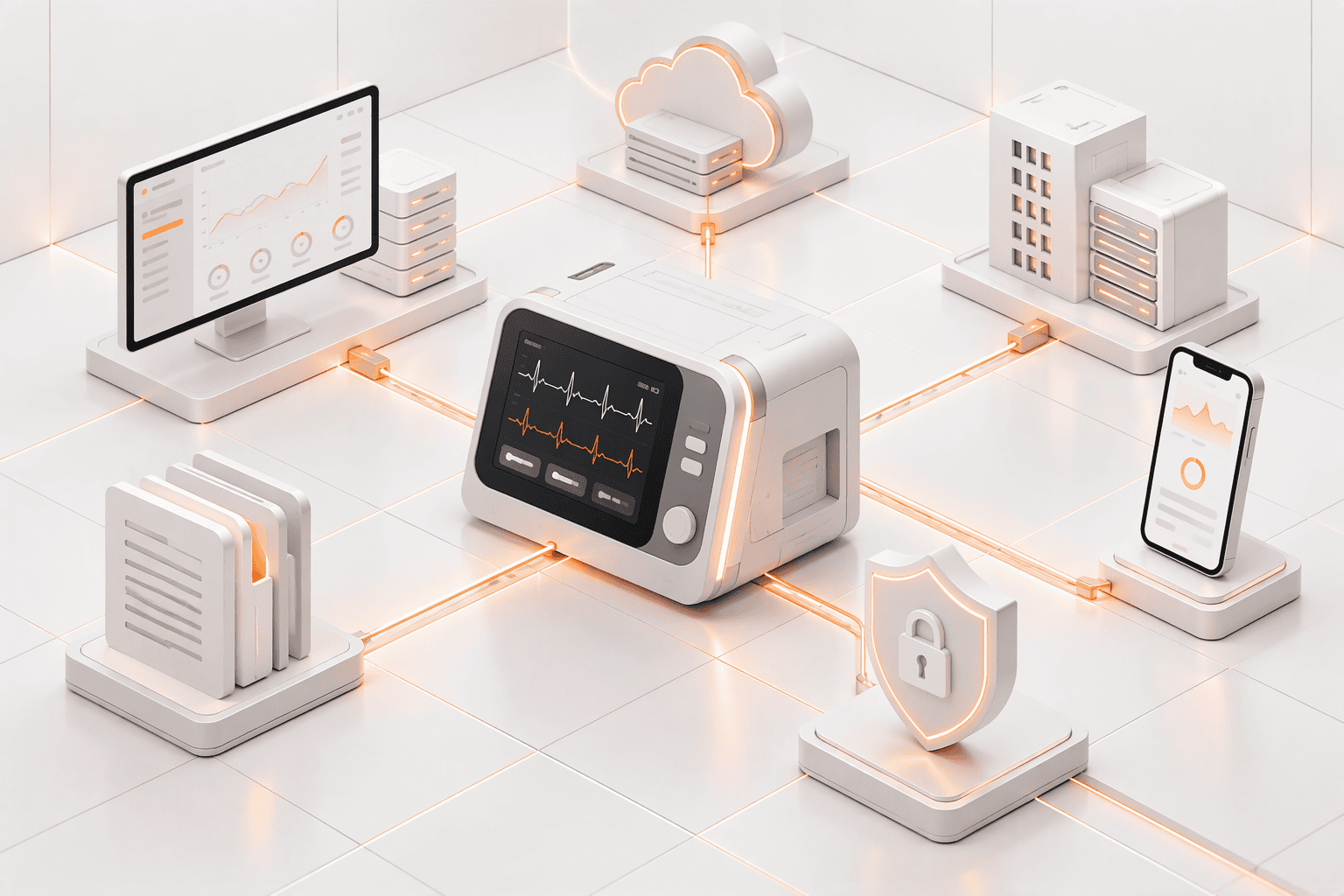
Scientific progress moves faster than the digital systems supporting it. When your laboratory data outgrows your spreadsheets and commercial tools, research slows down. We engineer custom biotech software development solutions that fix data silos, enforce regulatory compliance, and automate lab workflows. From custom LIMS and electronic laboratory notebooks (ELN) to bioinformatics platforms, purpose-built software protects data integrity and accelerates product timelines.
The Real Cost of Poor Data Infrastructure
Custom Biotech Software Solutions
Custom Biotech Software vs. Off-the-Shelf Solutions
Our Biotech Software Development Process: Discovery to Compliance
The Real Cost of Poor Data Infrastructure
Biotechnology companies often hit a wall as they scale. A startup might get by using Excel and legacy lab tools. But once a company starts running thousands of assays or moves into clinical phases, those manual systems break.
Right now, data preparation is a massive bottleneck. Discussions around data science education, such as those highlighted by Bellevue University in their data science overview, point to a well-known industry problem. Data scientists spend the vast majority of their time finding and cleaning data. Highly paid researchers waste entire days exporting CSV files from sequencers, reformatting spreadsheets, and uploading information into separate analytics platforms. This manual work introduces human error and creates massive blind spots for management.
The financial penalties get much worse when a product enters clinical trials. A 2024 analysis by the Tufts Center for the Study of Drug Development shows the mean direct daily cost of a Phase III clinical trial delay is $55,716. When you add in the value of lost prescription sales, a single day of delay costs a pharmaceutical sponsor around $800,000.
Most of these delays come from preventable operational failures like disconnected databases, slow lab turnarounds, and compliance errors. Off-the-shelf software rarely has the specific integrations needed to prevent these issues. To hit your clinical milestones and get therapeutics to market on schedule, your software needs to match how your lab actually operates.
Read about: How to Fix Fragmented Clinical Trial Data in the Biotech Sector
Custom Biotech Software Solutions
Generic enterprise software rarely survives the reality of a modern biotech lab. Translating complex biological processes into code requires architecture designed around exact scientific workflows. Whether a company is attempting to bridge the gap between early R&D and clinical trials, or scaling up to commercial manufacturing, overcoming these bottlenecks takes highly targeted engineering. Here is how specialized development addresses these exact industry challenges.
Custom LIMS Development
Tracking thousands of daily samples requires absolute certainty regarding location and environmental exposure. Unfortunately, commercial platforms often force technicians to alter their standard operating procedures just to fit the software’s rigid limitations. Custom LIMS development takes the opposite approach by digitizing the exact sample management processes a lab already uses. By writing dedicated RESTful and GraphQL APIs, systems can talk directly to mass spectrometers, liquid handlers, and plate readers. This allows data to flow straight from the hardware into a secure database, eliminating manual transcription entirely. Automated quality control parameters run in the background so that if a bioreactor drops in temperature, the system instantly flags the anomaly and pauses downstream work.
Secure Electronic Laboratory Notebooks (ELN)
Relying on paper notebooks or scattered digital files is a major regulatory liability. Modern R&D runs on structured, easily searchable documentation. Electronic Laboratory Notebooks (ELN) engineered specifically for biology and chemistry workflows change how teams document their days. These setups include native integrations for drawing complex molecular structures and automating reagent lookups. Most importantly, intellectual property stays protected. Through strict access controls, locked audit trails, and compliant electronic signatures, experimental data remains completely traceable for upcoming patent filings or audits.
Bioinformatics Pipelines and Multi-Omics Platforms
The shift from wet lab validation to in silico modeling demands massive computational power. As the global bioinformatics market pushes toward an estimated $52.01 billion by 2034, processing multi-omics data is no longer optional; it is the baseline. Analyzing Next-Generation Sequencing (NGS) or spatial transcriptomics will quickly overwhelm local servers. Creating scalable bioinformatics analysis software requires cloud-native pipelines hosted on AWS or Azure to manage the heavy compute loads needed for sequence alignment and variant calling. Pairing this backend with interactive visualization dashboards allows bioinformaticians to actually see patterns and spot target molecules faster.
Need professional help with building custom biotech software?
Genomics and Proteomics Data Platforms
Omics research generates terabytes of unstructured information that standard relational databases simply cannot index. High-performance genomics and proteomics data platforms solve this by ingesting raw sequencing data alongside public reference libraries like ClinVar and COSMIC. Setting up federated data architectures means multi-center research teams can run queries against massive genomic cohorts without transferring the underlying files, keeping everything strictly within HIPAA and GDPR privacy boundaries.
Bioanalysis and Assay Automation Software
Preventing experimental drift during assay design and normalization comes down to consistent data handling. Dedicated bioanalysis software removes the friction by pulling raw signal data straight from plate readers and chromatography tools. Instead of technicians wrestling with spreadsheets, automated mathematical models calculate concentrations and plot standard curves right inside the platform. Taking manual math out of the bioanalytical workflow drastically cuts turnaround times and boosts confidence in the final reported metrics.
AI and Machine Learning for Drug Discovery
Machine learning is completely altering how the industry screens compounds, but an algorithm is only as good as its underlying data pipeline. Properly operationalizing AI in drug discovery takes specialized digital infrastructure. Targeted AI drug discovery software runs ADME/Tox predictions, virtual screening, and molecular modeling across high-performance GPU clusters. The engineering focus here must prioritize model explainability, ensuring bench scientists understand exactly why the system flagged a specific lead candidate.
Read about: Where AI Actually Works in Biotech
CTMS and E-Clinical Integration
Moving into human trials means synchronizing data across clinical sites and tracking patient enrollment securely. Fragmented systems cause administrative delays that regularly cost sponsors tens of thousands of dollars every day. Consolidating these processes requires comprehensive e-clinical solutions. By integrating Electronic Data Capture (EDC) platforms and electronic Trial Master Files (eTMF) directly into tailored Clinical Trial Management Systems (CTMS), trial managers get a single operational view. Using standard healthcare protocols like HL7 and FHIR ensures this infrastructure communicates seamlessly with hospital Electronic Health Records (EHR).
Biomanufacturing and MES Systems
Taking a molecule from a small-scale lab environment to commercial manufacturing introduces intense regulatory oversight. Custom biomanufacturing software and Manufacturing Execution Systems (MES) give floor managers the real-time visibility they need into batch processing and deviation tracking. By wiring IoT sensors directly into production tanks, these systems instantly catch and flag environmental deviations, keeping facilities compliant with cGMP guidelines.
Diagnostic Software and Remote Patient Monitoring
Finally, for companies pushing into diagnostics or Software as a Medical Device (SaMD), the user interface and data security are equally critical. Custom diagnostic software built for both clinicians and patients simplifies test ordering, sample tracking, and remote patient monitoring. Engineering these applications requires embedding strict consent management frameworks alongside heavily encrypted cloud connections to keep medical hardware data totally secure.
Need professional help with building custom biotech software?
Custom Biotech Software vs. Off-the-Shelf Solutions
When it comes time to upgrade lab software, executives always weigh custom development against commercial SaaS products. Off-the-shelf software looks faster to deploy on day one. But the long-term operational friction almost always destroys the initial cost savings.
In commercial software environments, scientists often create workaround systems. Because a commercial LIMS is too rigid, technicians start using complex Excel macros to track samples. This completely defeats the purpose of buying the software and introduces massive compliance risks. Commercial lab software also penalizes growth. As you hire more technicians or open new trial sites, per-user license fees explode.
Here is a closer look at how custom biotech software development compares to off-the-shelf products over a typical five-year lifecycle.
You just rent access to a platform. No equity value is added to your core business.Your company owns the source code entirely. This adds tangible asset value to your organization.
| Operational Criteria | Commercial SaaS Software | Custom Biotech Software |
| Workflow Alignment | Forces your lab to adapt its processes to match the vendor’s pre-built layout. | Built specifically around your exact lab floor layout, instruments, and standard operating procedures. |
| Hardware Interoperability | Relies on standard vendor APIs which often fail to support older or highly customized lab hardware. | Custom APIs are built directly for your specific instrument fleet and legacy machines. |
| User Adoption Rates | Low. Poor interface design leads bench scientists back to manual spreadsheet workarounds. | High. Tailored user interfaces are designed around the actual daily routines of your lab technicians. |
| Five-Year Cost Structure | High recurring per-user fees that scale up significantly as your research team expands. | Fixed development cost with zero per-seat licensing fees. You own the software asset. |
| Validation Control | Vendor controls updates. Mandatory software patches can break your validated environment during an audit. | You control the update cadence. Validation packages are perfectly matched to your regulatory audit cycle. |
| Intellectual Property | You just rent access to a platform. No equity value is added to your core business. | Your company owns the source code entirely. This adds tangible asset value to your organization. |
Owning your codebase turns digital infrastructure into a corporate asset. You do not have to wait on an external vendor to update their product roadmap just to get the features your research requires.
Our Biotech Software Development Process: Discovery to Compliance
Developing software for the life sciences requires exact precision. A bug in a standard business app is annoying, but a bug in medical device software can invalidate a trial. Navigating these risks requires a clear engineering framework designed specifically for life science applications. Integrating deep discovery phases and strict regulatory compliance directly into agile development sprints ensures every platform is built for operational resilience.
In-Depth Discovery Phase
Every project begins with a structured discovery phase. Code is never written until scientific goals, the hardware ecosystem, and regulatory targets are fully understood. Technical architects sit down with your bioinformaticians, lab managers, and quality teams to map every sample path, identify data transfer bottlenecks, and audit your hardware interfaces. The infrastructure is evaluated to determine whether the data needs a cloud, on-premise, or hybrid storage architecture. After this review, a clear technical blueprint is delivered that outlines system architecture, wireframes, data migration plans, and project milestones. This upfront work prevents scope creep and guarantees the final product solves real operational problems.
Agile Engineering and Hardware Integration
Once the blueprint is approved, development moves into iterative sprint cycles. The focus remains on building modular software that can scale as your lab handles more volume. Custom API drivers are written to connect your physical instruments to the software platform. Whether a lab relies on older equipment serial ports or modern network interfaces, the architecture ensures data transfers cleanly without human intervention. Regular working demos are presented to your scientific teams during development, gathering direct feedback to make sure the user experience matches their daily routines.
Security and Compliance Integration
Regulatory compliance is treated as a core architectural requirement, never as a final polish before release. If the software manages electronic records for FDA submission, it is engineered to meet FDA 21 CFR Part 11 and EU Annex 11 standards from day one. Secure electronic signatures, timestamped audit trails, and role-based permissions are built into the database layer. This security architecture ensures complete adherence to ALCOA+ data integrity principles. For platforms handling patient health data, end-to-end encryption and automated data anonymization are deployed to maintain HIPAA and GDPR compliance.
System Validation and Long-Term Support
For life science platforms, code delivery is only half the job. The full software validation cycle is supported using GAMP 5 risk-based methodologies. Comprehensive validation packages are produced alongside the software, including Installation Qualification (IQ), Operational Qualification (OQ), and Performance Qualification (PQ) testing documents. For SaMD projects, development aligns with ISO 13485 and IEC 62304 standards. Once deployed, ongoing system maintenance, monitoring, and updates are provided to keep the software aligned with evolving regulatory rules and changing lab workflows.
Scaling Your Research Operations
Your scientific staff needs to spend their time analyzing results. When highly trained researchers spend their week formatting spreadsheets and transferring data between isolated systems, your discovery timeline stops moving.
Investing in custom biotech software development fixes these operational bottlenecks. By building targeted data pipelines, automating compliance documentation, and integrating your hardware natively, you create a digital environment that actually scales with your science.
Need professional help with building custom biotech software?