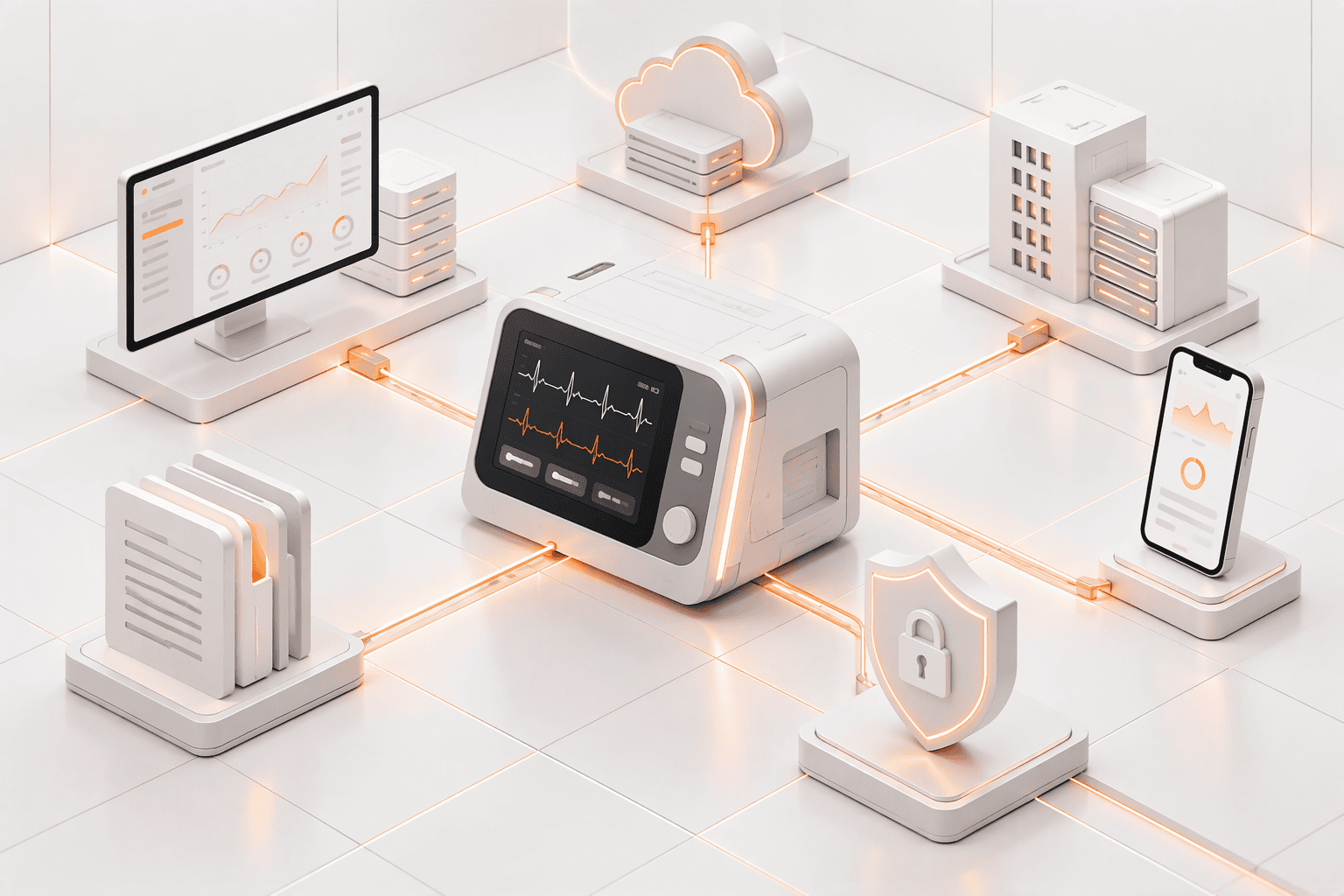
Biotech companies do not have a software problem in isolation. They have a systems problem. Samples move through physical workflows. Instruments generate data in different proprietary formats. Scientists capture experimental context. Quality teams review records, and downstream business systems need reliable analytics. When these pieces are disconnected, the true cost appears as duplicate data entry, rework, limited traceability, slow investigations, and massive operational friction when attempting to scale.
Defining the True “Smart Lab” Ecosystem
The Build vs. Buy Software Spectrum in Life Sciences
Core Capabilities of Custom Biotech Lab Software
AI, Scientific Data Engineering, and the Smart Lab
FDA-Compliant Software Development & Data Integrity
How a Specialized Custom Biotech Software Development Company Delivers
Modern high-throughput genomics and biopharma facilities routinely generate upwards of 10 to 15 terabytes of raw instrument data every single week. Despite this output, many still manage their operational lifecycles through fragmented spreadsheets and rigid software-as-a-service (SaaS) platforms.
Organizations are increasingly turning to a specialized custom biotech software development company to engineer a reliable digital thread across the workflows that matter most. Internal industry metrics indicate that laboratories adopting unified custom life sciences software typically experience a 35% to 40% reduction in manual data entry errors within the first year of deployment.
Defining the True “Smart Lab” Ecosystem
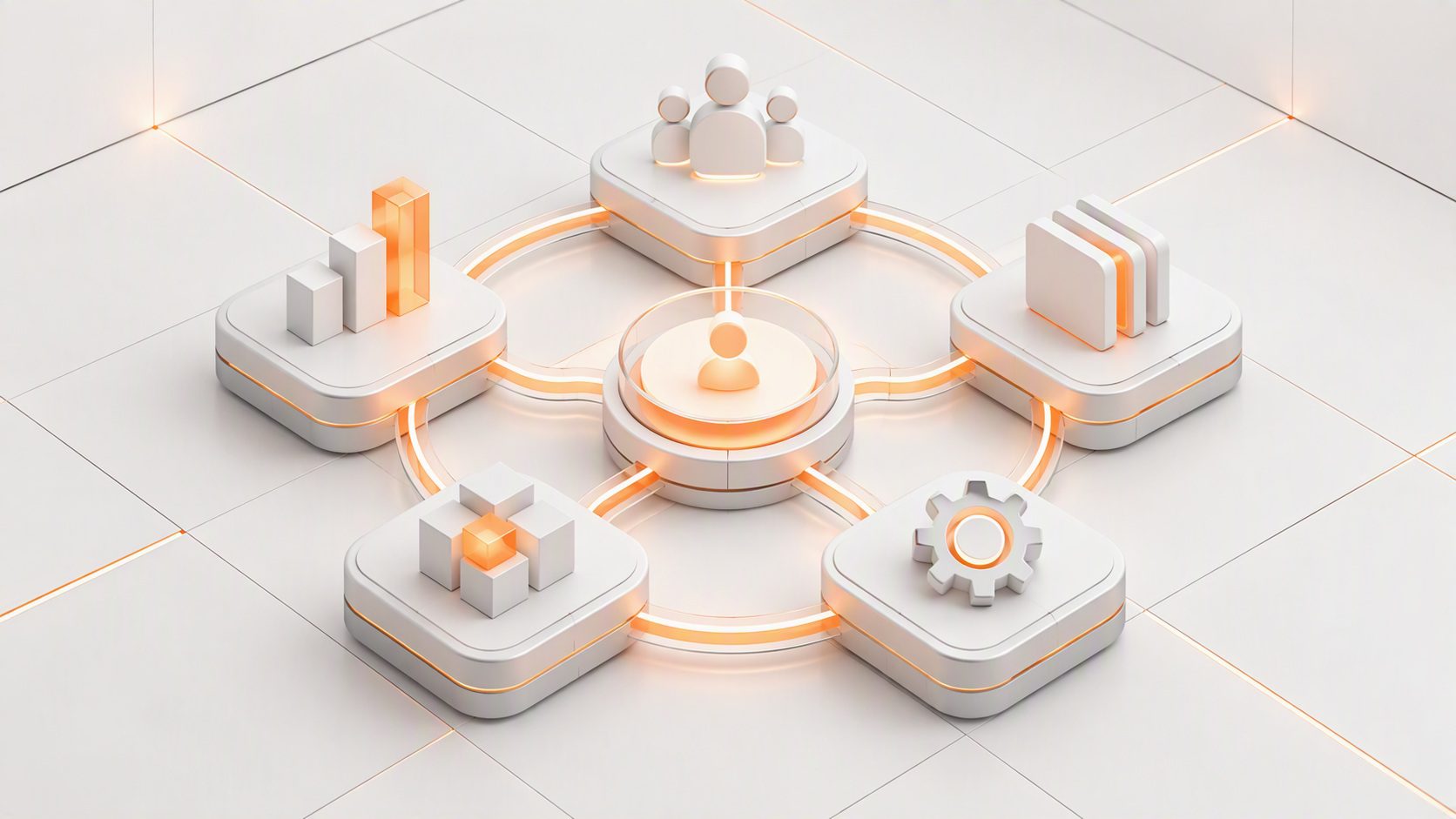
A Smart Lab is not simply a laboratory with more dashboards or superficial AI features. It is a highly integrated engineering environment where digital systems reliably represent the important physical and scientific events happening around them.
A practical Smart Lab architecture includes:
- Persistent Identities: Samples, aliquots, materials, experiments, and batches have stable identifiers and fully traceable lineage.
- Explicit Workflows: Process steps, dependencies, approvals, and handoffs are coded into software rather than relying on tribal knowledge or fragile spreadsheets.
- Rich Metadata: Instrument outputs are captured with the exact contextual information required to interpret them later.
- Instrument Connectivity: Relevant hardware outputs move into the digital workflow seamlessly through APIs, file ingestion, or device middleware.
- Bench-First UX: Scientists work in custom interfaces designed specifically for their actual physical bench process.
- Governance and Auditability: Security, access control, electronic signatures, and data-integrity controls are designed directly into the system where regulatory context requires them.
Read about: How to Fix Fragmented Clinical Trial Data in the Biotech Sector
The Build vs. Buy Software Spectrum in Life Sciences
The most mature architecture decisions are not a binary choice between SaaS and custom software. They exist on a spectrum. A trustworthy biotech software development company will recommend a commercial product when it is the objectively better choice, and custom development when ownership of the workflow creates meaningful strategic value.
The Four Architecture Choices
- Buy: Best when the process is completely standardized, and a mature commercial product meets requirements with acceptable configuration and commercial terms.
- Configure: Ideal when a platform can represent the workflow without creating a fragile customization footprint or forcing hidden process workarounds.
- Integrate: Necessary when existing systems are valuable but need custom API bridges to exchange data, connect instruments, or trigger work reliably.
- Custom-Build: Required when proprietary workflows, scientific data models, lab automation requirements, or business rules are genuinely differentiating and cannot be represented cleanly in the existing stack.
Organizations relying entirely on rigid SaaS platforms often spend up to 40 % of their annual software budget on external consultants simply trying to force proprietary assay management into generic templates. Custom biotech software development becomes mandatory when your lab depends on specialized robotics, complex data relationships, or rapid scaling that outpaces a vendor’s standardized roadmap.
Comprehensive Comparison: Generic SaaS vs. Custom Biotech Architecture
| Category | Buy (Off-the-Shelf SaaS) | Build (Custom Architecture) |
| What You Actually Get (The Deliverable) | A multi-tenant web application subscription with generalized features and rigid UI templates. | A bespoke software stack, custom database schema, native UI, and private cloud deployment built exclusively for your lab. |
| Workflow & Assay Capability | You must adapt your physical bench protocols and scientific processes to fit the vendor’s software logic. | The software acts as an exact digital twin of your proprietary assays, high-throughput rules, and novel biological modalities. |
| IP, Code & Data Ownership | Zero code ownership. Proprietary data resides on third-party clouds, making you dependent on the vendor for exports. | Full and absolute ownership of the source code, deployment architecture, and the underlying database. |
| Lab Equipment Integration | Constrained by the vendor’s pre-built standard API connectors. Vendor updates often break internal pipelines. | Limitless, real-time edge telemetry integration designed around the robotics and benchtop instruments you actually use. |
| Long-Term Financial Impact | Escalating, compounding per-user licensing fees. The more scientists you hire, the more expensive the software becomes. | Zero per-user seat fees. Initial upfront engineering investment transitions into efficient scaling based strictly on compute usage. |
| Compliance & Validation Control | Generic compliance features; you must wait for vendor roadmaps to resolve FDA/GxP capability gaps. | Native controls embedded at the database level. Engineering can be specifically designed to support your risk-based validation evidence. |
Need professional help with building custom biotech software?
The 6-Layer Smart Lab Software Reference Architecture
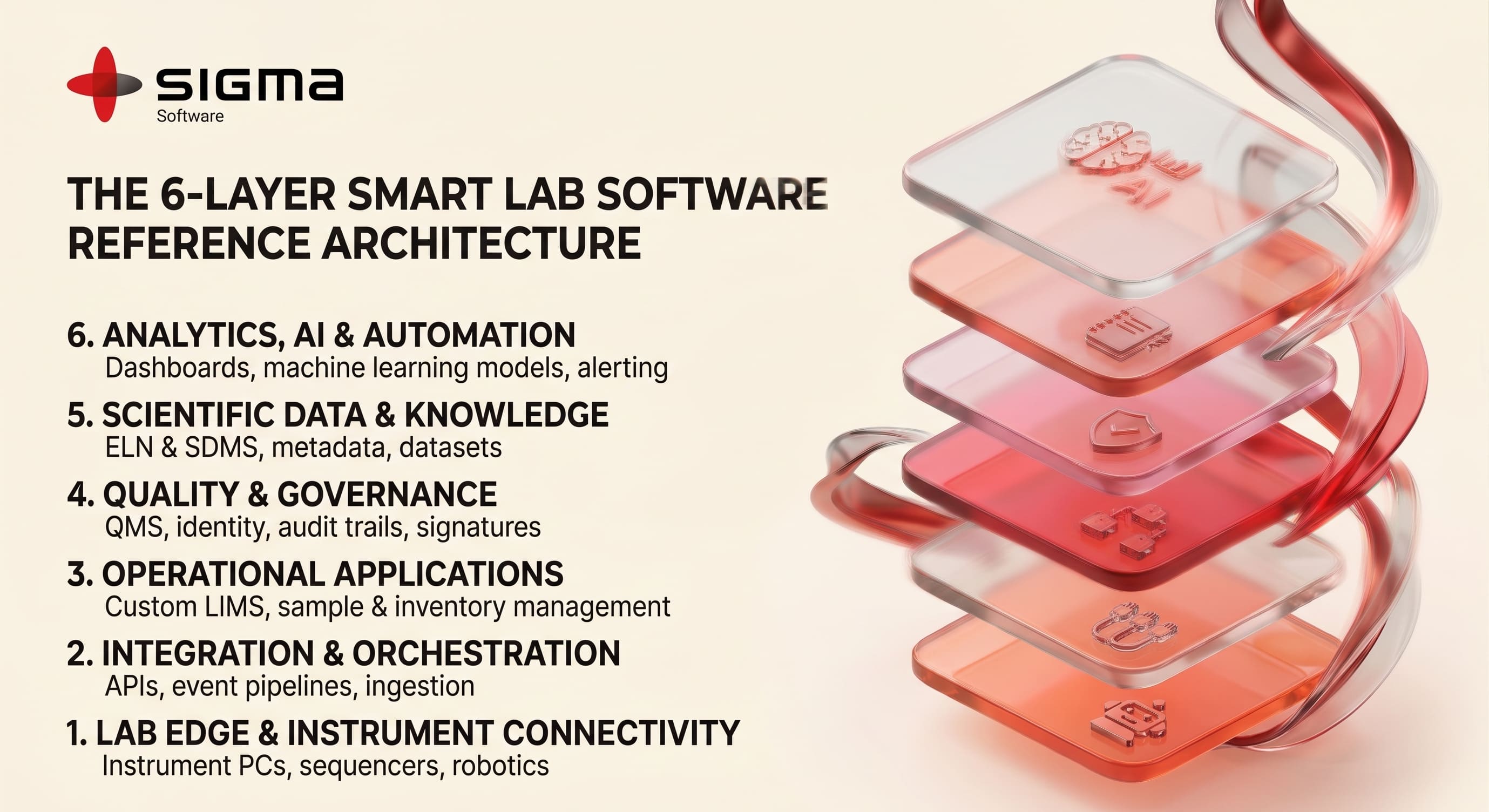
A connected biotech lab is easier to design when the architecture is separated into clear layers.
- Lab Edge and Instrument Connectivity: Instrument PCs, liquid handlers, plate readers, sequencers, and robotics. The objective is the reliable acquisition of instrument events without manual transcription.
- Integration and Orchestration: Handles high-throughput APIs, file ingestion, event pipelines, identity mapping, retries, and error handling. This determines whether systems actually exchange trustworthy information.
- Operational Applications (Custom LIMS): Custom LIMS development manages structured operational logistics, handling workflows, inventory, sample management, and status tracking.
- Quality and Governance (QMS): Identity management, roles, immutable audit trails, electronic signatures, document controls, and validation evidence.
- Scientific Data and Knowledge (ELN & SDMS): Connects ELN software development capabilities with scientific data management. Standards such as AnIML or Allotrope help create analytics-ready structures, but proprietary raw data is always preserved.
- Analytics, AI, and Automation: Dashboards, machine learning predictive models, alerting, and controlled lab automation. The architecture makes it clear which automated actions are allowed to alter a regulated workflow.
Core Capabilities of Custom Biotech Lab Software
A custom-engineered platform is only valuable if it genuinely improves the work scientists, technicians, and quality teams perform.
Sample and Entity Lineage
The system must make relationships explicit. A well-designed data model traces a workflow from the original sample to aliquot, plate, experiment, result, instrument run, reagent lot, and responsible operator. This makes investigation, reproducibility, and operational decisions instantly defensible.
Native Bioinformatics Integration
Where molecular design, sequence analysis, or computational workflows are central to the process, integrating those capabilities with laboratory records reduces context switching and preserves the relationship between digital design and physical execution.
Workflow Orchestration and Rule Engines
Scientists and lab managers should be able to see what has happened, what is required next, and who owns the next step. Workflow engines can model prerequisites, routing rules, exceptions, and automated actions while retaining appropriate change control for regulated environments.
Instrument and Lab Automation Integration
Custom laboratory software bridges instruments and enterprise systems through APIs, SDKs, files, or message queues. The goal is not “limitless integration” but highly reliable integration with defined interfaces, monitoring, and error handling.
Electronic Batch Records (eBR) and Review by Exception
For organizations scaling to manufacturing, software digitizes electronic batch records, material genealogy, and deviation workflows. Dashboards can surface out-of-range results and workflow deviations instantly. This “Review by Exception” methodology routinely reduces batch release times by 30% to 50 % by eliminating manual paper reviews.
AI, Scientific Data Engineering, and the Smart Lab
AI can create massive value in laboratory software, but reliable AI starts with reliable data.
Private AI and Data Controls
Biotech organizations handle highly confidential research, proprietary sequences, and unpublished results. For sensitive workloads, private cloud or self-hosted Sovereign AI architecture reduces exposure and provides absolute control over where data is processed, preventing leaks to public LLMs.
Retrieval-Augmented Generation (RAG) Realities
RAG can help scientists search controlled SOPs and internal knowledge. However, a production-grade implementation requires:
- Source attribution and strict provenance.
- Document-level and record-level access controls.
- Evaluation against representative questions.
- Human-in-the-loop review before any consequential actions are taken.
- RAG improves grounding, but it does not guarantee factual correctness. The system still requires monitoring.
Scientific Data Engineering for AI
AI initiatives fail when models cannot reliably connect inputs to the scientific context that generated them. A strong foundation requires consistent identifiers, metadata completeness, controlled vocabularies, and reproducible transformations. Custom biotech software development creates value by perfectly connecting the operational data required for these AI use cases.
Read about: Where AI Actually Works in Biotech
FDA-Compliant Software Development & Data Integrity
Compliance should influence architecture from the beginning when the intended use falls within a regulated scope. However, a critical distinction matters: Software is not “FDA-compliant” simply because it contains an audit trail or electronic signature feature. Compliance is achieved through a combination of technology controls, organizational procedures, and rigorous validation.
Data Integrity and ALCOA+
FDA guidance defines data integrity in terms of completeness, consistency, and accuracy. A custom system enforces the ALCOA+ principles directly at the database level: Attributable, Legible, Contemporaneously recorded, Original, and Accurate.
21 CFR Part 11 Software Controls
When 21 CFR Part 11 applies, relevant technical controls built into the architecture must include:
- Secure, computer-generated, time-stamped audit trails.
- Strict electronic signature controls with forced authentication.
- Authority checks and attribute-based access controls.
- Protection of records from unauthorized alteration or deletion.
Validation and Change Control (CI/CD)
Automated tests, CI/CD pipelines, and generated evidence make validation more efficient. They support a documented validation strategy (IQ/OQ/PQ), risk assessment, testing, and change control appropriate to the system’s intended use.
A Note on HIPAA and ISO 13485
HIPAA applies only to covered entities and business associates within its defined scope; a biotech company is not automatically subject to HIPAA simply because it handles biological data. ISO 13485 is a quality-management standard specific to medical devices. A knowledgeable software partner applies these architectures only when your product actually falls within that regulatory scope.
Read about: Custom Biotech Software Development: Scaling R&D and Clinical Data Pipelines
How a Specialized Custom Biotech Software Development Company Delivers
A credible vendor should explain not only what they will build but how they will reduce delivery risk before the build becomes expensive.
- Architecture Assessment: Mapping current systems, laboratory workflows, data flows, and integration pain points.
- Workflow Discovery: Documenting roles, scientific entities, regulatory scope, and non-functional requirements.
- Target Architecture: Defining application boundaries, integration patterns, security models, data ownership, and deployment strategy.
- Prototyping: Validating a critical workflow prototype or a real instrument API integration before committing to full implementation.
- Incremental Build and Integration: Delivering in controlled increments with automated tests, monitoring, and clear acceptance criteria without waiting for a massive launch day.
- Validation and Release Controls: Building traceability and evidence generation into the engineering lifecycle for regulated use cases.
- Optimization: Evolving the platform based on measured adoption, workflow performance, and the quality of automation outputs.
Need professional help with building custom biotech software?
Take the Next Step
The objective of a Smart Lab is not to accumulate more software. It is to create a connected operating model in which samples, experiments, instruments, data, and quality processes work together reliably.
If your organization is constrained by legacy off-the-shelf software or struggling to scale unstandardized data silos, the time to restructure your digital architecture is now.
- Schedule a technical architecture audit to map your systems, workflows, and automation opportunities.
- Request a comprehensive Build vs. Buy assessment to compare commercial products against custom development.
- Book a discovery session with our life sciences software specialists today.
FAQ
What is the difference between a LIMS and an ELN?
A LIMS primarily supports structured laboratory operations such as sample management, testing workflows, inventory, and status tracking. An ELN primarily captures experimental context such as protocols, observations, calculations, and scientific reasoning. In modern R&D environments, the strongest architecture natively connects these functions instead of forcing scientists to reconcile separate systems.
When should a biotech company consider custom software?
Organizations should consider custom software when proprietary workflows, scientific data models, lab automation requirements, or specific user experiences create meaningful differentiation that commercial products cannot support without excessive workarounds.
Is custom biotech software automatically more flexible than a commercial LIMS?
No. Custom software offers greater control over the architecture and user experience, but it also creates ongoing responsibilities for engineering, security, infrastructure, and validation. The right decision is the one that produces the best fit for your specific workflow and long-term scaling economics.
How does custom biotech software support 21 CFR Part 11 compliance?
Where Part 11 applies, custom software is designed around relevant technical controls: immutable audit trails, electronic signatures, forced authentication, and role-based access controls. Compliance is a combination of technology, procedures, and validation. No software platform guarantees compliance entirely by itself.
Can a custom LIMS integrate directly with laboratory instruments?
Yes, provided the instrument exposes a usable interface. Custom LIMS integration utilizes APIs, vendor SDKs, files, databases, or device middleware. A robust implementation also addresses automatic retries, error handling, network monitoring, and data integrity at the edge.
Need professional help with building custom biotech software?