OEMs preparing products for Germany’s §14a EnWG often treat protocol selection as a connectivity decision: Modbus for industrial devices, Matter for smart-home reach, KNX for building automation, or EEBUS for energy systems. But §14a readiness is a control-chain problem. This post offers an in-depth comparison of EEBUS, Matter, KNX, and Modbus suitability against the German grid requirements.
EEBUS vs. Matter vs. KNX vs. Modbus: Technical comparison overview
Modbus vs Matter vs KNX vs EEBUS: In-depth look at compatibility with §14a requirements
Many §14a protocol decisions start with a shortcut: “We already support Modbus,” “Matter now has energy features,” or “our product can connect to KNX,” so all is good. Or is it?
Germany’s §14a EnWG explicitly requires devices to take part in a regulated grid-control process: receive a power limit from a German DSO, understand it, apply it safely, show what happened, and return to normal when the limit ends.
A familiar protocol may be proven in industrial automation, smart-home ecosystems, or building control, yet still fail to meet the SMGW/control unit/EMS/device architecture required in Germany.
In this guide, we compare EEBUS, Matter, KNX, and Modbus against the §14a readiness requirements and show where each protocol fits, where it does not, and how to make the optimal decision.
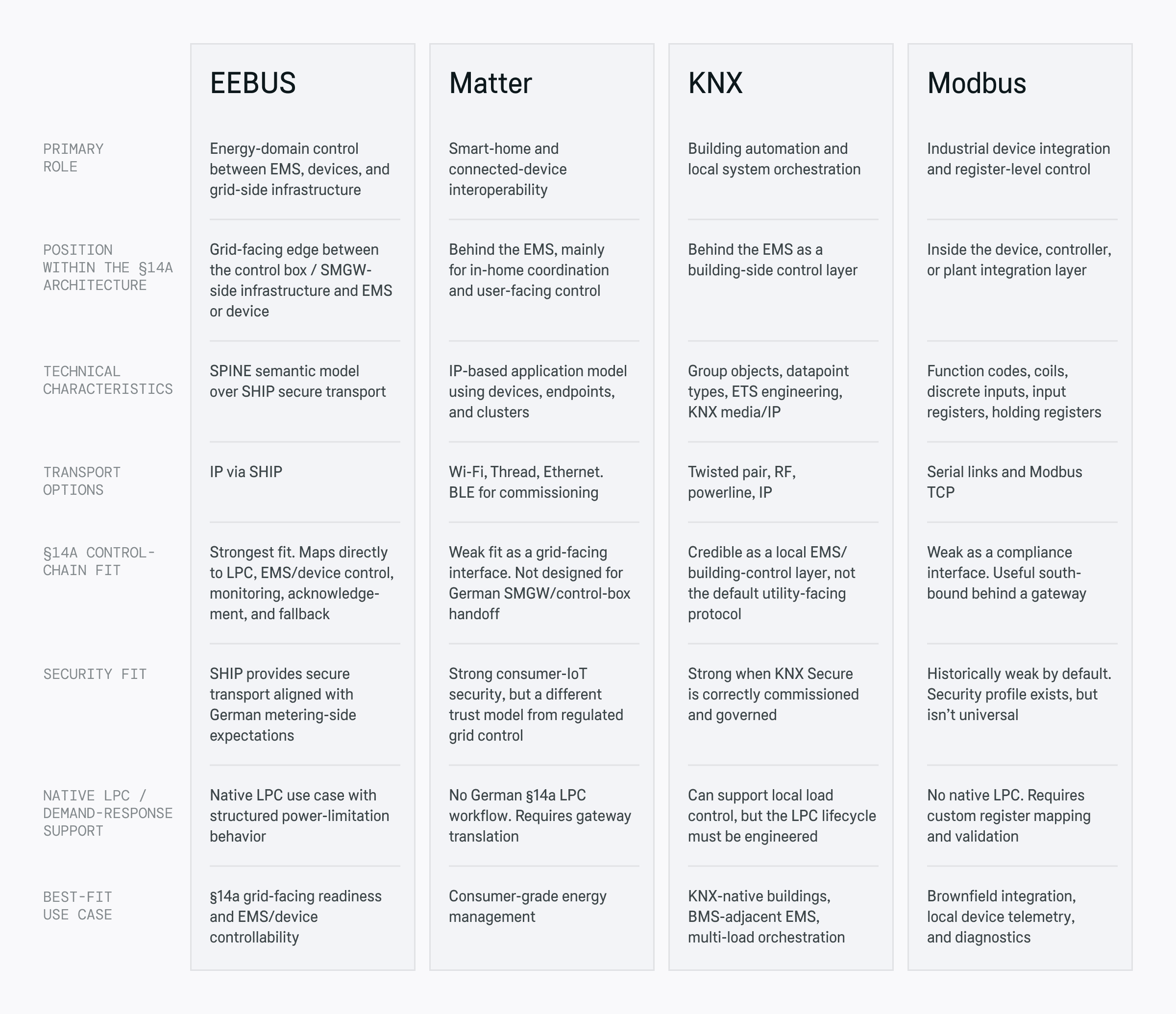
EEBUS vs. Matter vs. KNX vs. Modbus: Technical comparison overview
Our evaluation dimensions for comparison
On paper, EEBUS, Matter, KNX, and Modbus enable data exchanges between devices. Yet not all of them do that in a way required by the German regulatory framework.
For a meaningful comparison, we assessed each against four dimensions influencing their suitability for §14a implementations:
- Regulatory alignment
Is the protocol recognized or referenced by relevant German authorities, technical bodies, or implementation guidance?
This determines whether the protocol can credibly support a §14a readiness claim. - Control-chain interoperability
Can the protocol slot into the grid operator /SMGW/control unit/EMS/device chain without forcing a custom interpretation layer?
This shows whether it can support the actual German controllability path. - Security model
Does the protocol support secure local transport, authentication, and controlled access in a way that fits regulated energy environments?
This matters because §14a commands are grid-control instructions, not ordinary app commands. For devices sold in the EU, the Cyber Resilience Act also makes security a legal requirement. - LPC / demand-response support
Does the protocol provide a native or standardized use case for power limitation, acknowledgement, monitoring, fallback, and recovery?
This is the difference between moving a signal and proving §14a-ready behavior.
A protocol is only one part of that equation: readiness also depends on how the product interprets, applies, acknowledges, and recovers from a grid-control instruction. Explore what §14a readiness requires across the complete product control lifecycle.
Modbus vs Matter vs KNX vs EEBUS: In-depth look at compatibility with §14a requirements
Use EEBUS LPC at the grid-facing edge, then let Matter, KNX, or Modbus operate behind the EMS where they fit best.A protocol that can move a value isn’t automatically fit for §14a. The product or EMS must receive an authorized limit, interpret the grid context, apply it predictably, expose status, prove execution, and recover safely.
Modbus, Matter, and KNX all have legitimate roles, but the regulated power-limitation workflow needs compliance-grade semantics, secure local control, monitoring, acknowledgement, and native LPC support. As we explain in the following sections, these are the structurally strongest areas of EEBUS.
Modbus
Modbus is an application-layer communication protocol already used in many industrial devices for automation. It’s based on function codes and a simple data model (coils, discrete inputs, input registers, and holding registers), which runs over serial links (e.g., RS-232, 422, 485) or over Ethernet as Modbus TCP.
The simplicity in the underlying design is why Modbus is widely used in heat pumps, inverters, batteries, HVAC controllers, industrial gateways, and all sorts of PLCs. It’s a viable option for:
- Connecting equipment to a local controller to expose local measurements, operating states, alarms, and basic control points.
- Moving register-level data between devices that already know how to interpret each other’s maps.
- Brownfield environments where the priority is integration with an existing device base rather than redesigning the product around a new semantic model.
Yet, it’s a subpar choice for §14a readiness. Modbus’s core limitation is compliance-grade semantics. While it can write a power-limit value, it can’t provide the full lifecycle control natively: interpret, execute, acknowledge, and fail safely if the communication is interrupted. That creates three material weaknesses for Modbus as the external compliance interface.
Control-chain interoperability
Modbus handles interoperability primarily at the register level. So, two systems that “support Modbus” on paper may fail to properly exchange data in the way required by §14a EnWG because the protocol doesn’t natively define:
- Meaning of a given register
- Approach to values scaling
- Type of unit applied
- Duration of limit validity
- Command priority level
- Execution acknowledgement
Typically, these semantics sit in a device-specific register map or in an additional profile layered on top of Modbus. For example, SunSpec Modbus was developed by an alliance of OEMs to define common parameters, settings, and information models for DER monitoring and control.
Since §14a requires a multi-step controllability path across the SMGW/control unit/EMS/device architecture, the generic register-write option that Modbus offers isn’t sufficient. Modbus can carry the signal, but without a shared semantic profile or gateway layer, it doesn’t make the control behavior interoperable.
Security
Security is the second structural limitation. Legacy Modbus TCP commonly runs on port 502, which wasn’t designed for security-sensitive control environments.
A newer Modbus/TCP Security profile exists with a port 802, TLS, certificate-based identity, and anti-replay controls among other measures. But it’s not what most legacy devices rely on.
Weak security controls pose problems since §14a control is part of an authorized grid-side intervention process. Transmitted instructions must be protected against spoofing, tampering, misrouting, and unclear responsibility boundaries.
Likewise, if raw Modbus sits at the grid-facing edge, the OEM must define the controls around command authentication, execution logging, and authorization writes blocking, among other parameters. Technically, Modbus can support those controls through added architecture, but it doesn’t provide them out of the box.
LPC use case implementation
Modbus doesn’t have a native Limitation of Power Consumption (LPC) use case. It can represent individual control elements as registers, but §14a readiness requires a full control lifecycle: limit definition, target context, duration, acknowledgement, monitoring, heartbeat, fallback behavior, and priority over customer or app-level optimization.
For Modbus to work, you’ll have to design a custom semantic layer that maps each LPC behavior to specific registers and rules. This approach may be technically viable, but brittle and hard to certify.
Where Modbus still makes sense
Modbus remains a solid communication protocol for internal data exchanges, like local control, diagnostics, service access, and integration with existing controllers. It can also be connected to other protocols (EEBUS or KNX) as the orchestration layer for data delivery.
So, keep Modbus as a device-side integration protocol. But don’t force it to do a job (§14a communication) it was never meant to do.
Matter
Matter is an IP-based interoperability protocol for smart-home and connected-device ecosystems, distributed under an open-source license. It was developed by the Connectivity Standards Alliance (with some star members like Amazon, Apple, Google, Ikea, and Schneider, among others) in December 2019.
Matter runs over Wi-Fi, Thread, and Ethernet, with BLE typically used for commissioning. It defines a shared application model, device types, clusters, secure commissioning, device attestation, and operational credentials to enable:
- Device-to-app control
- Smart-home onboarding
- Cross-platform device interoperability
Matter 1.3 also introduced energy reporting and EVSE support, allowing devices to expose real-time power, voltage, current, and cumulative energy consumption or generation. Matter 1.4 expanded the energy scope to solar, batteries, heat pumps, water heaters, enhanced EV charging, thermostat scheduling, and Device Energy Management modes. Matter 1.5 went further by adding tariff and pricing data, grid carbon intensity, enhanced smart-metering support, grid-connection details, power-limit information, state-of-charge reporting, and bidirectional EV charging certification support.
All of the above make Matter an excellent consumer-facing and in-home energy layer management protocol. But the problem for §14a compliance is where it sits in the control chain.
Germany’s §14a EnWG environment is a regulated grid-control process involving multiple actors.

And the recent liaison with the OpenADR Alliance indicates that this won’t change in the future. Matter is resolved to continue handling communication between home appliances and the energy gateway, while OpenADR 3 will handle communication between the gateway, utilities, and the grid.
Control-chain interoperability
Current German §14a interface guidance doesn’t name Matter as an IF_CLS_CTRL profile for the SMGW/control-box-to-EMS or device handoff. While the protocol can perform some energy management operations on the device, these capabilities don’t match the regulated local control profile expected by German authorities.
For Matter, the ‘missing layer’ is control-chain authority. The device must know that a limitation instruction came from the German grid-control process, that it takes priority over app preferences or tariff optimization, and that its execution can be verified.
Without an EEBUS-facing EMS, a KNX profile in suitable building contexts, or another agreed grid-facing gateway, a Matter device won’t be §14a-interoperable.
The connection of these components requires an EEBUS integration strategy that works across the device, EMS, and grid layers. Sigma Software’s EEBUS implementation services help OEMs build that strategy and test it against real devices and conditions.
Security
Matter relies on a modern security model with secure commissioning, attestation, encrypted communication, and operational credentials. However, §14a requires alignment with the German metering and control security architecture, which is different from secure consumer-IoT communication.
The main requirements mismatch is authority. Matter can authenticate a device and establish encrypted sessions inside a Matter fabric, but §14a needs proof that a grid-control command came through the authorized German metering path and was executed under the right priority rules. A Matter controller, app, or ecosystem hub can’t automatically qualify as an SMGW/CLS-authorized control actor.
Recent security analysis also flagged some weaknesses in Matter’s PASE/CASE adaptations and notes that important security decisions are delegated to the vendor. This only reinforces the point: Matter may secure smart-home communication, but it doesn’t by itself satisfy the trust, authorization, evidence, and fail-safe expectations of the German §14a control chain.
LPC use case implementation
Matter’s energy features can support parts of home-energy coordination. But you’ll still need a §14a-facing control layer to prove how mandatory grid limitations are received, enforced, logged, and recovered from.
§ 14a LPC requires a mandatory curtailment workflow with defined command source, target scope, validity period, acknowledgement, active-limit state, timeout behavior, heartbeat, fallback mode, and restoration logic. The device or EMS must also enforce priority: a DSO limitation must override user preferences, app automation, tariff optimization, and comfort-oriented schedules.
Without a §14a-facing EMS or gateway translating the grid-side instruction into that local state machine, Matter features remain coordination primitives rather than a complete LPC implementation.
When Matter makes sense
If you want to profit from the ‘economies of scale’ in the smart home sector, Matter is the protocol to use. It has its merit for smart-home integration, local energy coordination, device discovery, cross-platform control, and future tariff-aware or carbon-aware operation.
But Matter isn’t the right option for demonstrating German §14a readiness.
KNX
KNX is an open building-automation standard used for many smart home components inside buildings. It works through group communication, group objects, datapoint types, ETS-based engineering, and multiple transport options, including twisted pair, RF, powerline, and IP.
Overall, it’s a mature, integrator-friendly, and widely used standard for locally orchestrating several systems. For example, a HVAC unit, metering, comfort automation, room control, and building energy management.
Unlike Modbus and Matter, it’s recognized as a secondary path for demonstrating §14a readiness by the VDE FNN. The German Commission for Electrical, Electronic & Information Technologies (DNE) also describes a possible implementation of power control at the grid connection point based on KNX, but with a caveat that for grid-serving applications, external access must use a secured connection, e.g., via the SMGW.
In this case, a possible KNX-based architecture could look like this:
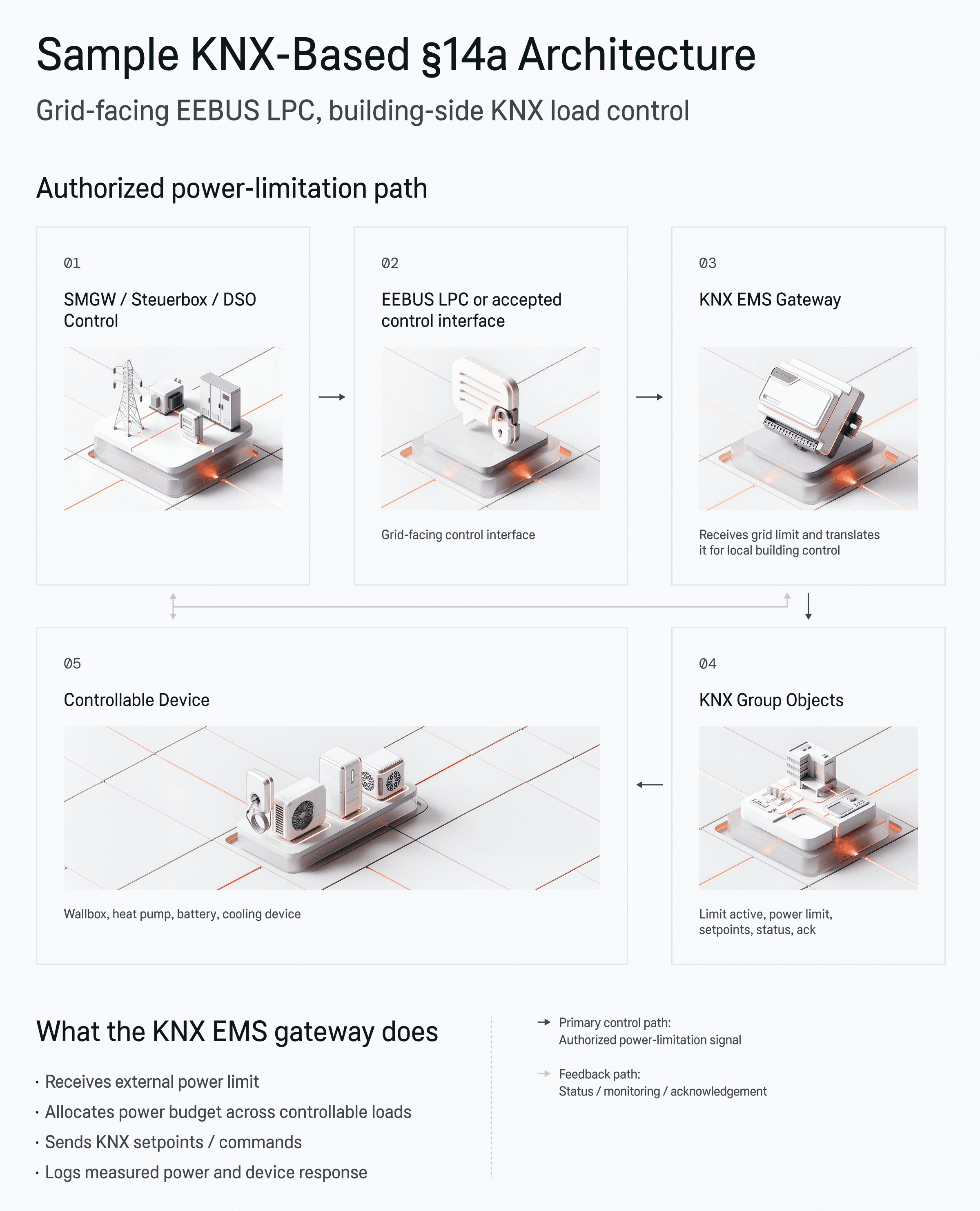
In other words, if KNX sits as a device-control layer behind a grid-facing interface, it can handle local allocation, device coordination, metering feedback, and building-side enforcement.
That said, generic KNX support doesn’t automatically equal German grid-control readiness.
Control-chain interoperability
The German §14a control chain is metering-led. The control signal originates from the grid-side process and reaches the site through the smart-meter gateway, control unit, or Steuerbox, CLS/HAN environment, and then the EMS or controllable device.
On the grid-facing side, the gateway receives the external limitation through EEBUS Limitation of Power Consumption, or another accepted control interface, where agreed. EEBUS LPC is specifically defined to limit the consumption of a building or device directly or through a local energy manager. With an EMS available, the limit refers to the EMS or building-level controllable-load total. Without an EMS, it refers to a single device.
The KNX layer then translates the validated grid limit into building-side control objects. A robust KNX interface has to expose, at a minimum:
- A §14a limit-active flag
- A total active-power limit,
- Per-device setpoints
- Actual active-power feedback
- Device availability
- Fault status, acknowledgement
- Optional timeout or priority information.
The main challenge of this approach is that every installation must consistently map the grid-facing limit into the correct KNX objects, device behaviors, and evidence model.
A simple KNX object named “power limit 4200 W” inside the building won’t be sufficient for §14a-compliance. And that triggers integration overhead and partner-specific validation.
Security
KNX Secure added new security features and products. KNX IP Secure and KNX Data Secure can protect communication against unauthorized access and manipulation. But §14a security also requires preserving the authority, priority, and evidence trail of a regulated grid-control instruction.
This requirement creates a responsibility boundary. The EMS gateway must be configured to:
- Establish that the incoming limit came from the accepted grid-facing interface
- Translate it without weakening its meaning
- Publish the relevant KNX commands securely
- Prevent ordinary building automation, user preferences, or vendor app logic from overriding mandatory grid limitations
The KNX project must also be commissioned so that group addresses, datapoints, keys, device roles, and access rights don’t create an uncontrolled write path into §14a-relevant objects.
In a KNX-native building, this is manageable because ETS engineering, commissioning discipline, and integrator workflows already exist. In a mass-market appliance rollout, it becomes a support burden.
LPC use case implementation
KNX can support local load control, but the §14a LPC lifecycle still has to be implemented explicitly.
The EMS gateway will have to be programmed for the following allocation logic:
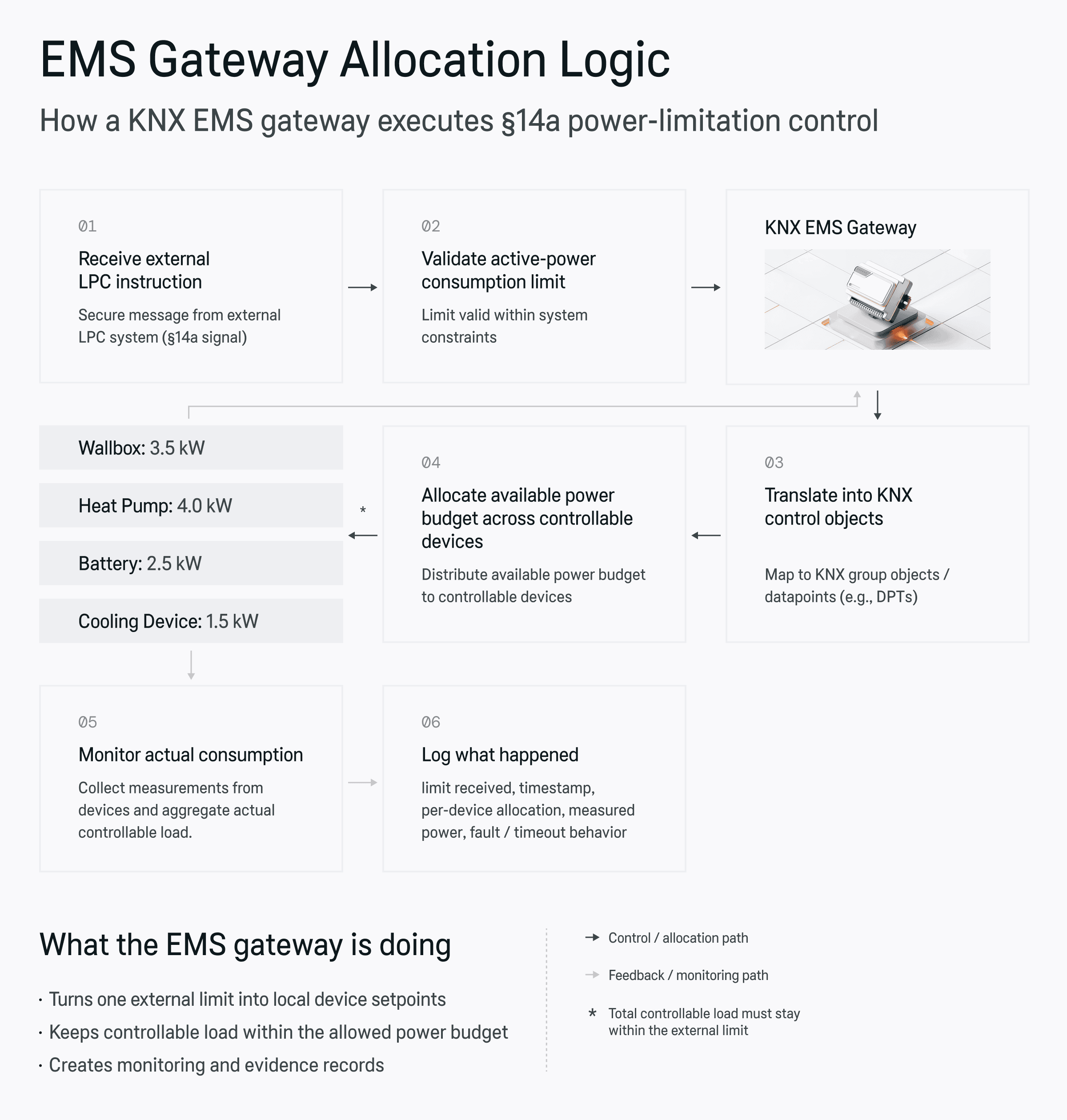
For KNX devices, the EMS can send charging-power, current, enable, reduced-mode, or power-limit setpoints through the relevant application objects. KNX HWH load-management objects may support load-shedding via locking signals, but this is optional and shouldn’t be treated as a universal §14a interface.
The EMS must also prove behavior: received limit, timestamp, duration, per-device allocation, KNX telegrams, measured power, acknowledgements, faults, timeout behavior, and recovery.
When KNX is the strongest choice
Using KNX makes sense when your product already lives in the professional building-automation stack. It’s a natural fit for KNX-native EMS products, building controllers, commercial HVAC, BMS-adjacent systems, integrator-grade wallbox deployments, and multi-load environments where the local building logic matters as much as the individual device.In this case, you can create a KNX EMS gateway or KNX IoT / API-server-based application to capture §14a-relevant limit on the grid-facing side, translate it into KNX datapoints, allocate the controllable-load budget, monitor device response, and log evidence.
EEBUS
EEBUS is a communication standard for energy-relevant devices, energy management systems, and grid-side control infrastructure. Technically, it’s based around two core layers: SPINE and SHIP.
- SPINE provides the standardized data model and use-case vocabulary: power limits, consumption values, device capabilities, acknowledgements, monitoring data, and control states.
- SHIP provides the secure IP-based transport layer that carries those SPINE messages between machines.
Unlike other protocols, it was purpose-built for energy coordination at the grid connection point and can participate in authorized grid-side processes. EEBUS use cases include grid protection, local energy management, dynamic pricing, self-consumption optimization, and power limitation.
Why EEBUS is the strongest choice for §14a readiness
EEBUS is the strongest §14a readiness choice because it aligns with the German control-chain problem at the right layer.
Germany requires a controllable device or EMS to participate in a specific grid-side process, and the EEBUS Limitation of Power Consumption use case was created for that lifecycle.
EEBUS slots directly into the German control-chain architecture
Matter is strongest inside the smart home. Modbus is strongest as a device-side register protocol. KNX is strongest for local building orchestration. EEBUS is the protocol that most directly maps to the German grid-control handoff.
With EEBUS LPC, the grid-side controller can send a power-consumption limit either to an EMS or directly to a device.
- With an EMS, the limit can apply to the controllable-load total behind the meter, and the EMS distributes that available power across devices.
- Without an EMS, the limit can apply only to a single device.
EEBUS also gives the EMS the data it needs to operate the limit intelligently. Monitoring of Power Consumption can provide device-level consumption values, while Monitoring of Grid Connection Point can provide grid-connection measurements. That matters because §14a control requires keeping the measured system inside the external boundary.
EEBUS fully aligns with the SMGW / control-box security model
EEBUS also fits the security context better than protocols designed primarily for consumer convenience or legacy automation.
It uses SHIP as the secure transport path for SPINE messages over IP, which is aligned with the German smart-meter gateway HAN security context. So it supports secure message transport and control.
EEBUS can sit behind the control box or SMGW-side infrastructure and carry the grid-relevant instruction into the EMS or device without forcing you to invent a proprietary trust model.
That said, you’ll still have to handle secure commissioning, certificate handling, firmware governance, logging, and regression testing. But EEBUS gives you a control interface that already speaks the language of the German metering-side architecture.
Other protocols push the security burden back at you:
- Raw Modbus requires you to define who may write the limit, how the command is authenticated, and how stale writes are blocked.
- With Matter, you’ll have to build a bridge from consumer smart-home trust to the German grid-control trust boundary.
EEBUS keeps the trust-boundary problem closer to the protocol’s intended operating model.
LPC implementation
EEBUS comes with native LPC support. It enables the exchange of a structured LPC message with a standardized interpretation path, so there’s less semantic invention.
EEBUS Power Limitation also includes critical control behaviors for the field: acknowledgement, heartbeat, and failsafe handling.
- Acknowledgement shows whether the EMS or device accepted or rejected the limit.
- Heartbeat confirms that the communication path is alive.
- Failsafe behavior defines what happens when the connection drops, a limit expires, or the device can’t apply the command.
These controls are essential to prove that your product is §14a-ready. A product that can reduce consumption but can’t prove what happened is weak in the German operating model.
With EEBUS, the OEM can build a testable control loop: secure connection setup, SPINE/LPC message exchange, command reception, acknowledgement, physical power reduction, monitoring feedback, timeout behavior, and recovery when the limit is removed.
However, turning this standardized flow into working software for embedded devices still requires implementation decisions that can affect cross-manufacturer interoperability. Find out how a shared EEBUS implementation can improve interoperability and reduce development effort.
Can we run EEBUS alongside Matter or other protocols?
Yes. And, in fact, you should.
EEBUS isn’t the best protocol for every layer. Matter may still be the right choice for consumer ecosystem integration. KNX may be the better choice for local building control. Modbus is still valuable inside a device or plant architecture.
Read also: Before the CRA arrives: What you should be prepared for
Making the right protocol decision
The optimal §14a protocol is the one that best fits the German grid-control process.
For most industrial OEMs, that’s EEBUS. It’s the protocol German regulators, grid operators, and metering-side stakeholders are converging around, and it has a ready-made LPC use case for the exact power-limitation requirement §14a introduces.
Other options still have their merit. Matter can support smart-home integration. KNX can coordinate building-side load control. Modbus can remain useful for device-side data exchange. But EEBUS is the safest grid-facing default.
If you want to understand where your current product architecture stands, check our §14a EnWG Readiness Scorecard. It will help assess your product’s control-chain readiness, communication architecture, LPC behavior, security model, fallback handling, and evidence gaps so you know where to focus first.
Evaluate your §14a compliance readiness before entering the German market
The §14a EnWG Readiness Scorecard helps industrial OEMs navigate Germany’s evolving grid integration requirements and prepare their products for §14a compliance.
WHAT’S INSIDE:
- 7-point readiness assessment for §14a EnWG compliance
- Self-assessment scorecards across four readiness levels
- EEBUS, control architecture, and device-behavior requirements
- Security, commissioning, and interoperability checklists
- Framework to identify compliance gaps and priorities
- Roadmap for German market readiness