Successful integration of medical devices into US hospitals is generally dependent upon only one question posed by the Chief Information Officer: "Does it support FHIR?" Most manufacturers answer affirmatively because they have embedded the web API into the device's firmware to secure the contract. After six months, the implementation is stalled because the hardware clogs up local networks with high frequency telemetry, patient identification becomes problematic at point of care, and hospital IT rejects the nested JSONs.
The Multi-Departmental Sale and Custom Integration Trap
Streaming Live Data Over a File Transfer System
The Missing Network Discovery Layer
Fleet Operations and Firmware Blind Spots
The Ten-Year Hardware Trap and the IEC 62304 Talent Crunch
The Comprehensive Solution: Decoupled Middleware Architecture
The misconception that a health data standard solves all problems associated with medical hardware is a common pitfall in the field. In response to aggressive government standards, hardware executives believe that they have to embed the web APIs into physical devices.
As a custom healthcare software development company specializing in complex healthcare integrations across the United States and Canada, we frequently resolve this problem. FHIR is exceptional when it comes to static medical records, but relying on it as a standalone hardware strategy ruins deployments, alienates hospital clients, and burns through budgets.
The Multi-Departmental Sale and Custom Integration Trap
Each hospital will have its own implementation of an EHR, PACS, or LIS. As a result, your team is forced to build custom data mappings for each installation. Everything that you managed to achieve in a good pilot falls flat when you attempt a wide-scale rollout due to problems with patient matching and device registration.
The worst thing is that the IT, Biomed, Security, and Procurement departments of a hospital examine your solution independently. Just one department can stop you from making the sale.
If the security team of a hospital starts sending you extensive questionnaires or demanding a detailed threat model and software bill of materials (SBOM), you will be forced to work hard to satisfy their demands. Manual creation of such compliance documents takes months of engineering time.
Streaming Live Data Over a File Transfer System
HL7 built legacy standards to fix the nightmare of sharing static medical records. If a doctor in New York needs to pull a discharge summary from a clinic in California, it works beautifully. It operates on RESTful web services, utilizing standard request-and-response architecture. A client asks for a specific resource, the server packages it in a text file, and sends it back.
Medical devices do not create static files. They generate aggressive, high-velocity streams of continuous telemetry. That changes everything.
A modern intensive care unit bed spits out hundreds of physiological data points every single minute. A continuous patient monitor updates heart rate variability, blood oxygen levels, and respiration rates multiple times a second. Forcing this high-velocity data into a RESTful architecture is like trying to stream a live football game through a fax machine.
Sending a discrete HTTP request for every single physiological measurement overloads the local network. The payload size of a standard resource contains heavy metadata, coding system tags, and hierarchical text. Doing that fifty times a second for ten different metrics per patient across an entire hospital wing will crash local Wi-Fi. In an operating room, delayed data impacts patient safety by stalling critical bedside alarms.
HL7 International launched the Caliper FHIR Accelerator explicitly because traditional FHIR standards struggle to handle high-frequency telemetry in critical care environments. Until those new frameworks mature, forcing high-frequency waveforms through a standard REST API is flawed engineering.
The Missing Network Discovery Layer
Hospital administrators expect true plug-and-play functionality. When a nurse plugs a new monitor into a wall, they expect the system to recognize it instantly.
Standard web APIs cannot do this. They are strictly an information model, dictating spelling and grammar, but possessing zero rules for how machines find each other on a physical network, verify hardware identity, or negotiate local connections.
Real device integration requires two-way communication and physical hardware control. Consider a closed-loop medication administration system where a central clinical system adjusts an intravenous pump’s drip rate based on real-time vitals. You cannot safely use a standard web API endpoint to change the physical behavior of life-support hardware. If hospital Wi-Fi drops for two seconds during an HTTP POST request, the pump might miss the command to stop the infusion.
Smart engineering organizations rely on specialized, localized protocols like IEEE 11073 Service-oriented Device Connectivity. SDC handles dynamic network discovery, low-latency bedside communication, and fail-safe hardware commands. If your software architecture only speaks the language of electronic health records, your hardware is blind to the physical floor.
Read more: Architecting for Reliable Medical Device Connectivity
The Data Science and AI Gap
Hospitals buy hardware to feed massive corporate data lakes. Driven by value-based care, hospital data science teams want to capture your telemetry, combine it with historical records, and run artificial intelligence models to predict clinical deterioration hours before symptoms appear.
There is a major catch. AI models perform exceptionally well in research environments, but they struggle once deployed because raw device data often lacks necessary clinical context. Teams struggle to show performance across patient subgroups or detect data drift after launch.
Furthermore, because FHIR exchanges discrete records, internal data structures are deeply nested JSON trees. Data scientists cannot run efficient analytics on raw, nested JSON without intermediate mapping algorithms and relational databases to flatten the data.
A peer-reviewed study in the Healthcare journal demonstrated that when hospital engineers try running predictive machine learning models across millions of raw observation resources, their SQL query engines time out. The data must be flattened, transformed, and mapped into columnar storage formats like Apache Parquet first. Dumping raw JSON payloads into hospital cloud environments pushes a massive engineering burden onto your buyer.
Fleet Operations and Firmware Blind Spots
Once your devices are deployed across North America, operational visibility becomes a massive hurdle. Manufacturers often do not know which software version runs on which specific device out in the field.
Without remote diagnostics and a safe way to push signed firmware updates, fixing a bug or security vulnerability requires sending an expensive field engineer to the hospital site. Bluetooth pairing and patient onboarding issues generate a massive share of support calls. Meanwhile, legacy devices run operating systems that can no longer be patched, creating severe cybersecurity risks.
The Ten-Year Hardware Trap and the IEC 62304 Talent Crunch
Developers often misunderstand medical manufacturing timelines. Hardware moves glacially. Building a new device and securing clearance from the FDA or Health Canada takes years, and hospital procurement teams expect hardware to remain in active service for seven to ten years.
Software standards evolve aggressively, and newer API versions are not strictly backward compatible. If you hardcode an API version into your device firmware, a future EHR upgrade by your hospital client can break the connection entirely.
Fixing this is exceptionally difficult because firmware engineers who also understand strict medical software standards like IEC 62304 are exceptionally hard to hire. Battery life, strict reliability requirements, and a decade-long product lifetime limit every design choice. When firmware, mobile, and cloud teams release on different schedules, regressions appear at the boundaries between them, slowing down manufacturing design transfers.
Need professional help with building medical device software?
The Comprehensive Solution: Decoupled Middleware Architecture
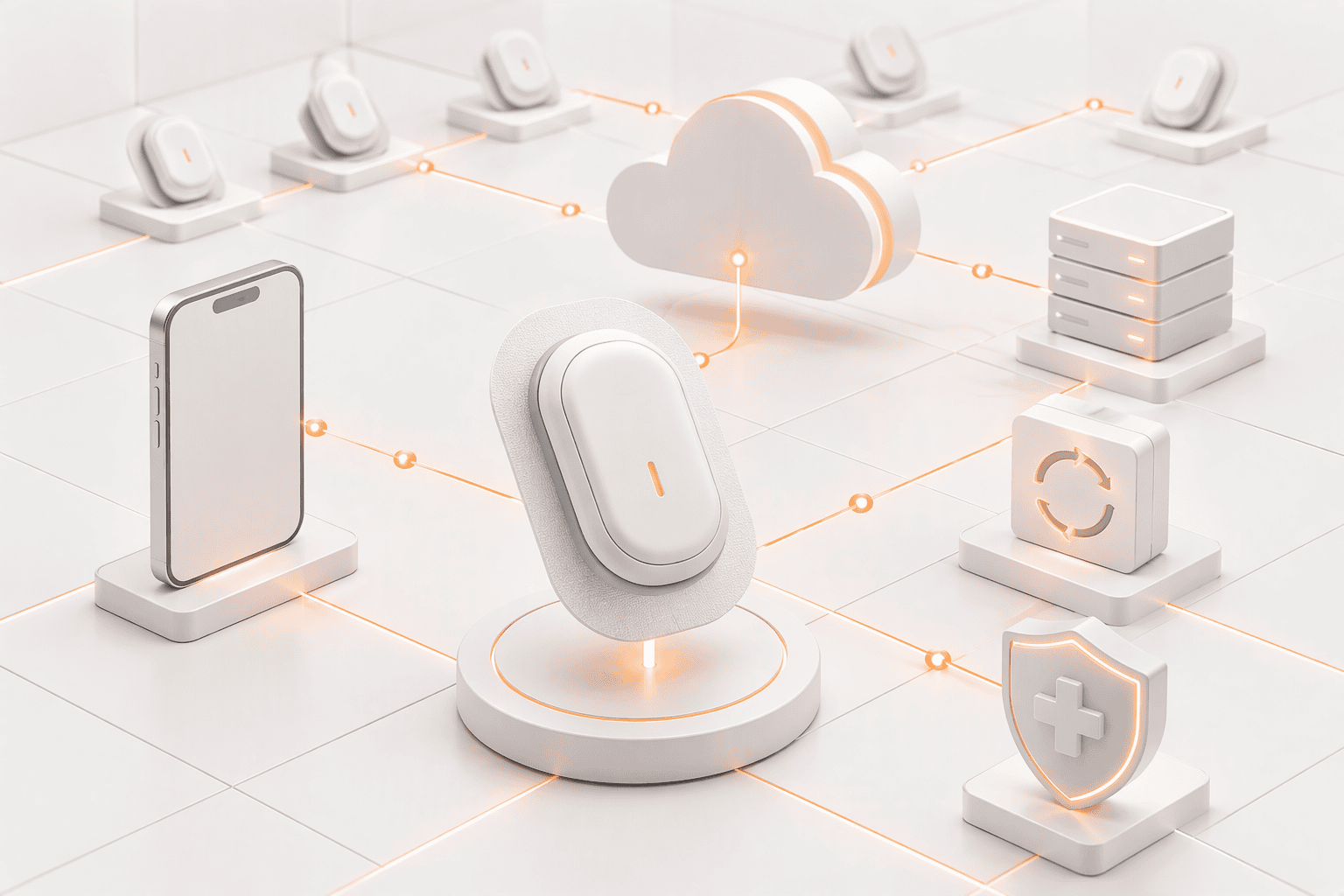
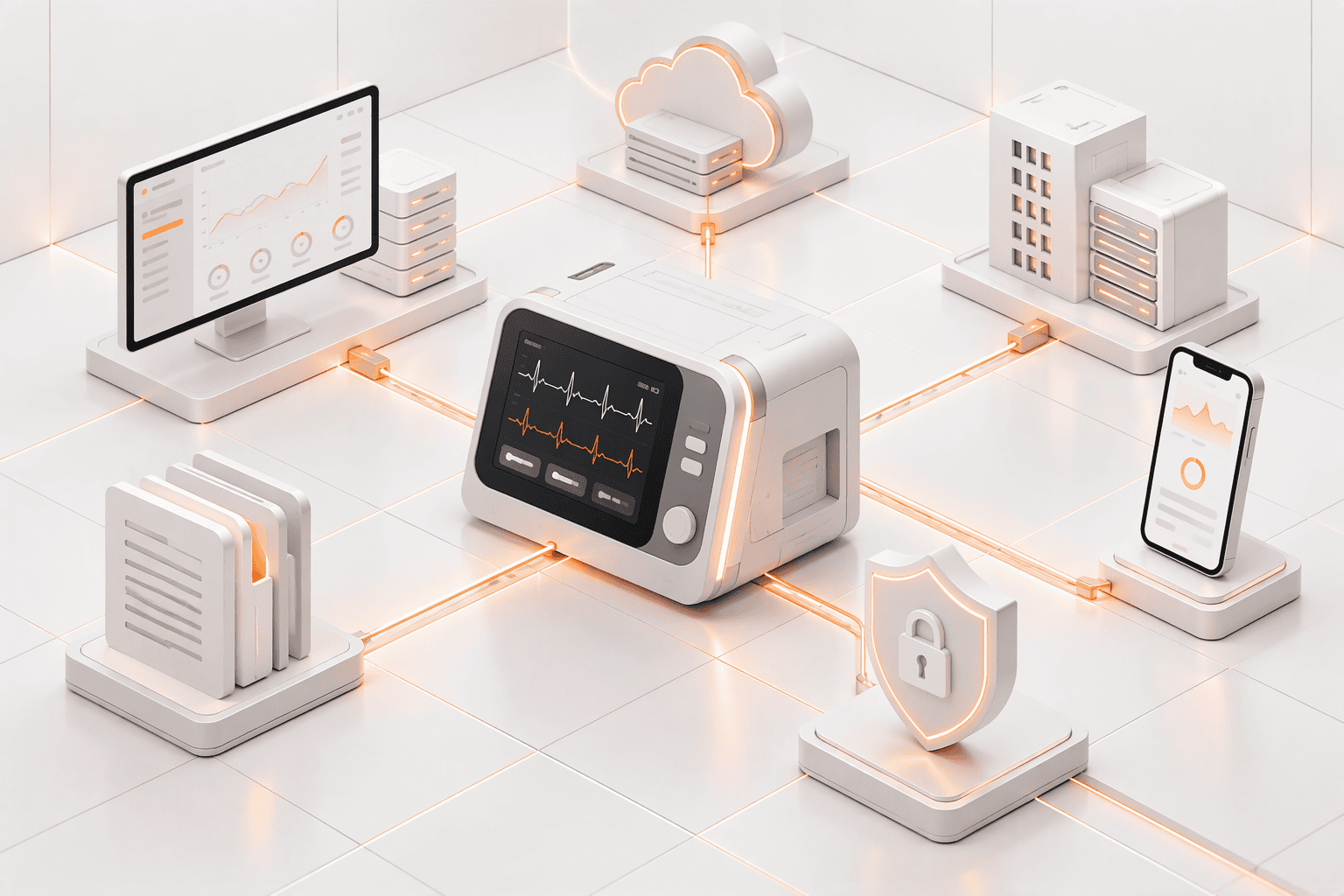
To solve these compounding integration, compliance, and operational roadblocks, forward-thinking medical device companies are abandoning firmware-level web APIs. Instead, they implement a decoupled software middleware architecture that abstracts connectivity completely off the physical hardware.
This comprehensive technical solution is structured across four dedicated layers, accompanied by targeted operational and compliance modules.
The Four-Tier Integration Middleware
- The Bedside Layer: At the physical level, your device ignores enterprise software standards entirely. It communicates using ICU-specific protocols like IEEE 11073 SDC for dynamic discovery and secure control, or lightweight MQTT and WebSockets for simpler sensors. This guarantees real-time safety, ultra-low latency, and optimized battery life.
- The Edge Gateway Layer: Specialized software gateways sit on the local hospital network or in a secure, HIPAA-compliant cloud. This gateway acts as a universal translator. It absorbs high-velocity telemetry, runs local anomaly-detection algorithms, filters out digital noise, and bundles raw data into meaningful clinical events before enterprise transmission.
- The Enterprise Layer: The gateway translates cleaned data into the exact electronic health record standard required by the facility, batching updates intelligently. If a hospital upgrades its Epic or Oracle Health system, your FDA-cleared firmware remains untouched, and we simply update the mapping logic inside the cloud gateway.
- The Analytics Pipeline: Utilizing an event-driven message broker like Apache Kafka, the system routes data to multiple destinations simultaneously. Clinical summaries go straight to the EHR, while raw, flattened telemetry routes directly into the hospital data lake, formatted perfectly in columnar formats for data science and AI teams.
Solving Fleet Operations and Remote Diagnostics
Instead of forcing field engineers to visit hospitals for routine bug fixes or firmware upgrades, the middleware layer provides centralized fleet visibility.
- Remote Version Control: Maintain a real-time inventory tracking exact software and firmware versions across every device in the field.
- Signed OTA Updates: Deliver secure, cryptographically signed firmware updates over the air, eliminating manual intervention and closing security vulnerabilities instantly.
- Proactive Diagnostics: Capture device health metrics and telemetry errors remotely to resolve Bluetooth pairing, network drops, or hardware faults before clinicians even notice an issue.
Streamlining Cybersecurity and Hospital IT Approvals
To prevent security questionnaires and procurement reviews from stalling your sales pipeline, a modern middleware platform bridges compliance gaps automatically.
- Automated SBOM and Threat Modeling: Generate standardized software bills of materials and threat models directly from the software architecture build pipeline, turning a manual months-long chore into an automated routine.
- Enterprise Identity Management: Implement robust OAuth 2.0 and SAML integrations that satisfy hospital cybersecurity standards without requiring custom security builds into physical medical firmware.
Why Partnering for Middleware Accelerates Time to Revenue
The key source of competitive advantage as a medical device manufacturer does not lie in working through the complex politics of hospital enterprise IT and IEC 62304 compliance pipeline. Creating a resilient, secure, and scalable middleware layer internally takes years instead and distracts from creating innovative hardware solutions.
Hardware pricing continues to decrease due to pressure from hospital purchasing committees. In order to retain profitability, you need a reliable source of software and services revenues.
Collaboration with a healthcare software development company can resolve this challenge. Our team will do the heavy lifting related to hospital interoperability, data pipeline engineering, and regulatory compliance while delivering pre-engineered code and integration frameworks along with hardware.
Major health systems across the United States and Canada demand zero-latency clinical decision support and analytics-ready pipelines on day one. Let your hardware do what it was designed to do, and let a custom software layer handle the heavy lifting of integration.
Need Expert Help with MedTech Compliance and Integration?
Learn more about how we support FDA Cybersecurity and SBOM Readiness for modern healthcare software.