Forward Deployed Engineering: From Adoption to AI-Native Operations

AI-native operations cannot be created by simply adding AI tools to existing workflows. They require changes to decision logic, controls, data flows, human review, and accountability. Forward Deployed Engineering supports that shift by putting engineering close to the operational environment where those changes have to be designed and tested. This article explains what FDE is, how it differs from consulting and traditional delivery roles, and when it becomes useful for enterprise AI initiatives moving from task-level adoption to AI-native operations.

Most companies I talk to about AI are doing the same thing: finding tasks where AI can help, and plugging it in. This typically comes down to writing assistant here, classification model there, perhaps automated service endpoint triggering. Progress is visible, costs dip in a few places, and the innovation narrative holds up in board presentations.

Yet the competitive position often does not fundamentally change. This happens because what most businesses are doing is task-level AI adoption. It has value, but it also has a ceiling. If the workflow underneath stays the same, AI usually improves parts of the process but not the way the business creates, protects, or scales value.

There is a different category emerging: organizations that redesign processes from the start with AI as a native component.

Moving AI from Pilots to Production

The State of AI report points to a clear pattern: companies that see meaningful financial impact from AI are not just adding tools to existing processes. They are more likely to redesign the workflows around them. More than half of organizations attributing over 5% of EBIT to AI report fundamental workflow redesign as part of their AI deployment, compared with around 20% among less successful organizations.

AI adoption vs. AI-native operations

The difference between these two approaches is the level at which the change happens:

  • AI adoption improves individual tasks inside an existing workflow. A human still moves information between systems, interprets context, decides what matters, escalates exceptions, and carries accountability across the process. AI helps with parts of the work, but it does not change how the work itself is structured.
    The result is incremental productivity and a manageable change-management story. Useful and the right place to start.
  • AI-native operations are different. Here the workflow itself is designed with AI as part of the operating logic. The system prepares decisions, routes work, interprets signals, applies rules, checks confidence, and escalates only where human judgment or accountability is required.

That shift is not cosmetic. It changes the data layer, governance model, approval logic, exception handling, and the role of people in the process. It also changes what kind of delivery model can make the transition real.

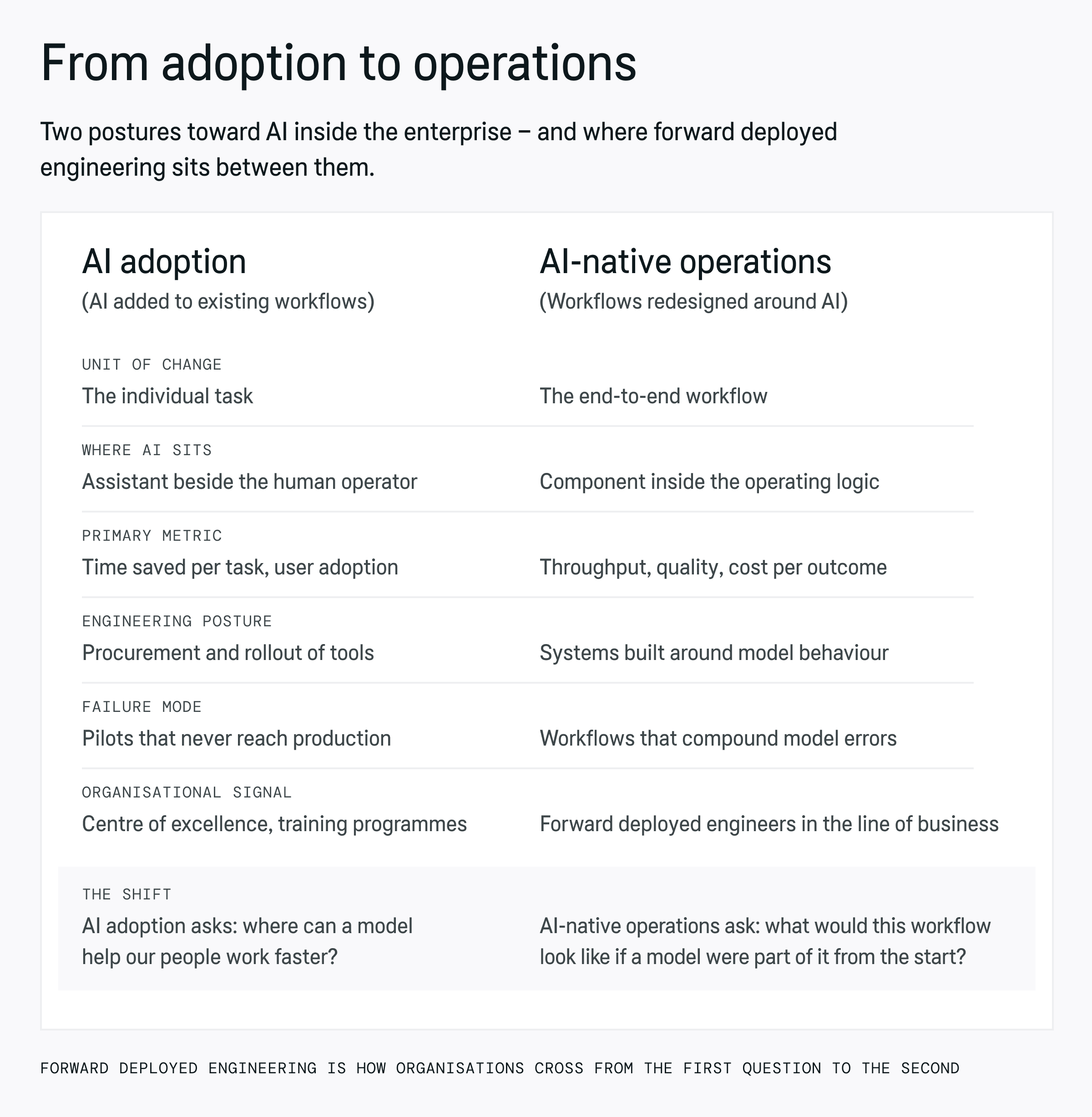
From adoption to operations
Two postures toward AI inside the enterprise – and where forward deployed engineering sits between them.
AI adoption
(AI added to existing workflows)
AI‑native operations
(Workflows redesigned around AI)
Unit of change
The individual taskThe end‑to‑end workflow
Where AI sits
Assistant beside the human operatorComponent inside the operating logic
Primary metric
Time saved per task, user adoptionThroughput, quality, cost per outcome
Primary metric
Time saved per task, user adoptionThroughput, quality, cost per outcome
Engineering posture
Procurement and rollout of toolsSystems built around model behaviour
Failure mode
Pilots that never reach productionWorkflows that compound model errors
Organisational signal
Centre of excellence, training programmesForward deployed engineers in the line of business
The shift
AI adoption asks: where can a model help our people work faster?AI-native operations ask: what would this workflow look like if a model were part of it from the start?
Forward deployed engineering is how organisations cross from the first question to the second.

When the goal is system replacement or task automation, a traditional handoff-based model can still work. But when the work itself needs to be redesigned around AI, requirements cannot simply travel from business teams into engineering and come back as a finished system. The delivery team has to stay closer to the workflow while it is being reshaped.

This is where Forward Deployed Engineering becomes relevant.

AI adoption augments the people inside an existing workflow; AI‑native operations redesign the workflow so that a model is part of how it runs — and forward‑deployed engineering is the discipline that gets organizations from one to the other.

What Forward Deployed Engineering is

In practical terms, Forward Deployed Engineering is a delivery model in which a customer-embedded, production-owning engineering team identifies a high-value operational problem, designs the AI-native workflow, builds or adapts the technical system, deploys it into the real environment, measures adoption, and turns what works into reusable delivery patterns. (You will sometimes see it written as Forward Deployment Engineering. The terms are often used interchangeably.)

The role does not stop at discovery, recommendation, or prototype. A Forward Deployed Engineer is close enough to the customer to understand operational reality, and technical enough to make that reality executable. That is why the role is different from both consulting and traditional engineering.

The model works on two levels.

The first is the individual engagement. A team goes from discovery to deployment to measurement in one tight cycle, close enough to the customer’s workflow to make real operational change happen without waiting quarters for it.

The second level is where the real difference appears. Each engagement leaves something behind that the next one can reuse: delivery patterns that proved repeatable, infrastructure that became reliable enough to standardize, governance that was tested in production instead of designed on a slide.

That means the next engagement does not start from zero. The second one starts with more structure than the first. The tenth starts with much more than the second. Over time, delivery becomes faster, cost drops, and the organization builds capability at scale.

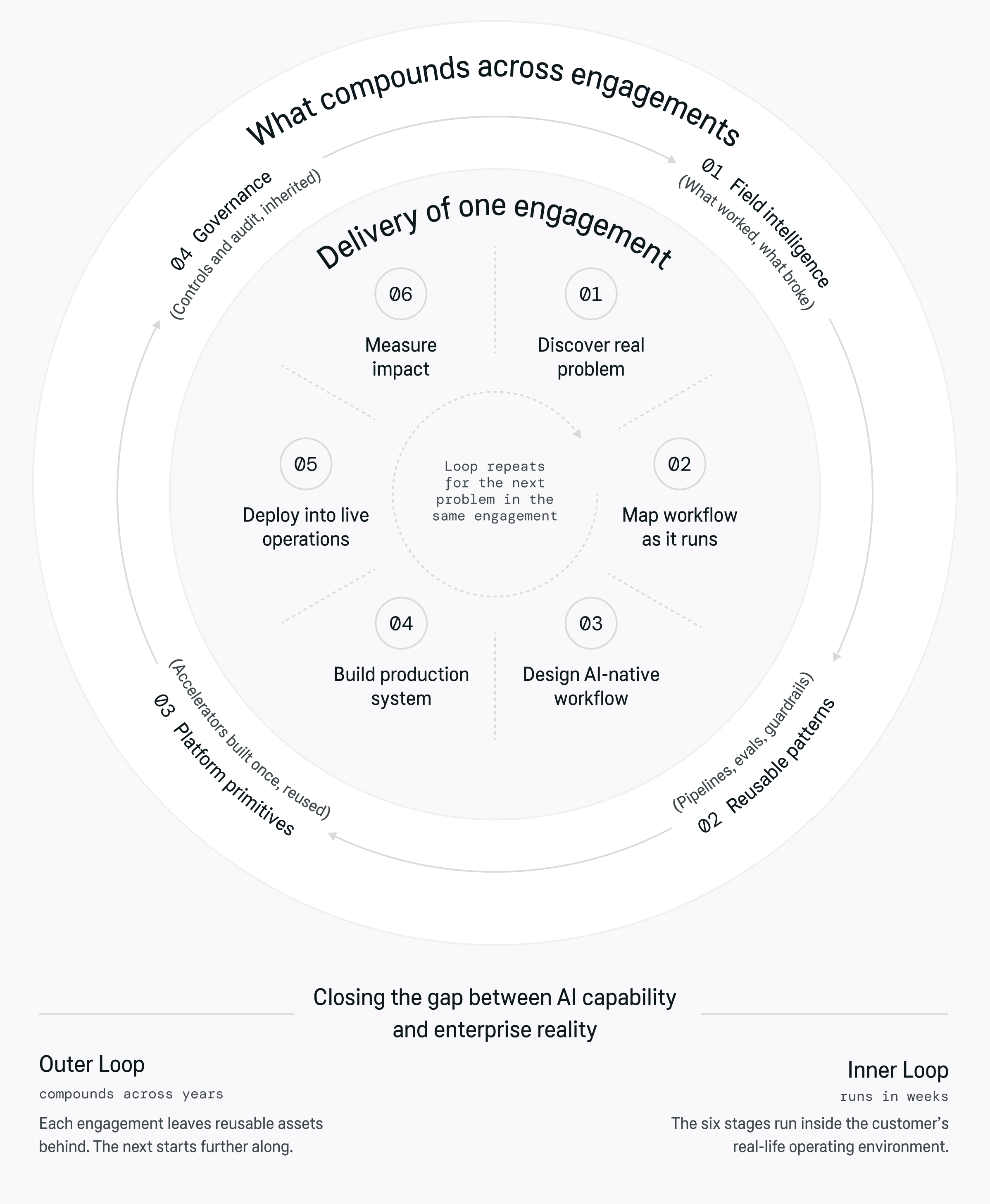
Outer loop – what compounds across engagements
Each engagement leaves reusable assets behind. The next one starts further along.
Field intelligence
(What worked, what broke)
Reusable patterns
(Pipelines, evals, guardrails)
Platform primitives
(Accelerators built once, reused)
Governance
(Controls and audit, inherited)
Inner loop – delivery of one engagement
Six stages run inside the customer’s real operating environment. The loop repeats for the next problem in the same engagement.
1. Discover real problem2. Map workflow as it runs3. Design AI-native workflow
4. Build production system5. Deploy into live operations6. Measure impact
Closing the gap between AI capability and enterprise reality
  • Inner loop runs in weeks
  • Outer loop compounds across years

You may also see related terms such as Forward Deployment Engineer or AI FDE. The naming varies, but the operating logic is consistent: the engineering team moves forward into the business environment instead of waiting for requirements to travel backward into delivery teams.

How Forward Deployed Engineering changes AI delivery

Rather than deploying AI backward into processes designed without it, Forward Deployed Engineering means engineering processes forward with AI as a first-class design constraint. Not “where can we add AI to this?” but “if AI were already here, how would we design this?” Even though the concept is in no way new, practical ways to implement or scale it remain one of the biggest challenges in enterprise AI.

Forward Deployed Engineering helps AI work move from pilot to production through three connected shifts.

Process re-engineering around AI

Redesign around AI capabilities instead of retrofit. Revisit decision flows, approval layers, information handoffs. Often this means eliminating steps that exist only because humans needed to bridge information gaps AI can now close automatically. This requires fluency in AI tooling: model selection, evaluation, orchestration, and the operational data plumbing around them.

Capability building inside the customer organisation

AI-native operations require people who can design with AI, govern it, and improve it. That is the next step beyond simple usage of it. FDEs integrate in customer organization and lead by example, pilot, deliver iteratively, and gradually reach scale.

Infrastructure for continuous improvement

AI-native operations produce data that needs to flow back into models, processes, and governance. FDEs that build this feedback loop from the start – model telemetry, evaluation pipelines, and human-in-the-loop review – compound their advantage with every release.

Forward Deployed Engineering vs consulting, business analysis, and solutions engineering

The model is often confused with adjacent roles that look similar on a slide but significantly differ operationally.

A business analyst captures how work is done today and translates it into requirements. Forward Deployed Engineering starts from a different question: given what AI can now do, how should this work be done? BA produces a specification that automates the current process and hands it off. An FDE team redesigns the process and implements it. AI transforms from being an add-on to becoming a structural component of how decisions are made, exceptions handled, and quality controlled. You cannot arrive at that output through BA methods, because BA preserves the process logic that FDE is specifically trying to eliminate, and stops before the engineering that makes it real.

The same distinction applies to other familiar roles.

  • A Solutions Engineer proves that a product can fit. FDE makes the system work inside the customer’s operating reality.
  • A Solutions Architect designs the target architecture. FDE also builds, tests, deploys, and iterates it.
  • A Professional Services Consultant delivers a project. FDE turns the delivery into a repeatable operating pattern.
  • A Customer Success Manager drives adoption. FDE owns the technical and process changes that make adoption possible.

This is why FDE should not be treated as a renamed delivery role. It is an operating model that combines discovery, engineering, deployment, adoption, and feedback into one loop. FDEs come from the intersection of several existing roles in software and solutions engineering, data and ML, professional services, and domain expertise. The common shift is the same in every case: from handoff to ownership, from requirements to redesign, from pilot to production, from one-off delivery to repeatable capability.

How the domain knowledge gap is addressed

The bottleneck in AI transformation is rarely the technology. It is understanding what a process is optimizing for, beneath the stated requirements.

FDE addresses this by embedding engineers with operational teams before any model is chosen, mapping the decision logic operators actually use rather than what the documentation says they should, and validating assumptions against production data early.

How FDE delivers and scales

FDE starts narrow and ships fast — a single workflow, a real operational output, something the organization can see working within weeks. That first delivery is not a prototype to be thrown away once the concept is proven. It is built with the right data pipelines, governance, and handoffs in place from the start, so scaling is a matter of extending what already works. Early results build the organizational trust and operational credibility that fund everything that comes next.

Success metrics

The success metric is not whether an AI feature was launched. It is whether the way of working has changed.

A successful FDE engagement should leave behind measurable workflow impact: shorter cycle time, fewer handoffs, better decision quality, higher automation coverage, lower exception rates, stronger governance, and a team that knows how to improve the system after the first release. The first deployment matters, but the compounding mechanism matters more.

Where Forward Deployed Engineering is useful, and where it is overkill

If your operating model is stable and the only thing that changes is the tooling around the workflow, changing the delivery model would be overkill. Writing assistants for individual productivity, code generation inside an existing SDLC, classifiers on well-understood inputs, contained back-office automations – these are real AI use cases with real value, and they do not need an embedded engineering team to deliver.

FDE becomes useful when the workflow itself is uncertain or needs to change. That usually means several things are true:

  • The process depends on tacit domain knowledge.
  • The current workflow has too many handoffs.
  • Decision logic is partly undocumented.
  • The data exists but is fragmented or inconsistently trusted.
  • Human review is needed, but not everywhere.
  • Governance, auditability, or risk controls matter.
  • Adoption will fail unless the system fits real operational behavior.
  • The first deployment needs to become a repeatable pattern, not a one-off pilot.

In these cases, we are talking about not just building an AI feature but changing how work gets done. And that is where FDE earns its place.


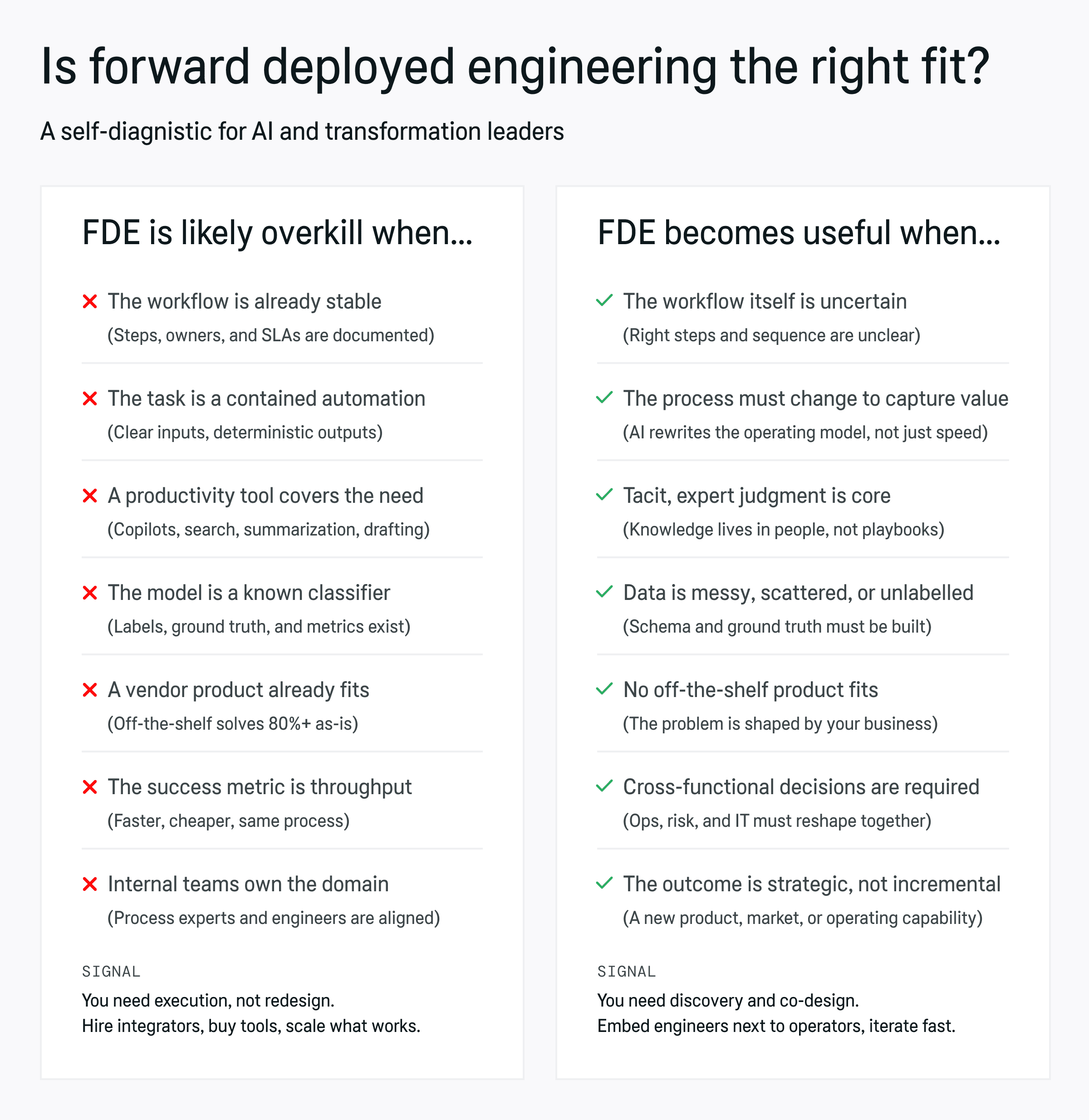
Is forward deployed engineering the right fit?

A self-diagnistic for AI and transformation leaders

FDE is likely overkill when…FDE becomes useful when…
The workflow is already stable
(Steps, owners, and SLAs are documented)
The workflow itself is uncertain
(Right steps and sequence are unclear)
The task is a contained automation
(Clear inputs, deterministic outputs)
The process must change to capture value
(AI rewrites the operating model, not just speed)
A productivity tool covers the need
(Copilots, search, summarization, drafting)
Tacit, expert judgment is core
(Knowledge lives in people, not playbooks)
The model is a known classifier
(Labels, ground truth, and metrics exist)
Data is messy, scattered, or unlabelled
(Schema and ground truth must be built)
A vendor product already fits
(Off-the-shelf solves 80%+ as-is)
No off-the-shelf product fits
(The problem is shaped by your business)
The success metric is throughput

(Faster, cheaper, same process)

Cross-functional decisions are required
(Ops, risk, and IT must reshape together)
Internal teams own the domain
(Process experts and engineers are aligned)
The outcome is strategic, not incremental

(A new product, market, or operating capability)

Signal: Signal:
You need execution, not redesign.

Hire integrators, buy tools, scale what works.

You need discovery and co-design.

Embed engineers next to operators, iterate fast.

AI Compass: a structured pathway to AI-native execution

Forward Deployed Engineering is not the default answer to every AI initiative. Some organizations need to start with stronger data foundations. Some need governance and guardrails before they scale. Some need a lighter delivery path for contained use cases. Others are ready for embedded execution because the operational problem is already visible, but the path to production is not.

This is where a structured route matters.

At Sigma Software, we use AI Compass to map that route. The compass brings together our AI-related offerings across four practice areas: AI SDLC Practice, AI Guardrails, AI Business Transformation, and AI in Product Engineering. The goal is to understand your current state, define the right AI destination, and structure the next steps around your operating reality, constraints, and pace.

Forward Deployed Engineering can become one of the execution patterns inside that roadmap, especially when the route runs through AI Business Transformation. If you are working out where AI fits in your operations, which workflows are worth redesigning, and what should come first, a Compass Session is a practical place to start.

Book a Compass Session

Share article: