On November 27, in Lviv, Forbes AI Summit brought together entrepreneurs, technology leaders, and scientists for an honest conversation about how AI is reshaping business and society today. Businesses are already investing in infrastructure, transforming operating models, upskilling teams, and expecting measurable outcomes, but has artificial intelligence already moved from hype to real-world implementation? Our colleague Max Kovtun, Chief Innovation Officer at Sigma Software, took part in discussions about the hottest AI trends, the future of technology, and how ready businesses truly are for the next era – and he shares his impressions about the event in this article.
I had the pleasure to take part in a panel discussion “Next Big Things. Which areas of AI development will become critical for business in the near future” on Forbes AI Summit. As you can guess, the entire event was dedicated to AI :).
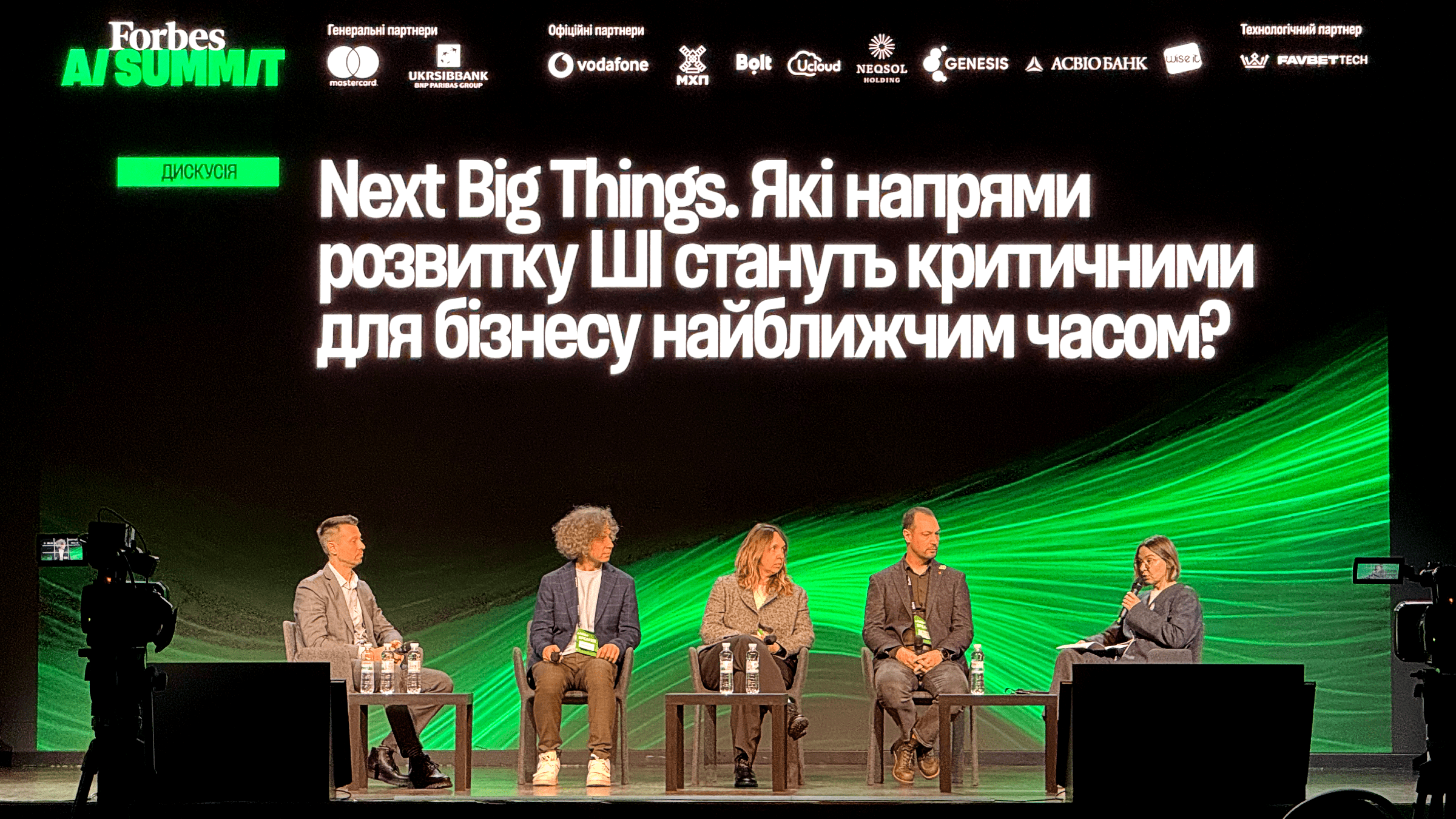
The majority of participants represented real sectors of economy – not IT). They too are interested in employing AI in company operations, but they have their problems as well. One comment, in particular, caught my attention – a CEO of a company complained about technology providers. They promise improvements and value after buying AI services, but when a company buys, completes projects, adds AI – there’re no improvement, those promises simply do not work. So, he said that they were thinking about shifting to Revenue Sharing cooperation model with AI tech providers, not to pay for promises and “doing the work”, but to pay for results.
During our panel, we discussed MIT research, which shows that 95% of AI projects fail—and what can be done to avoid joining that statistic.
My take on this (other participants of the panel discussion shared similar takeaways) is that there are two distinct kinds of problematic AI projects:
- When everybody wants AI, and technology is so complex that not many people really understand how it works, magical thinking turns on. Lots of ideas are formulated as “We do this, then we do that, and AI will do everything else”. Many of them are simply not realistic, or do not take into account the imperfect world we all live in. So, when such ideas are launched – they, of course, crash being hit by reality. What to do – involve AI experts in idea evaluation and filtering before launching projects.
- When everybody wants AI, you’re tempted to put it into everything, all the problems look like nails. I understand this desire, but we need to realize that AI works non-deterministically, it is hard to verify that AI functionality works as expected, it drifts with time, etc. There’re many problems, which are not present in deterministic solutions. It is also more costly. So, if the problem could be solved without AI – it should be solved without AI.
I personally face these two kinds of ideas all the time. So, be cautious, guys, when somebody shares their idea with you, or you want to bring your idea :).
Another interesting question was: What should companies do in the next 2-5 years? Since most businesses are technology users, not creators, their focus is on adopting AI built by others. And the biggest problem here is the readiness of the organization for AI solutions.
Imagine you’re putting on glasses that filter out everything non-digital and looking onto your organization through them. What would you see? I think we do not realize that lots of organizational aspects do not have a digital footprint. Our way of work, our understanding of things, our priorities, our ideas, many records and entities do not exist in the digital world. There is organizational consciousness which is completely non-digital. So, we will probably see small pieces of organization scattered across the space. That is what AI will see when you add it to your company. Will it solve all your problems blindfold? Nope.
It was an insightful day, and I was glad to share our professional vision with non-technical business leaders. These conversations are crucial because they bridge the gap between technological innovation and practical business application. AI is not just about algorithms—it’s about transforming how organizations think, operate, and create value. These conversations are crucial because they bridge the gap between technological innovation and practical business application. AI is not just about algorithms—it’s about transforming how organizations think, operate, and create value.