For industrial OEMs, margin compression is no longer a cycle but a structural shift. The challenge is not only to find new revenue beyond the initial sale, but to understand what capabilities are needed to deliver it profitably. Here's a practical framework for manufacturers to assess where they stand and plan the next step toward service-led revenue.
Why the installed base is your most underutilized asset
Know your starting point: the OEM maturity matrix
The economics that sustained industrial OEMs for decades are buckling. Gross margins in the industrial machinery and components sector fell from 39.8% to 36.9% in a single year ending Q4 2025, while net margins dropped from 13.4% to just 8.2% over the same period. These numbers are pointing to a structural change.
Engineering excellence and installed-base scale, the twin pillars of OEM competitive advantage, no longer translate into pricing power the way they once did. Rising input costs, labor inflation, and customers demanding more value for less spend have locked many manufacturers into a cost pass-through trap they cannot engineer their way out of.
But there is a lever that a growing number of OEMs are pulling, and it changes the entire commercial logic of the business.
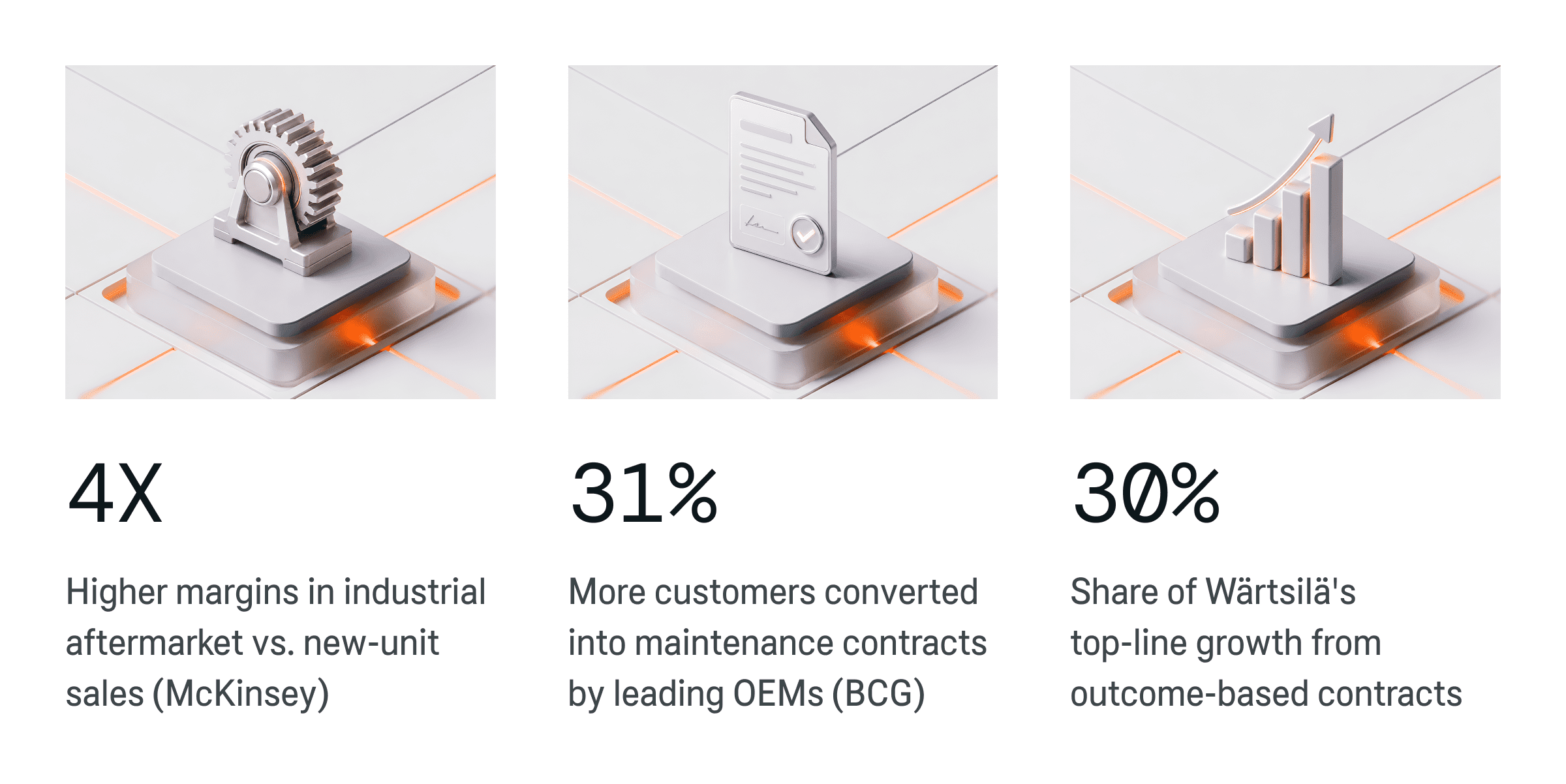
Why the installed base is your most underutilized asset
Most OEMs own something extraordinarily valuable: thousands of machines operating in the field. Yet they have almost no visibility into how that equipment performs, degrades, or gets used once it leaves the factory floor. That gap between installed-base scale and operational visibility is where margin is lost and where it can be recaptured.
When you connect that installed base, even partially, three margin mechanisms unlock simultaneously:
- Higher service attach rates
Asset visibility creates the conditions for proactive customer engagement, converting one-time buyers into maintenance contract holders
- Lower cost-to-serve
Remote diagnostics reduce truck rolls, lift first-time fix rates, and shift service from reactive to predictive, cutting delivery costs at scale.
- Outcome-based pricing power
When value is tied to uptime or performance, premium pricing becomes defensible. Recurring revenue replaces CAPEX volatility.
Know your starting point: the OEM maturity matrix
The biggest mistake organizations make in connected product initiatives is skipping straight to advanced analytics or large IoT deployments before the underlying infrastructure and service operations are ready. This produces stalled pilots, stranded investment, and internal fatigue.
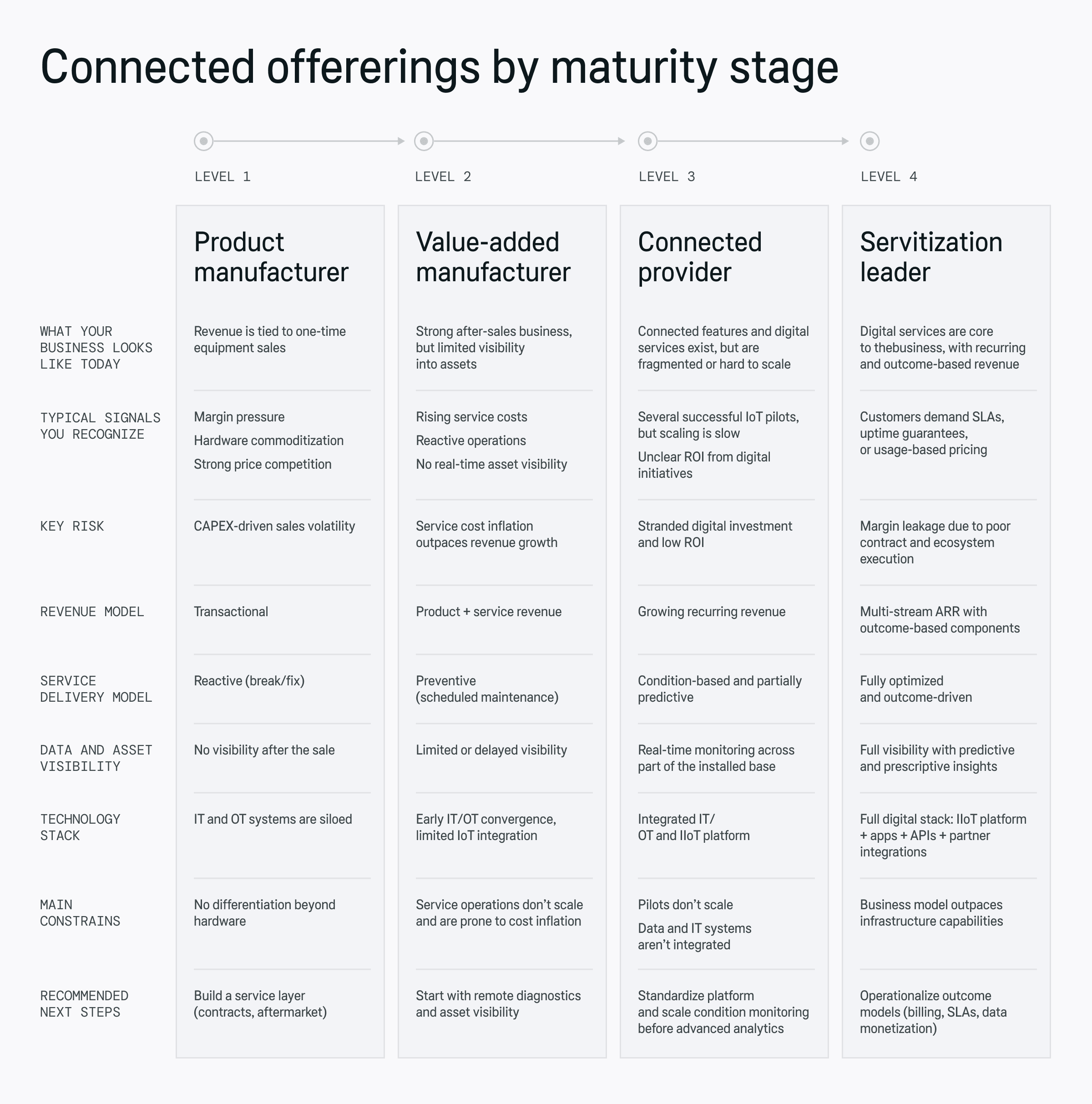
The path that generates sustainable ROI starts with an honest assessment of where your organization sits on the maturity curve. Not where you aspire to be, but where you actually are.
Each level has its own set of blockers and a logical next step. Trying to leap two levels at once almost always stalls in execution. Progress happens by solving a specific business problem at each stage, starting with service efficiency, then scaling data and platform capabilities, and only later enabling new business models.
Navigating this path often requires a more structured view of priorities and next steps.
Sigma Software’s “Scaling Connected Products” white paper is designed to be your decision guide. It maps each maturity level to its key blockers, recommended next steps, required capabilities, and expected business impact. Сontact our team to receive the white paper and get a better understanding of where to focus next and what it will take to move forward,
The most common traps at each stage
Level 1 → 2: The initiative ownership gap
At Level 1, initiatives stall not because the ideas are wrong but because no one owns them. Connected product conversations get siloed between R&D, IT, service, and leadership. The priority is not technology, it’s formalizing service as a commercial model and building a unified view of the installed base.
Level 2 → 3: Overestimating the platform upfront
Most Level 2 OEMs underestimate how much impact lightweight connectivity can deliver before a full IoT platform is needed. Basic telemetry like status, fault codes, and usage patterns, streamed to a simple internal portal, can cut truck rolls, improve first-time fix rates, and begin the cultural shift from reactive to data-driven service. Start here. The platform can come later.
Level 3 → 4: Pilot proliferation without standardization
Level 3 organizations often have multiple successful pilots running on incompatible data models, fragmented IoT platforms, and inconsistent commercial packaging. The scaling challenge is standardization. Consolidating IoT infrastructure, harmonizing data pipelines, and integrating with core business systems (FSM, ERP, CRM) is what converts pilots into scalable product lines.
Level 4: Primary risk shifts from technology to economics
Poorly structured outcome-based contracts or misaligned SLAs can erode margins even when technical execution is strong. The priority shifts to billing automation, SLA tracking, and ecosystem integration. Together, they create a chain where data feeds operations, operations feed contracts, and contracts drive revenue.
What Sigma Software delivers at each stage
Effective connected product enablement requires alignment between embedded systems, cloud platforms, data architecture, cybersecurity, and service operations. Sigma Software works at the intersection of physical products, operational realities, and recurring-service business models. We build each new service layer on a stable technical foundation, sized to your current maturity level.
Our manufacturing software development approach brings these layers together, from secure device connectivity and predictive diagnostics to enterprise integration and scalable service platforms.
Whether you are running a first-connectivity proof of concept, standardizing a fragmented IoT estate, or operationalizing outcome-based billing, the engagement is scoped to what generates the most impact at your specific stage — not the most sophisticated architecture on paper.
With 40+ value-added service lines for global enterprise clients, Sigma Software delivers 20–30% faster time-to-market for digital services in manufacturing and a documented 30% reduction in unplanned downtime through predictive monitoring solutions.
If you recognized your company’s current stage while reading this article, the most useful next step is a focused conversation about what your specific first project should look like, what it would take to execute, and what return you should expect.
That conversation works best with a structured picture of your data, products, and services. Our Scaling Connected Products Whitepaper will help you build that view, with a clear way to score your current capabilities and map your new connected offering step by step. Download your copy of the whitepaper below.
Find your stage on the connected products maturity matrix
The Scaling Connected Products Whitepaper outlines the steps industrial manufacturers take to turn connected products into profitable service ecosystems.
WHAT’S INSIDE:
- Connected products maturity matrix
- Self-assessment checklists
- Progression roadmap
- Predictive maintenance use cases
- Recurring revenue and service scaling guidance