For decades, the manufacturing formula for success was the same – build great equipment, ship to the Client, and get the profit. Now, more OEMs are discovering that this formula keeps them on a one-time sales treadmill, which is no longer enough to drive expected profitability. So, manufacturing companies of all sizes are exploring new operating models. One approach that helped companies create long-term value is appending equipment sales with value-added services. In this article, we’ll explain how to make this transformation work and bring long-lasting service contracts and recurring revenue beyond what the traditional model can deliver.
What Connected Product Enablement Really Means
Technology Built for Business Outcomes
From One-Off Sales to Lifetime Value
Business moves through servitization at its own pace, gradually adding digital capabilities to its equipment. Often, such initiatives are developed in parallel, which makes them fragmented across cloud, connectivity, and data teams. As a result, companies lack a holistic view of the overall setup from device to the end-user’s app. Hence, they struggle to improve services, develop new revenue models, strengthen customer relationships, and move beyond a one-time sale model.
This is where a Connected Product Enablement (CPE) approach comes into play, helping manufacturers to consolidate the servitization initiatives and launch scalable pilots.
This approach ensures connections across devices, data, and people. In simple terms, it works like this: connected devices send telemetry through secure networks to the cloud, where the data is processed and analyzed. The resulting insights are delivered through applications and data products to service, engineering, and business teams, enabling remote support, predictive maintenance, and outcome-based service models.
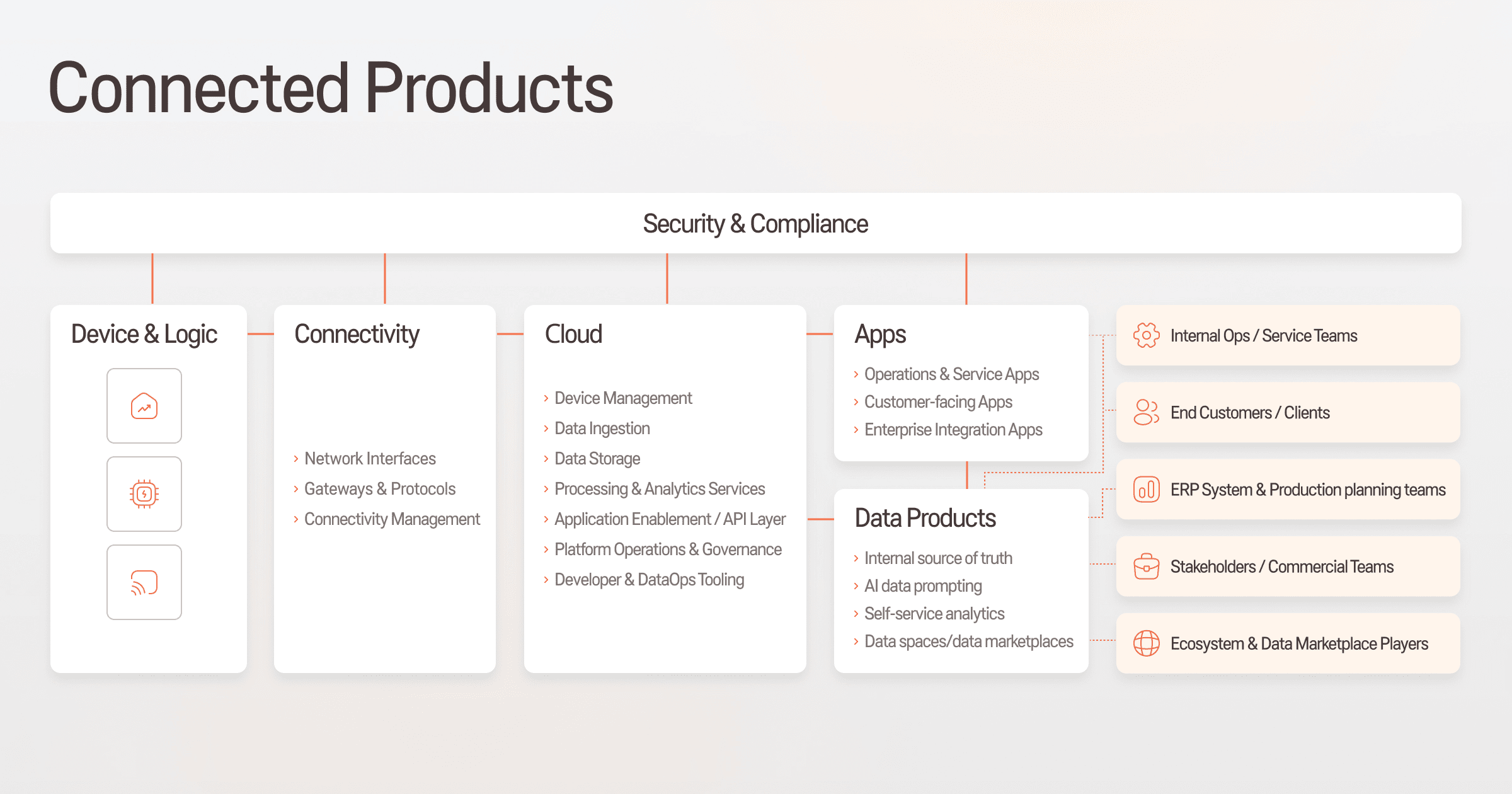
As a result, CPA allows companies to establish a continuous feedback loop, thereby driving constant and recurring revenue.
What Connected Product Enablement Really Means
A Connected Product Enablement (CPE) approach is not about adding new layers of technology, but getting a holistic view of your connected system with its devices, cloud infrastructure, and people.
This approach does not exist as a standalone solution. Instead, it integrates into the enterprise landscape, connecting equipment data with existing systems such as ERP and CRM, and extending current workflows rather than introducing parallel ones.
It is important to understand, however, that the shift from a device-only model to a connected product ecosystem also introduces new challenges. As products are connected, they become a target for new types of cyberattacks. Malicious actors have learned that attacking individual company systems one by one is inefficient. Instead, they look for entry points in connected devices and shared platforms that can be exploited at scale.
A single small vulnerable device can cause a cascading breach, exposing sensitive operational data, making security a critical consideration when building connected systems.
Beyond security, regulatory compliance also needs to be embedded throughout the development process. Regulations such as NIS2, the EU Cyber Resilience Act (CRA), and the EU Data Act introduce requirements for robust security, risk management, and data governance practices set up in connected systems by design. Thereby making it too risky to treat security requirements as an afterthought.
This is why Connected Product Enablement is closely coupled with Cybersecurity and Compliance services to help manufacturers establish security mechanisms across the entire product lifecycle. As a result, device onboarding, data transmission, and access control operate within a unified framework, avoiding ad-hoc integrations.
CPE Embedded security practices include:
- Unique device identity and controlled onboarding to prevent unauthorized connections
- Secure data flows between devices, cloud services, and enterprise systems
- Architecture aligned with regulatory requirements such as CRA and NIS2
Built on the secure and integrated foundation, Connected Product Enablement supports a shift toward service-oriented operations, enabling businesses to:
- Monitor and manage your equipment fleet in real time
- Predict and prevent failures before they affect SLAs
- Monetize usage data through subscription or pay-per-use models
- Integrate seamlessly with MES, ERP, SCADA, and CRM systems
- Secure every connection from device to cloud with CRA- and NIS2-compliant architecture
Whether equipment is new or already in use, Connected Product Enablement allows for starting small by adding simple telemetry to existing machines. As the organization gains experience, this setup can be expanded into a shared service platform used across products and customers.
Technology Built for Business Outcomes
At the heart of Connected Product Enablement is a simple idea: make product data usable across the business to drive informed decisions.
In most manufacturing organizations, data lives across machines, service systems, MES, ERP, and customer tools. The challenge is to connect it consistently so that different teams can rely on the same information.
Connected Product Enablement is focused on providing a common technical backbone that allows product data to move across teams and to end users. The first step in this process is edge-to-cloud data integration. This means connecting data generated by machines to the cloud systems and streaming it to your enterprise ecosystems, including ERP, CRM, analytics, and customer portals. As a result, real-time and historical machine data become available for service planning, billing, and customer support.
Further, analytics and AI help turn this data into actionable signals. Teams can predict maintenance requirements, track usage patterns, and forecast demand to support proactive service delivery.
However, these insights only become actionable when they reach both internal teams and customers. Usually, this happens through the application layer, which includes enterprise systems, customer portals, apps, and management dashboards. When designed with usability in mind, the application layer allows teams to translate insights into actions: efficiently open and manage service tickets, plan interventions, order parts, and communicate status to customers.
From One-Off Sales to Lifetime Value
Once equipment is connected and integrated, manufacturers get a foundation to introduce new service models that allow businesses to generate recurring revenue. Based on the company’s needs and readiness, there are several popular manufacturing models:
- Outcome-based SLAs
Manufacturers define service agreements around uptime or performance levels. Real-time equipment data helps teams monitor how well you fit your SLAs, track measurable results, and determine what you actually deliver. - Pay-per-use services
Businesses price services based on actual equipment usage, such as operating hours, output, or consumption. Telemetry from machines provides a clear and auditable basis for billing and revenue tracking. - Predictive maintenance contracts
Continuous maintenance is scheduled based on equipment condition instead of fixed intervals. Such ongoing monitoring and analytics reveal early signs of failure, helping teams reduce unplanned downtime and service costs.
Manufacturers do not necessarily need to commit to a single service model. They can either apply one model consistently across all services or combine different models across product lines, customer segments, or regions. For example, one product line may operate under outcome-based SLAs, while another uses pay-per-use pricing or predictive maintenance contracts, depending on operational risk, customer needs, and commercial strategy.
The key is to identify which model fits each product and customer relationship, and to support those choices with reliable data from the field. When usage, performance, and condition data are available and trusted, it allows for pricing services realistically, managing risk, and adjusting offerings as conditions change, without redesigning their service operations each time.
The Quick-Win Pathway to Avoid Pilot Purgatory
Embracing a new service model leads to organizational change, but it does not have to cause disruption. When organizations attempt to change everything at once, initiatives slow down, but when they move too cautiously, pilots never progress beyond experimentation.
In contrast, manufacturers that avoid this trap take a staged approach that delivers early results while keeping risk under control. Their typical workflow includes the following stages:
- Retrofit or native connectivity
The starting point is a small, controlled scope. Manufacturers connect a limited fleet of machines, either by retrofitting existing assets or enabling connectivity by design on new equipment. Basic telemetry provides visibility into how machines operate in real conditions. The objective at this stage is visibility, not optimization. - Analytics and service insight
With reliable data in place, teams introduce a BI layer that enables practical use cases such as predictive maintenance, usage tracking, and SLA dashboards, and lays the foundation for future AI adoption. Service teams begin to anticipate issues instead of reacting to failures, while commercial teams gain data that supports outcome-based and usage-based offerings. - Scale across the business
Once value is proven, manufacturers expand the model across additional products, regions, and customers. Data flows integrate with service management and billing systems, enabling consistent delivery and monetization on scale. This phase typically focuses on repeatability rather than experimentation.
This approach allows companies to move step by step, focusing on early efforts rather than building full-scale solutions. It enables teams to test methods and refine them as the initiative evolves. However, the most important step is to clearly define the goals, scope, and expected outcomes before launching any initiative to avoid pilot purgatory. In such a way, only initiatives that demonstrate tangible value move forward, ensuring pilots evolve within operational capabilities.
How the Value Compounds
The real test of any pilot is not whether it works in isolation, but whether it can improve the business ROI over time. If manufacturers begin operating connected services at scale, they see a new positive pattern:
- Service costs come down
When service teams rely on actual equipment condition instead of alarms and customer calls, emergency dispatches become the exception. Planned interventions replace urgent ones, and spare parts inventory aligns more closely with real failure patterns. Over time, this reduces labor, logistics, and inventory carrying costs without sacrificing service quality. - Asset uptime improves
With fewer unplanned failures and faster response to emerging issues, equipment availability increases. As uptime stabilizes, manufacturers meet SLA commitments more consistently. This reliability directly influences contract renewals and long-term customer relationships, especially in environments where downtime carries high operational or financial penalties. - Revenue becomes steadier
As service contracts, subscriptions, and usage-based pricing grow, revenue depends less on new equipment sales cycles. Instead of fluctuating with capital expenditure decisions, income spreads more evenly over time. This improves forecasting, increases lifetime value per installed asset, and reduces exposure to market volatility. - Compliance stops slowing expansion
A security and compliance-ready architecture enables organizations to swiftly adapt to new regulatory requirements when extending services across regions or into regulated industries. With a solid framework in place, manufacturers avoid reengineering their systems each time a new obligation arises and can append the necessary controls to the existing framework.
Taken together, these effects reinforce one another. Lower service costs protect margins, higher uptime strengthens customer retention, recurring revenue improves financial stability, and compliance readiness keeps growth paths open. This is how connected services move from tactical improvements to sustained business impact.
The Takeaway
The shift from machines to services is not just a trend. It’s the next step in manufacturing evolution. As margins on equipment tighten and customer expectations rise, value no longer comes from a sale. It now depends on real-world performance, service efficiency, and the ability to deliver reliable outcomes over time.
However, transitioning from a one-time sales model is not a single-step change. It requires new visibility, new operating models, and a clear path from product performance to business value. This is where Connected Product Enablement makes the transition practical, bridging the gap between machines in the field and business models in the boardroom.
Above all, CPE isn’t about a radical overhaul. It’s about transforming carefully, step by step. If you are ready to build your own way to service-based delivery, we are here to help. Our Connected Product Enablement service is designed to help manufacturers move beyond one-time sales and create long-term value around product performance without operational disruptions along the way.