In custom healthcare software development, the architectural decisions we make dictate data security. Right now, the standard pattern for integrating artificial intelligence involves routing protected health information (PHI) to external cloud-based models. This approach introduces structural risks. To protect patient data and maintain compliance, healthcare organizations need to rethink where and how their compute workloads execute.
The Security Crisis of Cloud AI
What Sovereign AI Is and How It Solves the Problem
How Sovereign AI in Healthcare is Built and How it Works
Practical Example: Building a Sovereign Diagnostic Assistant
The Security Crisis of Cloud AI
Relying on external infrastructure for medical data processing compromises security fundamentals. Every time a system transmits data outside its native boundary, the potential for unauthorized access grows.
The Illusion of Cloud API Security
Sending PHI to a commercial large language model via an encrypted API is a common deployment choice, but from a systems architecture standpoint, it inherently increases your risk exposure. While a Business Associate Agreement establishes legal liability, it does not physically secure the network. The moment a patient’s medical record traverses the hospital firewall, it remains exposed, even with transport layer encryption in place.
This risk compounds when the payload reaches the vendor’s data center. By transmitting patient records to a managed AI provider, your system security becomes tied to theirs. Commercial cloud AI platforms operate on multi-tenant architectures where your clinical data shares physical memory and processors with thousands of other organizations. Because these high-profile third-party vendors are lucrative targets for hackers and sophisticated exploits, the safety of your data relies entirely on their software-level isolation. If the vendor’s shared hardware or external platform is compromised, your regulated records could be exposed. Furthermore, processing workloads on external servers dramatically complicates data residency requirements.
What Sovereign AI Is and How It Solves the Problem
To resolve these systemic risks, we need a fundamentally different architectural pattern. If routing data out to an external AI creates the vulnerability, the solution is to bring the AI inside the secured environment. This is the core concept behind Sovereign AI.
By definition, Sovereign AI means deploying machine learning systems where the organization retains full, independent control over the four critical layers of the stack: the data, the model, the compute infrastructure, and the operational governance. It is about building an intelligence layer that is entirely localized, eliminating reliance on foreign vendors and cross-border data transfers.
Defining the Sovereign Perimeter
In practical terms, a sovereign architecture moves the deployment artifact to the data, rather than exporting the data to an external model. By bringing the models in-house, we establish a localized intelligence layer built directly on your bare-metal servers or private cloud.
As a healthcare software development company, we build systems where these AI models operate strictly behind your existing firewalls. The AI runs as a containerized, isolated service. It queries your internal EHR databases, processes the inferences using local compute nodes, and delivers the clinical insights directly to the user interface. Because the system is air-gapped from the public internet, patient data never leaves the local area network.
Bypassing the Data Processor Dilemma
Integrating third-party cloud products creates a heavy compliance burden. Mapping data flows to satisfy HIPAA and GDPR requires extensive auditing of external vendors. A sovereign architecture significantly eases this burden and helps organizations meet their regulatory obligations more efficiently.
By confining the clinical datasets, the open-weight models, and the compute hardware entirely on-premises, you physically cut off external risk exposure. While comprehensive compliance involves many factors, operating the model within a closed-loop system completely removes the need to audit the security posture of an external data processor. This approach helps transform a complex compliance liability into an internally governed, fully auditable asset.
Need professional help with building a sovereign AI architecture?
How Sovereign AI in Healthcare is Built and How it Works
Transitioning from a cloud-dependent architecture to a localized system requires a clear engineering strategy. As a custom healthcare software development company, we do not just install applications. The focus is to architect environments where machine learning workloads execute efficiently and securely within strict compliance boundaries.
The Three Pillars of Local Infrastructure
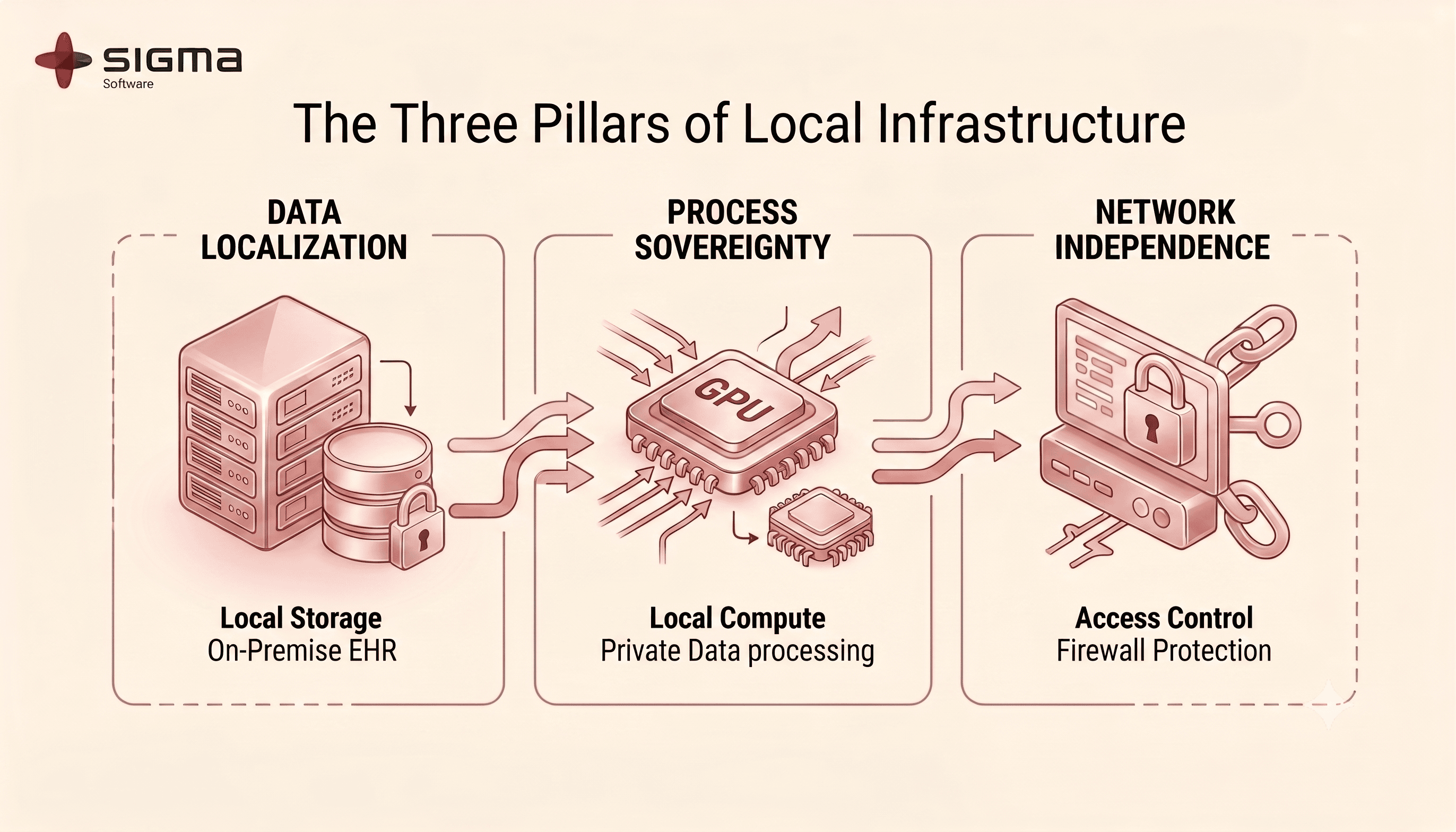
To engineer a functional sovereign system, the architecture must rest upon three distinct technical foundations.
Data Sovereignty: This is the baseline. All patient records, clinical notes, and training datasets reside exclusively on internal storage arrays. The data architecture complies strictly with local legal requirements because the physical drives never leave the governed jurisdiction.
Infrastructure Sovereignty: Reliance on shared cloud compute is eliminated. The processing happens on hardware the hospital actually controls. This requires provisioning on-premise GPUs or utilizing strictly isolated single-tenant private clouds. Controlling the bare metal ensures no other organization can access the compute cycles processing patient data.
Model Sovereignty: Renting access to closed-source black-box APIs is not a secure option. Instead, the strategy involves deploying open-weight models. By possessing the actual model weights locally, the hospital owns the inference logic outright. The organization dictates when the model is updated, how it is modified, and exactly how it processes inputs.
Read about: Top 10 Open-Source AI Models for Healthcare Software Development
Confidential Inference and Trusted Execution
Securing data at rest and data in transit is standard practice. Sovereign AI introduces the ability to secure data in use. When a clinician queries the model, the system must process plain-text PHI to generate a clinical response.
To protect this process, Trusted Execution Environments (TEEs) are configured directly on the internal hardware. TEEs provide hardware-level memory encryption. When the local GPU processes an inference request, the patient data remains encrypted in the system RAM. The data is decrypted only inside a highly secure, isolated section of the processor. Even if a rogue employee or a hacker gained full administrative control of the server, they could not copy or read the patient data being actively processed. This architectural layer guarantees compute-level privacy.
Practical Example: Building a Sovereign Diagnostic Assistant
To understand how this architecture functions in production, examining the deployment workflow for a specialized clinical tool provides clarity.
Sourcing the Open-Source Foundation
Training a massive neural network from scratch is unnecessary. The open-source community provides highly capable foundation models. For a medical use case, our engineering team selects an open-weight model specifically trained on medical literature, such as Meditron-70B.
Instead of calling this model via a web endpoint, we pull the model files directly from a secure repository onto the local hospital server. Validating the cryptographic checksums ensures the files remain untampered, which establishes a secure baseline for the environment.
The Local Deployment Workflow
Once the model is on-site, the configuration process begins. First, the hospital IT team completely isolates the server environment to block any outbound access to the open internet.
Next comes supervised fine-tuning. The model ingests a curated dataset of the facility own de-identified clinical notes and diagnostic histories. This step aligns the base model with the specific terminology, formatting, and clinical protocols unique to the hospital.
Finally, the system exposes this fine-tuned model as an internal microservice. We build a secure internal API that connects the local Electronic Health Record (EHR) system directly to the inference server.
When a doctor requests a diagnostic summary, the EHR sends the patient history over the secure local network to the server. The local GPU generates the clinical insights and returns them to the clinician dashboard. The entire loop executes instantly and entirely on-premises, creating a highly specialized diagnostic assistant that never transmits a single packet to the outside world.
Read about: The Evo 2 Model in Genomic AI: Architecture and Bioinformatics Software Development
Final Thoughts
The architectural shift toward localized machine learning is no longer just an engineering best practice for risk mitigation. It is rapidly becoming a regulatory requirement. With the enforcement of strict data residency laws and tightening healthcare compliance frameworks globally, depending on third-party cloud processors for sensitive patient data creates an unsustainable technical debt.
Building a sovereign infrastructure means taking back control of the computational stack. It allows healthcare organizations to deploy advanced diagnostic assistants, automate medical coding, and analyze clinical records without ever exposing the facility to external API breaches or multi-tenant cloud vulnerabilities. The hardware and open-weight models required to run highly capable AI on local servers are fully viable today. The healthcare systems that adapt their network topologies now will secure their patient data, bypass complex compliance bottlenecks, and turn their internal intelligence layer into a permanent, verifiable asset.
Need professional help with building a sovereign AI architecture?