With dozens of SBOM solutions available, selecting the right tool can be difficult. Vendors offer a wide range of capabilities, but the question is whether a tool can deliver accurate, reliable, and scalable SBOM generation without adding unnecessary complexity or cost. This article breaks down the essential evaluation criteria that can help organizations select a solution that delivers long-term value.
Why SBOM tooling is a business decision
Open-source vs. proprietary tools
A Software Bill of Materials (SBOM) is a structured inventory of software components included in a product. For business units preparing for Cyber Resilience Act (CRA) obligations, producing an SBOM is no longer a one-time exercise. It requires establishing an automated process capable of generating accurate and up-to-date information about software throughout its lifecycle. Businesses need to ensure that SBOMs are accurate, consistently maintained, and integrated into development processes at scale. The effectiveness of these efforts largely depends on choosing the right SBOM tool.
Before diving into the details, here are the main points to keep in mind when selecting an SBOM tool.
Executive summary
- There is no universal “the best” SBOM tool
The best choice is the one that fits the organization’s software, delivery process, and operating model. - Tool fit affects business outcomes
Poor fit can create missing components, inconsistent reports, manual workarounds, and weak evidence for compliance and vulnerability response. - Open-source and proprietary tools solve different problems
Open-source tools usually offer transparency and flexibility, while proprietary platforms provide faster deployment, central governance, support, and reporting. - A pilot is essential
The organization should test shortlisted tools on representative software before making a broad commitment. - Different software environments may need different tools
A multi-language organization may achieve better results by using several specialist generators and consolidating their outputs.
Why SBOM tooling is a business decision
An SBOM is useful only when it is accurate enough to support real decisions. The quality of the result depends not only on what a tool can scan, but also on how well it fits the organization’s software and delivery environment.
A well-matched tool can produce SBOMs automatically and consistently at the right points in the delivery process. It can also help the organization use common formats such as SPDX or CycloneDX, apply the same rules across teams, and keep evidence available for vulnerability management, change tracking, and compliance reporting.
By contrast, poorly matched tools can generate incomplete inventories, inconsistent outputs, false alarms, fragile automation, and extra manual work. These weaknesses can turn SBOM generation into a compliance checkbox rather than a dependable business capability.
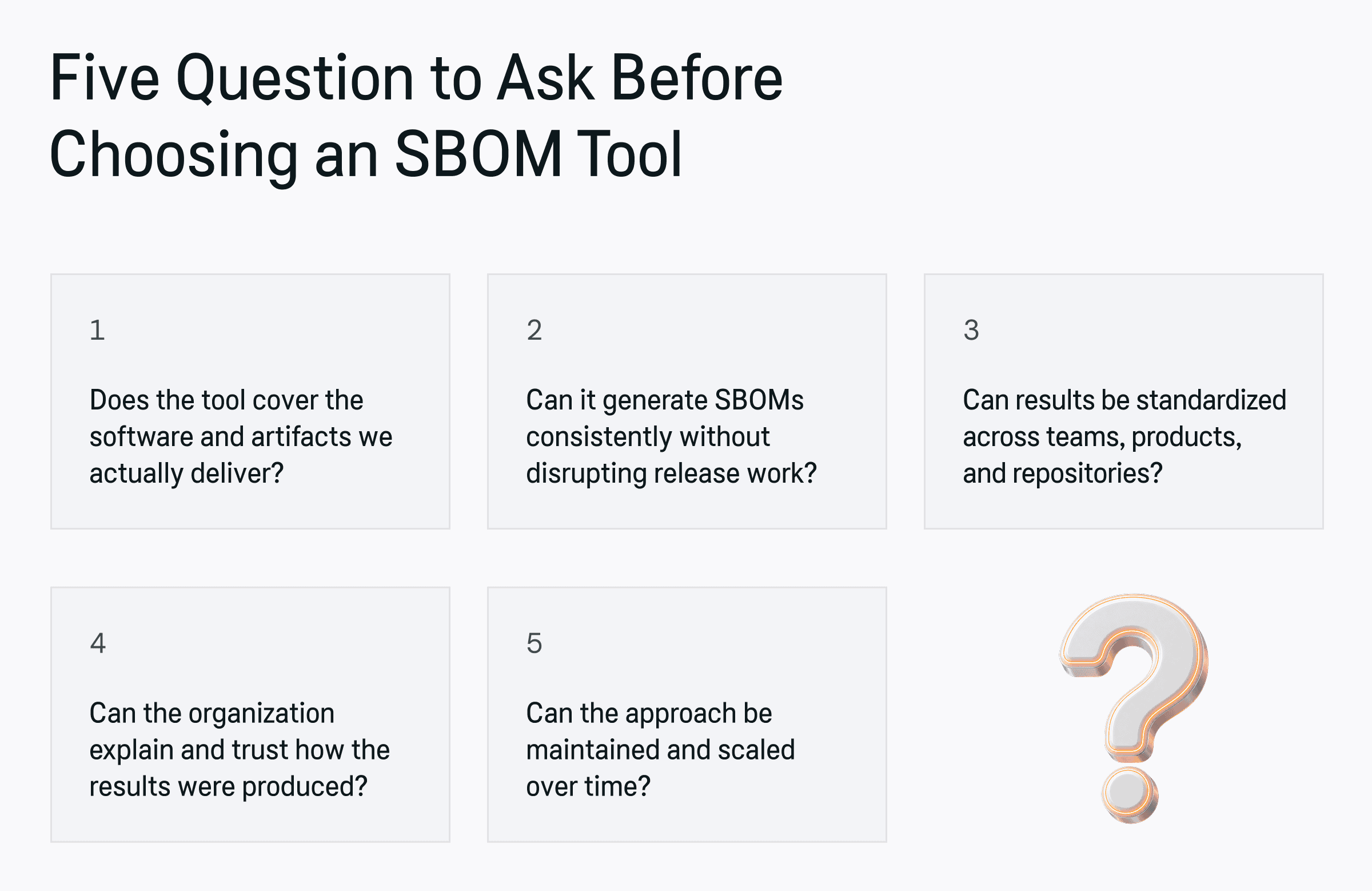
When evaluating SBOM tools, the goal is not to find the platform with the longest feature list, but the one that best fits the organization’s needs. The following questions provide a practical framework for making that decision.
Open-source vs. proprietary tools
The first major choice is often between open-source tools and proprietary platforms. The decision is not simply about license cost. It is a trade-off between flexibility and control on one side, and convenience, support, and centralized management on the other. The table below provides a high-level comparison of the two models.
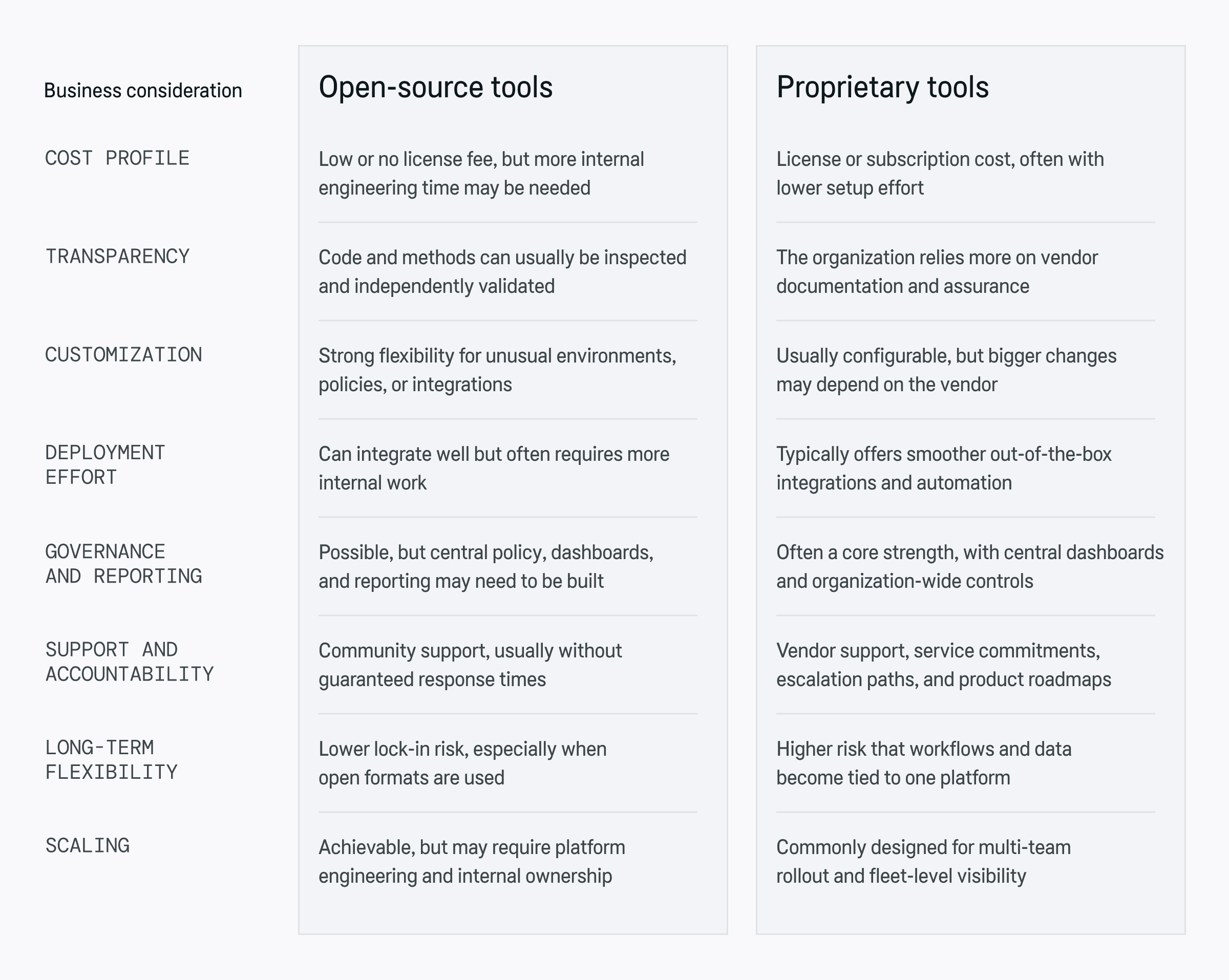
However, in practice, the choice is not always an either-or decision. Organizations can combine the strengths of both approaches to address different operational and governance needs. Many organizations benefit from a hybrid model: open standards and specialist tools where flexibility matters, combined with commercial platforms where centralized governance, reporting, and operational support are priorities.
One tool may not fit every software environment
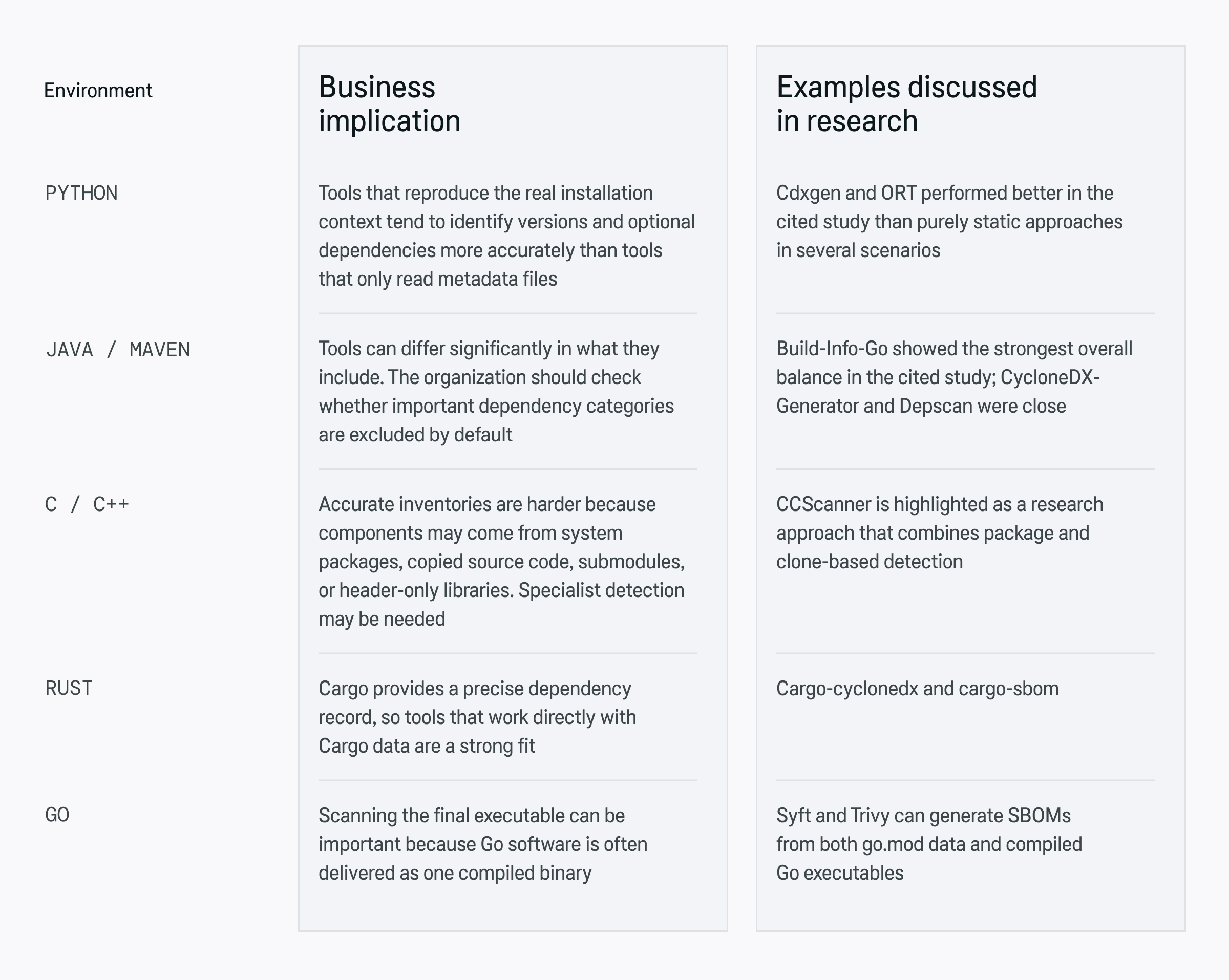
Research shows that SBOM quality varies by programming language and build environment. The most dependable results generally come from tools that use the same dependency information as the software’s own build or package-management process, rather than relying only on broad scanning or file metadata.
Use research as guidance, not as a substitute for testing
Academic studies are valuable because they compare tools using repeatable methods and measurable criteria such as completeness, precision, and consistency. They also help explain why a tool may work well in one software environment and less well in another.
However, most academic studies focus on open-source tools because researchers can access them and repeat the experiments. Proprietary platforms are harder to compare independently because their implementation is closed and licensing can limit testing. Vendor material, industrial reports, and demonstrations can still be useful, but they are often based on a specific environment and may not represent the organization’s own software estate.
Practical selection process
As the choice of SBOM tool is not solely a technical decision, it is important to evaluate solutions against real operational, security, and compliance requirements. The following six-step process translates the technical findings into a business decision path:
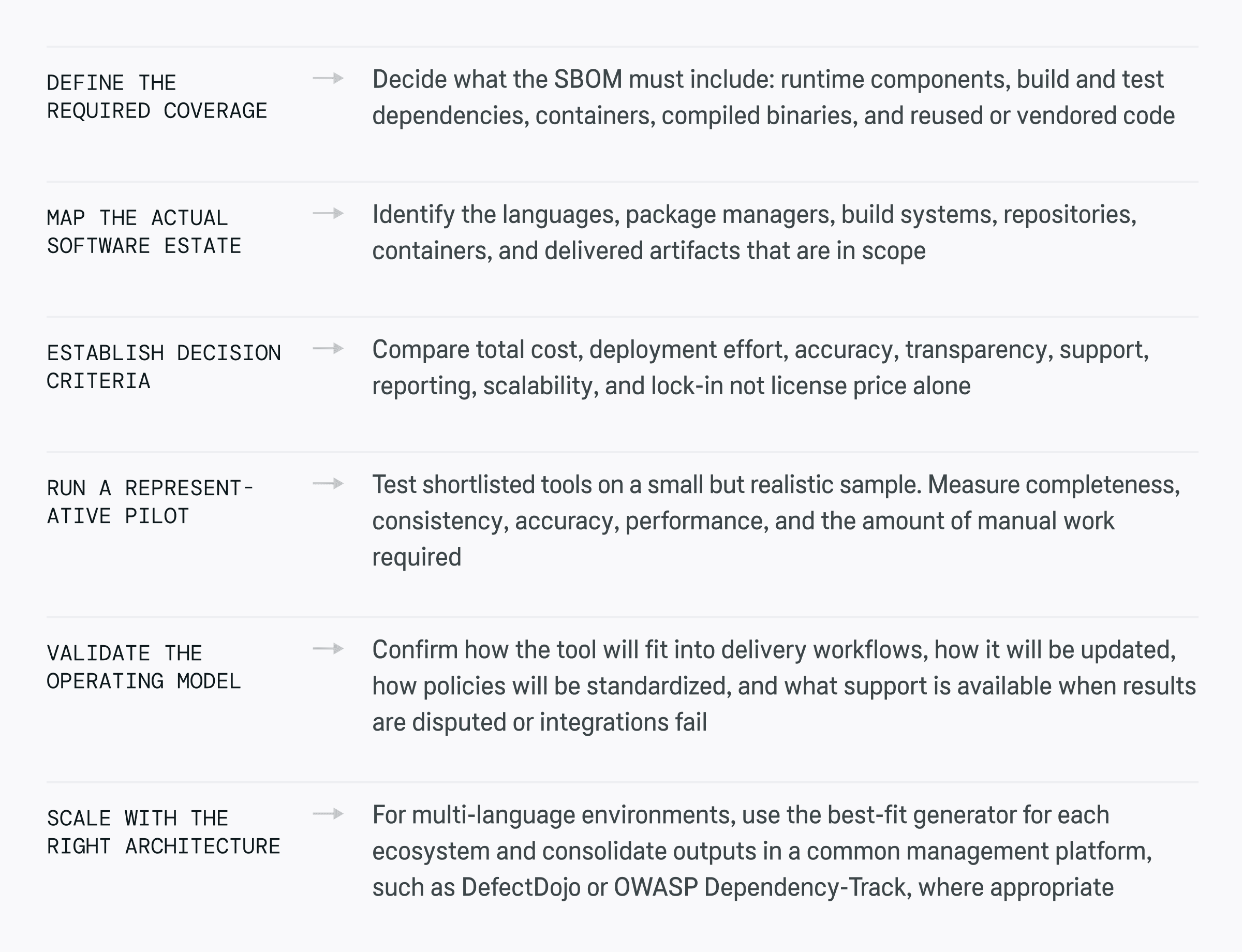
The goal is not to find the best tool, but to establish an approach that produces reliable, explainable, and actionable results over time. This way, your SBOMs could support decision-making across security, engineering, compliance, and risk management functions, creating value well beyond regulatory requirements.
If you assess SBOM tools, prepare for Cyber Resilience Act (CRA) obligations, or are looking to strengthen software supply chain security, contact our team. Our experts will help you select the right tooling, streamline implementation, and establish an SBOM program that aligns both with your compliance requirements and business goals.