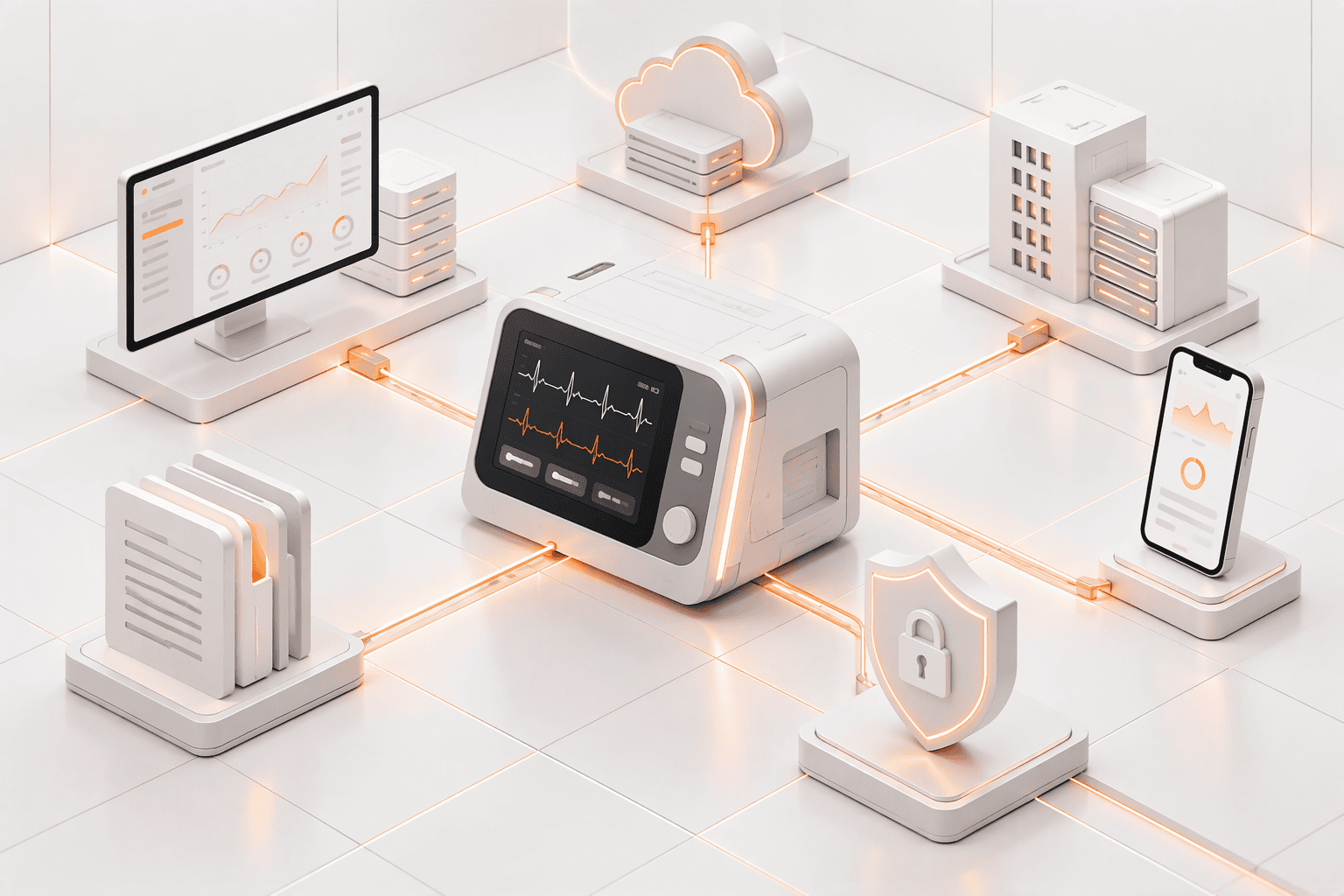
Running a clinical trial generates a staggering amount of specialized information. From the moment patient screening begins to the final regulatory submission, every single phase of drug development creates data points that need careful tracking, secure storage, and rigorous analysis. In theory, all of this information should flow naturally into a central hub, giving your clinical operations team the ability to monitor trial progress as it happens. If you are a technology leader in the biotech space, you know that this is rarely how things actually work.
The Root Causes of Disconnected Systems
Why Data Fragmentation is a Critical Business Risk
Architecting a Unified Clinical Data Layer
A Step-by-Step Guide for Biotech Technology Leaders
Instead, data fragmentation is the default reality for most organizations. Your critical clinical, operational, and commercial data likely live in completely separate software silos. For instance, an electronic data capture (EDC) platform might hold your patient case report forms, while a separate clinical trial management system (CTMS) tracks investigator payments and site performance metrics. Because these systems rarely communicate right out of the box, your research teams are left dealing with severe operational bottlenecks.
Fixing this disconnected infrastructure is not just a standard IT cleanup project; it is an urgent business priority. This article breaks down exactly why these data silos form, how they actively delay trial timelines, and what engineering steps your team needs to take to build a truly unified clinical data architecture.
The Root Causes of Disconnected Systems
Biotech companies naturally buy specific tools to handle very distinct phases of research. At first glance, this approach makes total sense. Your team absolutely needs an EDC to collect trial data securely. You need a laboratory information management system (LIMS) to track complex biological samples. You also might rely on a quality management system (QMS) just to keep up with compliance tracking.
The catch is that you are buying these tools from entirely different vendors. Software providers design their products with proprietary databases and highly unique export formats. A data file downloaded from your EDC will rarely match the formatting of a file exported from your safety database. Without a dedicated data integration layer sitting in the middle, these applications remain entirely isolated from one another.
Adding external partnerships makes the situation even more complicated. Most biotech sponsors outsource their clinical operations to multiple contract research organizations (CROs). Every CRO brings its own preferred technology stack and working habits to your project. When external laboratories run specialized biomarker testing, they hand over data in yet another unique format. The sheer variety of incoming data structures creates an immediate, heavy barrier to rapid analysis.
Rapid company growth also plays a huge role in the problem. As biotech firms advance from early clinical stages toward commercialization, they tend to scale up their operations faster than their IT infrastructure can support. Sometimes, they inherit legacy systems through mergers. Very quickly, IT departments find themselves supporting a messy patchwork of incompatible applications.
Why Data Fragmentation is a Critical Business Risk
Leaving your clinical systems disconnected is a massive operational risk. It directly impacts the speed, safety, and financial stability of your entire development program.
Slow Operational Decisions
Trial managers desperately need constant visibility into site performance. Think about it: if the metrics required to evaluate patient enrollment rates require manual extraction from three different platforms, the resulting reports are completely outdated by the time they are generated. Sponsors simply cannot fix underperforming trial sites quickly if they cannot see the problem happening in real time.
Stalled Artificial Intelligence Initiatives
Many clinical-stage biotech companies are actively building internal AI and ML capabilities from scratch. They want to deploy machine learning operations (MLOps) on platforms like Databricks to optimize patient recruitment or predict trial risks. However, AI models require clean, structured, and normalized data to function properly. A stalled AI initiative is almost always just a data fragmentation problem in disguise. Teams cannot build an AI-ready environment if their underlying clinical systems are not integrated first.
Read about: Where AI Actually Works in Biotech
Cybersecurity and Vendor Dependency Risks
Fragmented systems drastically expand your attack surface. Biotech companies face significant cybersecurity risks from handling patient health information across multiple disconnected SaaS platforms. When your organization relies heavily on unintegrated third-party vendors, you take on active IT dependency risks. A security incident at a single third-party vendor can completely halt clinical operations and impact revenue.
High Labor Costs and Manual Errors
When software systems do not connect automatically, human beings have to bridge the gap. Highly skilled biostatisticians and clinical data managers spend countless hours manually matching data sets in massive spreadsheets. This kind of manual reconciliation is an incredibly expensive waste of talent, and it dramatically increases the risk of basic transcription errors.
Complex Regulatory Compliance
The biotech sector operates in a strict multi-GxP environment, requiring exact alignment with standards like FDA 21 CFR Part 11 and EU Annex 11. Regulatory agencies demand complete, transparent audit trails. Proving the exact origin of a data point is incredibly difficult, if not impossible, when that information has been copied and pasted manually between an EDC and an analytics dashboard.
Need professional help with building custom biotech software?
Architecting a Unified Clinical Data Layer
To fix this problem, IT teams need to shift how they view enterprise software. Instead of looking for a magic bullet software vendor that does everything, biotech companies must build a central data integration layer. The ultimate goal is to connect fragmented SaaS clinical systems into a governed data environment.
Establishing the Central Repository
The very first step involves deploying a modern data warehouse or data lake. Platforms built on Snowflake, Databricks, or Microsoft Fabric provide the massive storage capacity needed for clinical datasets. This central repository acts as the single, reliable destination for all operational and clinical information.
Building Automated Data Pipelines
Next, engineering teams build automated data pipelines to connect those disparate systems. Using custom API connections or industry standards like HL7 and FHIR, these pipelines extract information from platforms like Medidata, Oracle, and Veeva. This extraction process happens automatically on a set schedule, completely replacing the need for manual CSV file downloads.
Data Normalization and Governance
Raw data is rarely usable right away. The engineering pipelines must normalize the variables in transit. For example, if one clinical site measures patient weight in pounds and another uses kilograms, the pipeline automatically converts all values to a single standard. The integration layer also forces internal data to align with the Clinical Data Interchange Standards Consortium (CDISC) formats, which are strictly required for regulatory submissions.
A Step-by-Step Guide for Biotech Technology Leaders
Overhauling your clinical infrastructure requires very careful planning. Moving too fast can easily disrupt your ongoing trials. IT directors and CTOs should follow a methodical implementation process to ensure things go smoothly.
Step 1: Map the Technology Stack
Start by identifying every single piece of software currently touching your clinical or operational data. Document the vendor, the hosting environment, and the specific department responsible for the tool. Do not ignore smaller tools like individual site survey platforms or specialized lab reporting software.
Step 2: Identify Manual Bottlenecks
Get out of the IT department and speak directly with the clinical operations team. Find out exactly where they spend the most time reconciling spreadsheets. These specific manual tasks highlight the integrations that will deliver the fastest return on investment for your business.
Step 3: Define Systems of Record
Clearly establish which platform serves as the absolute source of truth for specific data categories. Your EDC should be the system of record for patient responses. Your CTMS should be the final authority on site budgets. Setting these hard boundaries stops contradictory data from overwriting your correct records.
Step 4: Execute a Controlled Pilot
Do not attempt to connect all of your systems at once. Pick two platforms that currently require heavy manual data entry, such as the connection between a Veeva CRM and your clinical data outputs. Build the API connection, apply your data governance rules, and test the flow with a small, controlled subset of trial data.
Step 5: Perform Compliance Validation
Any piece of software touching clinical data requires strict validation. Teams must conduct thorough Computer Software Assurance testing to prove the system works exactly as intended. This includes running Installation Qualification (IQ), Operational Qualification (OQ), and Performance Qualification (PQ) protocols. You must prove to auditors that the data integration layer maintains FDA 21 CFR Part 11 compliance during automated transfers.
Step 6: Deploy and Monitor
Once validation is complete, you can push the integration out to the production environment. Provide hands-on training to the clinical staff so they know exactly how to access the newly unified dashboards. Finally, set up automated alerts to notify the IT team instantly if an API connection drops or if incoming data fails to meet your quality standards.
Need professional help with building custom biotech software?
Infrastructure Assessment Checklist
Technology leaders can use this checklist to quickly evaluate their current data environment and spot immediate gaps.
- Are your biostatisticians spending more than five hours a week cleaning and formatting data manually?
- Does your team rely on exporting CSV files to move information between your EDC and your analytics tools?
- Do you have active, documented IT security audits and third party vendor risk assessments in place?
- Is your underlying data infrastructure clean enough to support your planned AI or machine learning initiatives?
- Have all current systems managing clinical data passed rigorous GxP validation procedures?
- Does your current architecture provide a complete, unbroken audit trail from the point of data entry to the final reporting dashboard?
- Are you struggling to integrate SaaS platforms like Medidata, Oracle, or Veeva with your internal operational databases?
Deep Domain Expertise in Healthcare Software
Specialized Healthcare Engineering
Building data infrastructure in the highly regulated biotech sector requires highly specialized knowledge. Generalist IT approaches often fail here because they simply do not account for strict clinical compliance standards or the daily realities of trial operations. Sigma Software Group operates as a specialized partner for clinical-stage and commercial biotech companies. We help organizations solve the specific technical challenges of data fragmentation. We start every single engagement with a structured discovery phase. This means we sit down with your team to map your exact IT systems, assess your compliance gaps, and deliver a detailed engineering roadmap before we write any code. Consequently, we focus entirely on outcome-based delivery, ensuring that our technical work directly removes manual labor from your clinical operations.
Deep Clinical Platform Integration
Our engineers possess deep clinical platform experience. Specifically, we actively work across Medidata, Oracle, Veeva, Databricks, Snowflake, and AWS environments. This domain knowledge allows us to design unified architectures that normalize outputs from multiple EDC platforms into a single governed environment.
Strict Compliance and Quality Assurance
When it comes to compliance and quality systems engineering, our delivery model inherently reduces regulatory risk. Furthermore, we are fully ISO 13485 and ISO 27001 certified. We actively manage GxP system validation, provide CSV engineering support, and deliver FDA 21 CFR Part 11-aligned implementations.
Advanced Analytics and Machine Learning
For teams looking toward advanced analytics, our global AI Center of Excellence provides production-ready machine learning capabilities. Supported by 2,600 engineers across 15 countries, we deliver the structured MLOps pipelines and AI-ready datasets that make predictive clinical analytics possible. As an example, we built the RITA patient recruitment platform for AstraZeneca, connecting multi source clinical data to automate eligibility screening and reduce recruitment cycle times. Ultimately, by addressing cybersecurity exposure, integrating fragmented software, and validating your data environment, we ensure your technical infrastructure actually accelerates your research.
Need professional help with building custom biotech software?