5% of organizations have already proven this is possible. This article is about what they built that the other 95% haven’t, and why it is a mindset, not a methodology. Across this research series, we have explored why so much AI investment still stops short of the customer. The final question the data leaves open is not what the 5% are building, but why they are building it differently. The answer is not a new technology or a better framework. It is a mindset.
Organic AI is what happens when an organization stops treating AI as something you implement and starts treating it as something you build around the customer. Not a project. Not a pilot. An operating decision about where AI belongs in the organization’s relationship with the people it serves.
This is the perspective we have been developing at Sigma Inspire, part of Sigma Software Group. Across the Group, we work with AI from different angles, bringing together business transformation, customer experience, AI expertise, and technology implementation. At Sigma Inspire, we look specifically at what happens when those capabilities reach the customer: whether AI actually changes the experience and creates value for the people an organization serves.
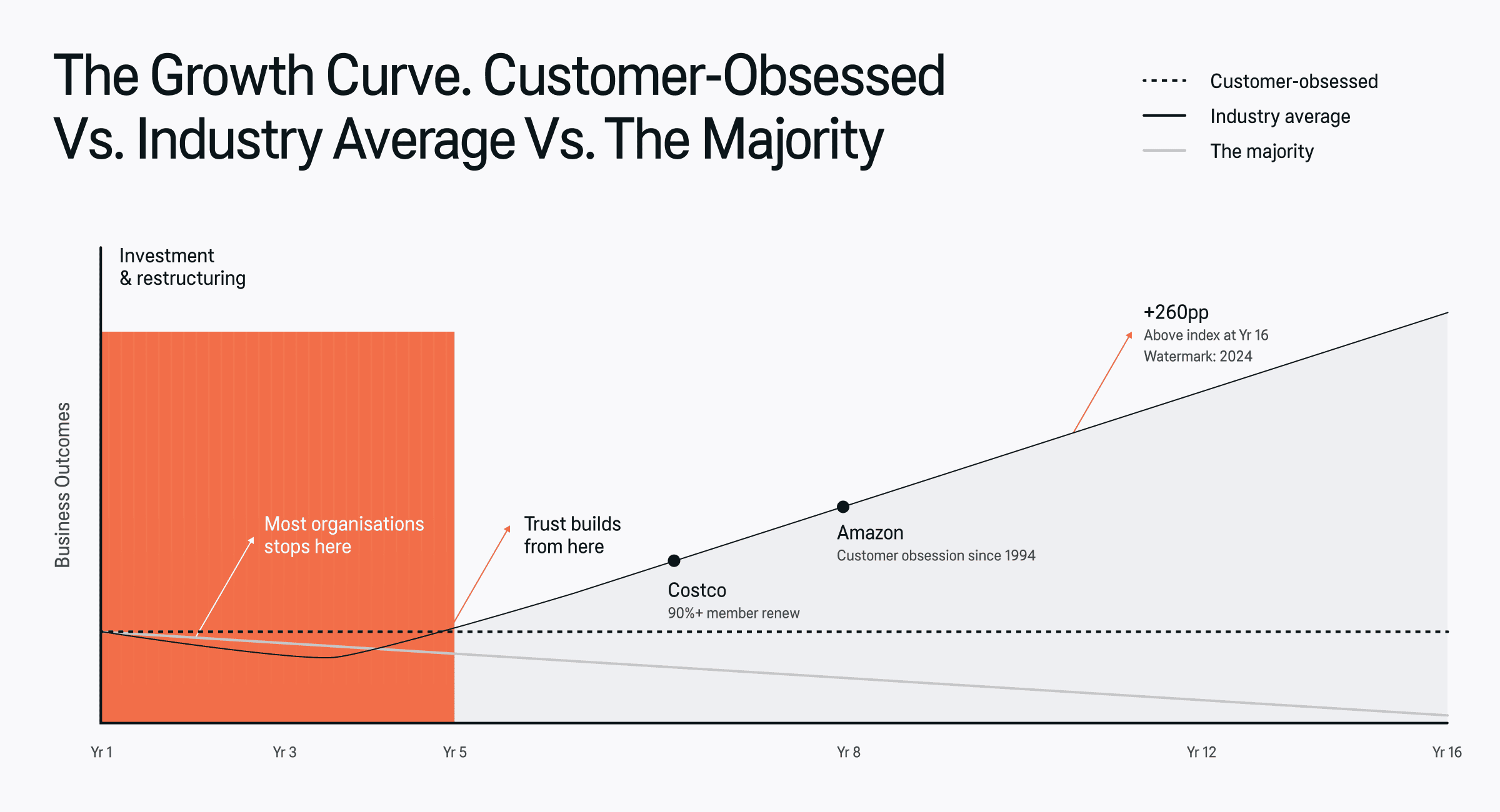
The data is unambiguous. Organizations that build genuine customer obsession deliver 260 percentage points above S&P 500 cumulative returns over 16 years. They grow revenue 1.7 times faster and generate 3.6 times the total shareholder returns of their industry peers. 5% of organizations have already built what it takes to reach that curve. The rest have the same opportunity in front of them.
What the data also reveals, and what most conversations about customer obsession miss, is that the journey has a shape. It is not a straight line upward from Year 1. There is an investment phase first: a period where you restructure how the organization works, sharpen how decisions get made, embed AI in ways that actually reach the customer, and build the measurement infrastructure to know whether the work is landing. This phase builds before it returns. The organizations that stay in it long enough reach a growth curve that competitors cannot replicate, because by then the loop is running and reinforcing itself.
The Five Qualities of an Organic AI Organization
These five qualities are not a checklist. They are what we observed in every organization that has moved from the 95% into the 5%. Some have all five at full strength. Most have two or three strongly, and the rest are where the gap lives. What they share is that when all five are present together, AI stops being an internal capability and starts being something the customer can feel.
Customer Distance / They aimed at the customer, not the process.
Most organizations deploy AI where it is technically feasible: where the team has capacity, the data is cleanest, or the use case is most controlled. The 5% start with a different question. Where does AI touch the customer, and where doesn’t it? Every customer interaction that AI could improve but doesn’t is a trust signal left unreturned: a reason to stay that the customer never received. The organizations that built Organic AI made closing this distance the primary directive, not an aspiration for the next planning cycle.
Need professional help with building Organic AI?
Business Impact Potential / Every decision through the same three questions. Customer first, every time.
DVF Thinking is the decision engine that keeps every initiative anchored to what actually matters. Every decision moves through three lenses: Desirability, what customers genuinely need; Viability, what the business can sustain; and Feasibility, what technology can reliably deliver.
The natural tendency in most organizations is to start from Feasibility. What can the technology do? What does the platform support? What can we ship by Q3? Applying DVF with customer obsession at the centre inverts this. Desirability leads. The question is always: is this something a real person, in a real moment of their life, would find genuinely valuable? Viability follows. And Feasibility comes last, because in an organization built around the customer, technology should answer to the human need, not the other way around.
Process Clarity / They owned the process before they ran the AI.
AI cannot do clean work in a messy process. Every organization that has deployed AI into a customer-facing process and seen it underperform shares one structural characteristic: the process the AI was asked to support was not clear before the AI arrived. Who owns the decision? What does a good outcome look like? Where does human judgement take over from the model? The 5% answered these questions before they wrote a line of code. Process clarity is not preparation for AI implementation. It is the precondition for AI value. Without it, deploying faster is not an advantage. It is a more expensive route to the same failure.
AI Readiness / They built AI that fits the journey, not beside it.
This is the most visible difference between AI as a pilot and AI as an operating model. In most organizations, AI sits parallel to the customer experience, processing and predicting inside the organization while the customer experience continues on a separate track, largely unaffected. The 5% made a different architectural and design decision: the AI was built to live inside the moments that shape what customers feel, not adjacent to them.
That requires different thinking about integration, latency, failure states, and what deployment means when a real customer is on the other side. AI readiness in a customer-facing context is not a question about model accuracy. It is a question about whether the system can operate at the moment it needs to: reliably, consistently, and in a way that fits how the customer actually moves.
Data Readiness / They fed it intelligence, not just data.
Data is raw material. Intelligence is what customer-facing AI needs. The 5% were deliberate about what they put into their AI: not every data point available, but the right signal, at the right resolution, governed and available at the moment the AI needs it.
Customer-facing AI fails when it is trained on what is easy to collect rather than what is relevant to the interaction. AI data readiness is not a question about storage or pipelines. It is a question about meaning: does your AI have what it needs to produce a result the customer would recognise as relevant? The 5% treated this as a design decision first, and an infrastructure project second.
What Becomes Possible
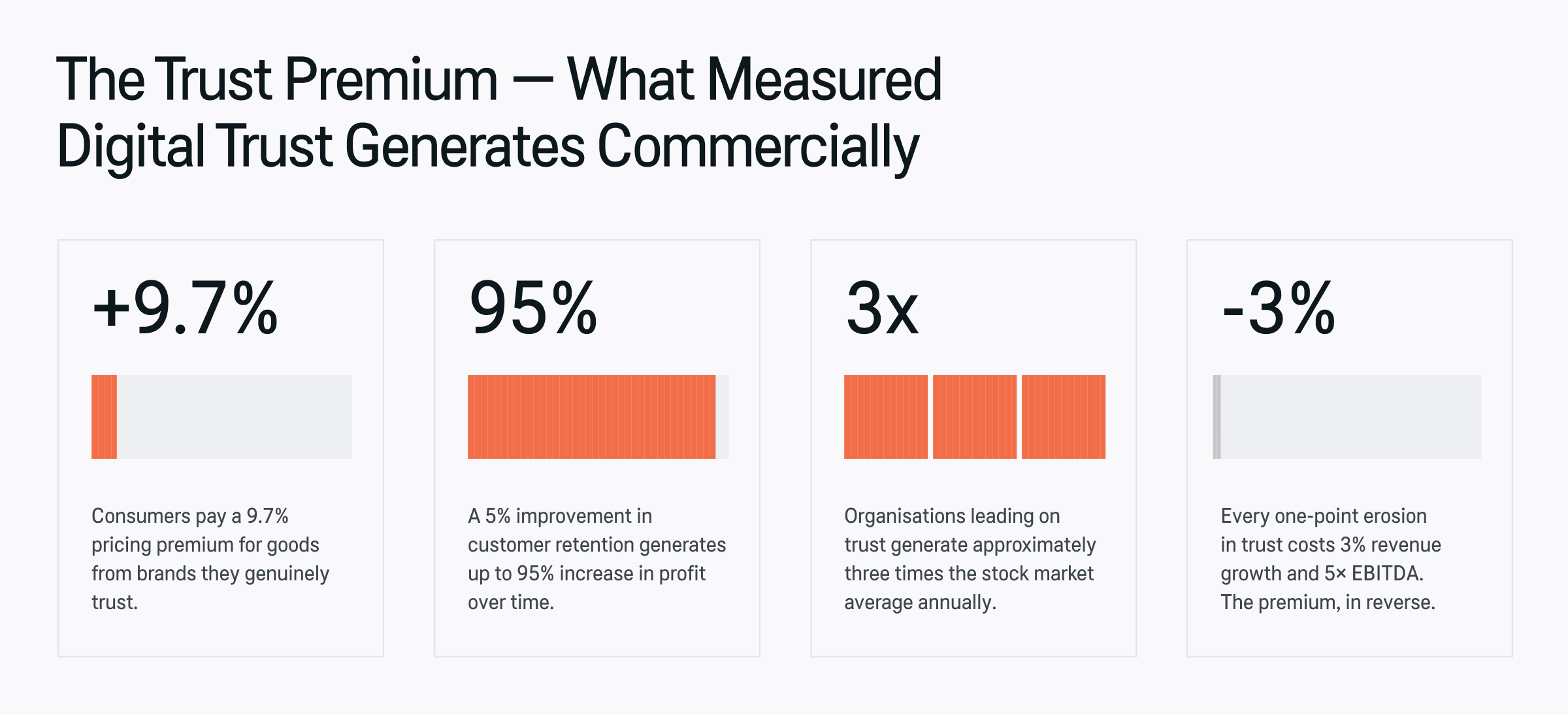
The commercial evidence for this is not marginal. Organizations that build measurable digital trust generate a different category of commercial outcome. Not a percentage point better. Structurally different. Here is what the data shows organizations that get the sequence right are achieving.
Your Organic AI Starting Point
Every organization that built Organic AI started from a different place. Different industry, different data maturity, different distance between their AI and their customer. The five qualities are not a sequence where you must begin at one and end at five. They are a diagnostic: a way of seeing clearly where the gap actually lives in your specific context, and which quality, addressed first, would start the whole thing moving.
Most organizations reading this already have meaningful capability across at least two or three of these qualities. What they often lack is the honest picture of which quality is holding the others back. That clarity changes everything about where to invest next. The organizations that have closed the gap found their starting point faster than they expected, because the evidence was already there. It just had not been read the right way.
Organic AI is not a destination. It is a decision about where AI belongs in your organization’s relationship with the people it serves, and which quality to build first. — Bruno Perez, Chief Experience Officer & AI Strategy, Sigma Inspire
That is what the Sigma Inspire Organic AI Assessment is designed to surface. Across the same five areas, it brings together key stakeholder perspectives to give organizations a clear, evidenced picture of where their AI stands in relation to the customer today, which quality to address first, and where to start.
Organic AI Assessment
The Organic AI Assessment turns the five qualities into a practical diagnostic for your organization. It uses ten questions across the five areas to establish where you stand today and where to focus first.
The process starts with a 30-minute preparation call, followed by a focused four-hour working session with key stakeholders. Over the next five days, Sigma Inspire synthesizes the findings into three clear outputs: your Organic AI Score, your Starting Point, and a First-Phase Direction for moving forward.
Would you like to discuss Organic AI Assessment for your organization?
Contact our AI Transformation team about the right starting point for your teams.
Explore the Organic AI Series
This article is part of the Organic AI Perspectives series, exploring why AI investment so often stops short of the customer and what organizations that close that gap do differently.
The extended version of this chapter on Medium also examines how six organizations put different parts of the Organic AI model into practice:
- Apple, where AI is designed into the experience rather than presented as a separate feature.
- Costco, where technology supports a deliberately consistent customer proposition rather than redefining it.
- Amazon, where AI is embedded throughout the customer journey and operating model.
- Nubank, which has built AI into a digital-first model serving customers at scale.
- Cleveland Clinic, where AI is applied within a high-stakes healthcare environment while keeping the patient experience at the center.
- Lululemon, where customer understanding and community remain central as digital and AI capabilities evolve.
Together, the cases show that Organic AI does not produce one operating model. The way it takes shape depends on the customer proposition, the organization, and the context.
- Chapter 1: AI is Everywhere. But Is It Working? – read the full version on Medium
- Chapter 2: The AI Last Mile Problem – read the full version on Medium
- Chapter 3: What Organic AI Looks Like – read the full version on Medium
- Chapter 4: Organic AI is a Mindset — read the full version on Medium
Sources
- Watermark Consulting, Customer Experience ROI Study, 2024 – CX leaders vs. laggards, 16-year S&P 500 tracking (+260pp outperformance).
- <u”>BCG, Customer-Obsessed Companies Outperform, 2025 – 1.7x revenue growth, 3.6x TSR over 16 years.
- Forrester, State of Customer Obsession, 2022 – fewer than 5% of companies are genuinely customer-obsessed.
- McKinsey, Unlocking Success in Digital Transformations, 2018 – 16% full success rate; culture as primary barrier.
- Microsoft Work Trend Index, 2026 – 67% of AI value is organisational, not technological.
- Accenture, To Affinity and Beyond, 2018 – 1pt trust decline -3% revenue growth, -5% EBITDA growth; $180B forfeited.
- PwC Consumer Intelligence Series, 2024 – 9.7% pricing premium for trusted brands.
- Bain & Company, The Loyalty Effect – 5% retention improvement up to 95% profit increase.
- Fred Reichheld, Harvard Business Review, Winning on Purpose, 2021 – NPS leaders generate ~3x market average returns.
- McKinsey Design Index, 2018 – top-quartile design companies: +32pp revenue growth, +56pp TSR vs. peers.
About Sigma Inspire
Sigma Inspire is an independent Customer Obsession Boutique within Sigma Software Group. It connects customer insight, product strategy, experience design, data, AI, and delivery to help organizations turn customer understanding into meaningful experiences and measurable business growth.
About Sigma Software Group
Sigma Software Group is a global technology company with more than 2,000 specialists operating across 20+ countries. The Group combines technology consulting, software engineering, AI expertise, and industry knowledge to help organizations move from business challenges and transformation strategies to implementation at scale.
Together, Sigma Inspire and Sigma Software Group connect customer and business transformation with the technology capabilities required to deliver it.