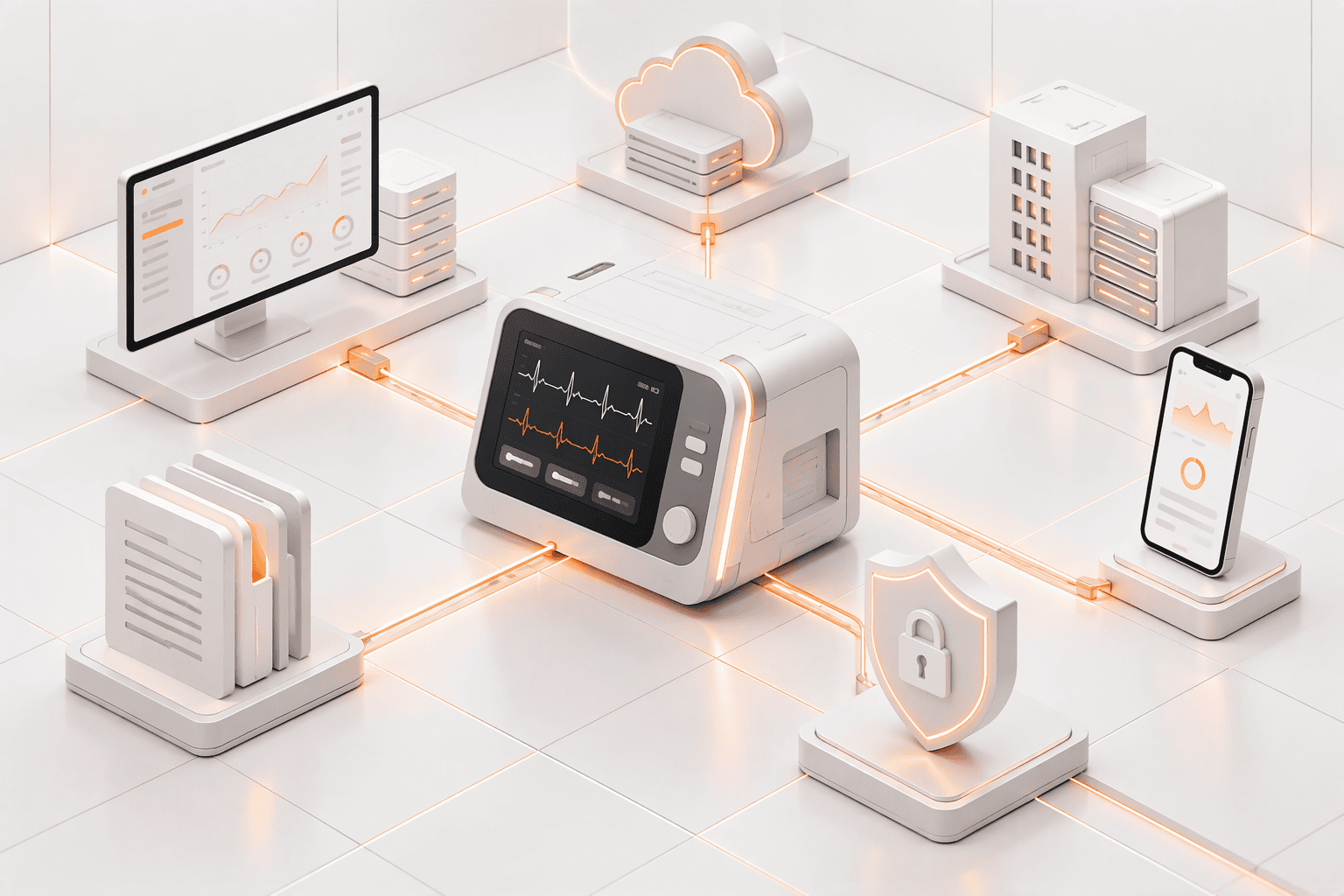
Building a great physical medical device is no longer enough to stand out in the highly competitive US market. Physical sensors, batteries, and microprocessors are largely commoditized. Today, your medical device's real intelligence, reliability, and competitive advantage live entirely in its software and connectivity infrastructure.
The Reality of Disconnected Fleets: 5 Critical Pain Points
Architecting for Reliable Medical Device Connectivity
Identity, Security, and FDA Compliance
Yet building a working physical prototype is only the first step. The real engineering headache begins when you deploy that device into a patient’s home or a busy American clinical environment.
Analysts project the global medical device connectivity market to grow to over $20 billion by 2035, with the United States driving the vast majority of that adoption. This massive capital influx proves one thing. Healthcare providers no longer want isolated hardware. They demand connected ecosystems.
Traditionally, medical devices functioned in complete isolation. They recorded a heartbeat, triggered an alarm, and immediately threw the contextual data away. Modern software-defined products reverse this completely by tracking patient data longitudinally. However, bridging the gap between a standalone piece of hardware and a securely connected, remotely managed fleet requires highly specialized engineering.
When manufacturers try to bolt connectivity onto legacy hardware without a solid architectural strategy, they run into massive operational roadblocks. We are talking about unpatched security flaws, overwhelmed technical support teams, and fragmented device ecosystems. As a custom software development company serving MedTech innovators across the United States, we help manufacturers build the cloud backends, embedded firmware, and companion apps needed to turn isolated hardware into intelligent, highly manageable fleets.
The Reality of Disconnected Fleets: 5 Critical Pain Points
Before we talk about the solutions, we need to look at why first-generation smart devices fail. Treating a connected medical device like a standard consumer gadget always leads to these five critical business constraints.
1. The Version Management Nightmare
You have thousands of devices in the field across different states, but no centralized cloud registry telling you which software version is running on which unit. Because hospital IT teams in different healthcare networks delay updates and patients ignore app notifications, your fleet fragments. Supporting this mess causes your software engineering costs to skyrocket. Your team is forced to ensure backward compatibility across dozens of old firmware versions, which brings new feature development to a grinding halt.
2. The High Cost of Blind Diagnostics
Without remote diagnostics, a device failure is a total black box. If an infusion pump malfunctions in a New York ICU, or a continuous glucose monitor stops syncing at a patient’s home in rural Texas, your support team has no technical data to find the root cause. Because of this, every reported fault requires you to ship a replacement unit or send out a field service engineer. With commercial field visits in the US costing anywhere from $300 to over $1,000 per incident, blind diagnostics will rapidly eat your profit margins.
3. Bluetooth Friction and the Support Call Avalanche
Connectivity is supposed to make patient care easier. But poorly designed onboarding workflows do the exact opposite. Bluetooth pairing issues routinely generate the absolute largest share of technical support calls for MedTech companies. In the consumer world, a failed Bluetooth connection is annoying. In healthcare, it is a strict barrier to prescribed therapy. When elderly patients or overworked nurses struggle to pair a device to a mobile app, they often abandon the hardware entirely.
4. The Security Patch Lag and Regulatory Risk
Cyber threats against US medical infrastructure are escalating at an alarming rate. In the past, pushing a security patch to a medical device meant physically visiting the hospital. Fixes took months or even years to reach vulnerable machines. Today, this delay is illegal. The FDA now strictly enforces rapid patch deployments. Without a mathematically safe way to push signed over-the-air updates, you face immediate regulatory blockades and massive product recalls.
5. Stranded Data and Missed Revenue
Device data is often treated as an exhaust byproduct instead of a core business asset. Manufacturers pay huge cloud infrastructure bills to store terabytes of telemetry, but they fail to turn that data into predictive alerts for doctors or anonymized research intelligence. This data just sits there. More importantly, disconnected devices miss out on lucrative Centers for Medicare and Medicaid Services reimbursement codes designed specifically for remote patient monitoring.
Architecting for Reliable Medical Device Connectivity
Solving these complex issues requires a multi-layered architectural approach. The goal is simple. We need to take the burden of connectivity away from the end user and place it entirely onto automated software protocols.
Picking the Right Network Protocol
Your connectivity pathway dictates your device’s power footprint, data limits, and ideal operating environment.
- Local Networks: For wearable medical devices, Bluetooth Low Energy remains the dominant standard due to its minimal battery drain. But relying on a patient’s smartphone introduces points of failure. Wi-Fi offers higher bandwidth for clinical equipment like smart imaging machines, though it demands more power and requires navigating strict hospital IT firewalls.
- Cellular IoT: When a device needs true autonomous connectivity without relying on local networks, cellular IoT protocols are mandatory. Technologies like LTE-M and Narrowband IoT provide deep indoor signal penetration and direct-to-cloud connectivity. This completely bypasses the hospital firewall, guaranteeing your engineering team uninterrupted fleet visibility from coast to coast.
Lightweight Application Messaging
Data transmission must be exceptionally lightweight to preserve battery life and ensure reliability. Message Queuing Telemetry Transport (MQTT) and the Constrained Application Protocol (CoAP) are vastly superior to traditional HTTPS for medical IoT. These protocols are built specifically for hardware with limited resources. They offer low bandwidth overhead and built-in Quality of Service levels to guarantee that critical health alerts are delivered, even over terrible cellular networks in remote parts of the country.
Frictionless Patient Onboarding
To stop the avalanche of support calls related to Bluetooth pairing, our custom software team prioritizes intuitive provisioning. We build secure, out-of-band pairing methods. Instead of forcing a patient to dig through complicated smartphone settings, we design companion apps that use fast QR code scanning or Near Field Communication (NFC) taps. The patient just taps their phone to the medical device. The software automatically exchanges cryptographic keys, pairs the hardware, and links it securely to the patient’s Electronic Health Record. This eliminates manual data entry errors and slashes your support overhead.
Read more: Medical Device Software Development: Building Products That Work Beyond the Prototype
Identity, Security, and FDA Compliance
A connected medical device is an endpoint on a highly targeted network. Device identity must start on the manufacturing floor by injecting cryptographic keys and X.509 certificates. This creates a hardware root of trust, allowing your cloud backend to mathematically verify the device before it accepts any data payload.
The regulatory landscape in the United States has completely shifted to enforce these practices. The FDA PATCH Act ended the era of deploying unmanaged medical hardware. Under current FDA rules, premarket 510(k) and De Novo submissions must include a highly detailed Software Bill of Materials and a proactive threat model.
You must prove you have the backend infrastructure to actively monitor for vulnerabilities and patch them instantly. For critical flaws that threaten patient safety, MedTech manufacturers are now expected to deploy full patches within 30 days.
Building a Secure OTA Update Architecture
A secure over-the-air update moves through three critical stages. If any stage is compromised, hackers can hijack the device.
- Developers compile the new software and cryptographically sign the package using private keys locked inside a Hardware Security Module.
- The update is pushed to the device via Transport Layer Security protocols, preventing man-in-the-middle attacks from altering the software payload during transmission.
- The device’s bootloader performs strict signature verification before installing anything. If the signature is invalid, the device actively rejects the payload.
Crucially, the architecture must support partition updates. The new firmware downloads to a secondary memory partition. If the update crashes, the device automatically rolls back to the known good primary partition. This guarantees your medical device is never permanently disabled in the field.
Need professional help with building medical device software?
Fleet Operations: Eliminating the Truck Roll
Once your device is securely connected and capable of receiving updates, the focus shifts to operational intelligence. Smart fleet management software provides a centralized cloud dashboard that gives your team absolute, real-time visibility over every single unit deployed nationwide.
Continuous Telemetry Monitoring
Fleet management platforms continuously ingest technical telemetry. This is entirely separate from patient health data and does not violate HIPAA regulations. Technical telemetry tracks battery drain rates, memory spikes, CPU load, and wireless signal strength. By analyzing this operational intelligence, you can execute highly accurate predictive maintenance. If the dashboard shows a specific batch of smart monitors draining batteries too fast, your team can write a firmware optimization and push a patch before a single patient experiences a device failure.
Remote Diagnostics
When a fault does happen, remote diagnostics drastically reduce logistical costs. Instead of forcing a nurse to read a complex error code over the phone or flying an engineer across the country, your support team can securely tunnel into the device from their desks. They can pull error logs, reboot crashed microservices, and reconfigure settings in real time. Resolving software issues remotely increases device uptime, builds clinical trust, and protects your profit margins from absurd field service expenses.
Turning Smart Device Data Into Business Value
The final goal of connectivity is data monetization and clinical value creation. Moving from standalone hardware to software-defined products allows your business to shift from one-off capital expenditure sales to highly lucrative, recurring revenue models.
Creating Clinical Intelligence
Raw data streams overwhelm doctors. If a smart ECG just dumps thousands of raw heart rate data points into a patient chart, the physician will ignore it due to alert fatigue. Custom software bridges this gap by applying machine learning algorithms at the edge or within a HIPAA-compliant cloud backend. These algorithms analyze the data against historical baselines to generate predictive alerts. They can notify a care team of an impending cardiac event days before the patient physically feels sick. US hospitals will gladly pay subscription fees for these insights because the Affordable Care Act heavily penalizes facilities for high readmission rates.
Generating Real World Evidence
On a broader level, the aggregated and strictly anonymized data from your deployed devices creates Real World Data. You can analyze this massive dataset to generate Real World Evidence. Instead of funding incredibly expensive clinical trials to prove a therapy works, you can utilize post-market surveillance data directly from your connected fleet. The FDA increasingly relies on this specific evidence to grant label expansions for existing treatments, which accelerates your time to market and massively cuts research costs.
Smart Medical Device Development Roadmap
Developing smart medical device software is highly specialized due to strict US regulatory rules governing patient safety and data privacy. Engaging a custom software development partner requires a highly structured engineering approach.
- Discovery and Strategy: Define the specific intended use, map out FDA compliance standards, and establish the cybersecurity threat model early in the process.
- Architecture and Proof of Concept: Prototype the complex hardware-to-software bridge, pick the right HIPAA-compliant cloud infrastructure like AWS or Azure, and validate the connectivity protocols.
- Core Engineering: Develop the embedded firmware, build the scalable cloud backend, and design frictionless companion mobile applications to minimize onboarding friction.
- Verification and Validation: Execute rigorous automated testing to mathematically prove the software meets all functional and safety requirements for regulatory submission.
- Deployment and Monitoring: Roll out the fleet management dashboard, activate automated telemetry gathering, and execute secure provisioning.
FAQ
Why are medical device updates so critical for FDA compliance?
Following the strict enforcement of the FDA PATCH Act, manufacturers must actively monitor post-market vulnerabilities. They are expected to deploy targeted security patches rapidly, often within thirty days for high-risk flaws. Secure over-the-air updates are the only logistically feasible way to distribute these mandatory security fixes to a globally dispersed fleet without requiring highly expensive physical product recalls.
How do we solve Bluetooth pairing issues for medical devices?
The solution is moving completely away from manual operating system-level pairing. Custom companion applications should utilize out-of-band pairing methods like Near Field Communication taps or fast QR code scanning. This automates the complex exchange of security keys, making the onboarding process virtually invisible to the patient and drastically reducing support calls.
Can an existing legacy medical device be connected to a fleet management system?
Yes. Through a specialized custom software development approach, legacy devices can frequently be retrofitted for modern connectivity. By integrating an external hardware gateway or a specialized IoT bridge module, the legacy serial output is converted to modern wireless protocols. This routes historical telemetry to the cloud backend securely without altering the core regulated medical hardware.
What is the difference between clinical telemetry and operational telemetry?
Clinical telemetry is the patient’s actual health data, which is strictly protected by HIPAA regulations and routed exclusively to secure clinical dashboards. Operational telemetry is the technical health data of the hardware itself, such as battery life, processor usage, and system error logs. Fleet management software relies entirely on operational telemetry to execute predictive maintenance and remote diagnostics without ever exposing protected patient health information.
Need professional help with building medical device software?