Many mid-size and large organizations depend on at least one legacy system no one wants to touch: often 10–20 years old, with outdated documentation and engineers long gone. Any change feels like gambling. This fear, not technology, is what truly blocks modernization.
Why “AI-generated tests” usually don’t solve the legacy problem
Anatoliy Kochetov, Chief Operating Officer, Sigma Software
Maxim Kovtun, Chief Innovation Officer, Sigma Software
Sigma Software and Datuum developed a joint technology blueprint: a practical, AI-native approach to behavior reconstruction and test coverage that fits how legacy modernization actually happens — incrementally, with uncertainty, and without the luxury of starting from scratch.
Over time, legacy systems become black boxes. Technologies get deprecated, security risks grow, and experts capable of maintaining these stacks are increasingly rare. Avoiding change is not an option — but neither is betting on an expensive, one-size-fits-all platform that wasn’t built for your system’s specific quirks and history.
Why “AI-generated tests” usually don’t solve the legacy problem
A wave of tools promises the same shortcut: feed legacy code into AI, generate tests, and modernize safely. It sounds good. Until you try it.
Legacy code is rarely testable by design. Tight coupling, implicit dependencies, and hidden side effects make unit tests fragile or meaningless. AI-generated tests commonly validate the wrong things, locking in implementation details instead of real behavior. When a system already behaves incorrectly, AI simply codifies that behavior. Technical debt becomes tested technical debt.
The problem is not test quality. The problem is the starting point.
The right starting point: behavior, not code
Modernizing a legacy system doesn’t start with tests. It starts with understanding how the system actually behaves.
AI helps here, but not by generating tests from code. Instead, it reconstructs behavior from multiple signals: static artifacts (specs, confluence pages, test cases, code, configs), historical artifacts (tickets, change history), and runtime signals (logs, metrics, production traffic). These are correlated into a behavioral model that engineers review and validate before any modernization begins.
Only after behavior is reconstructed do we generate end-to-end tests that lock in observable outcomes rather than internal implementation. Tests protect what users, integrations, and downstream systems experience, not the hidden plumbing. It’s the difference between documenting every pipe in a building versus documenting what happens when you turn the tap.
How we use this approach
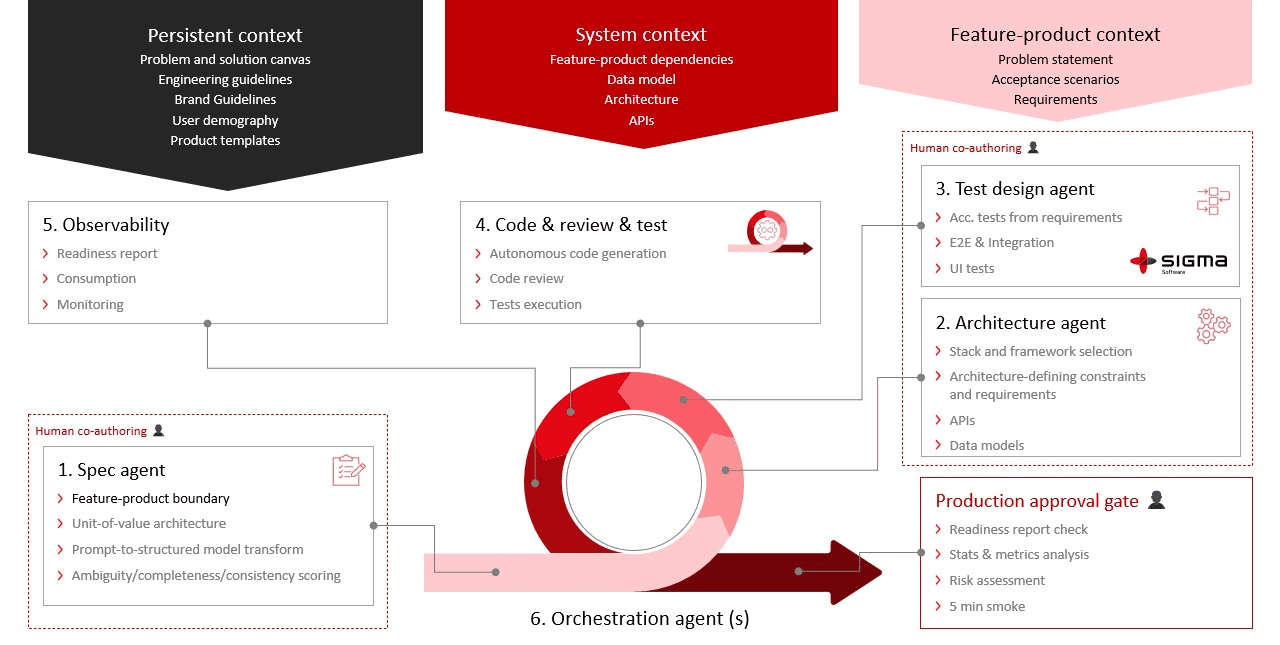
At Sigma Software, we apply this in production today. Our end-to-end test agent automates behavior reconstruction and test generation as part of AI-native, multi-agent development workflows, with confidence scoring and human-in-the-loop review built in before modernization begins.
Why this matters now and how you can act upon
Until recently, reconstructing system behavior required extensive manual analysis and tribal knowledge that often no longer existed. AI has changed that. Modern tools can reconstruct behavior from incomplete artifacts, correlate runtime signals with historical changes, and surface uncertainty with measurable confidence.
Organizations can now modernize decades-old platforms safely — without downtime, blind rewrites, or dependence on code no one fully understands.
This is part of why the partnership between Sigma Software and Datuum has become one of Sigma Software’s most sought-after AI offerings: behavior-first, AI-generated test coverage delivered as a fixed-scope engagement, a dedicated team of AI-enabled engineers, or a full transformation of customer teams toward AI-native SDLC practices.
Learn more at sigmasoftware.ai