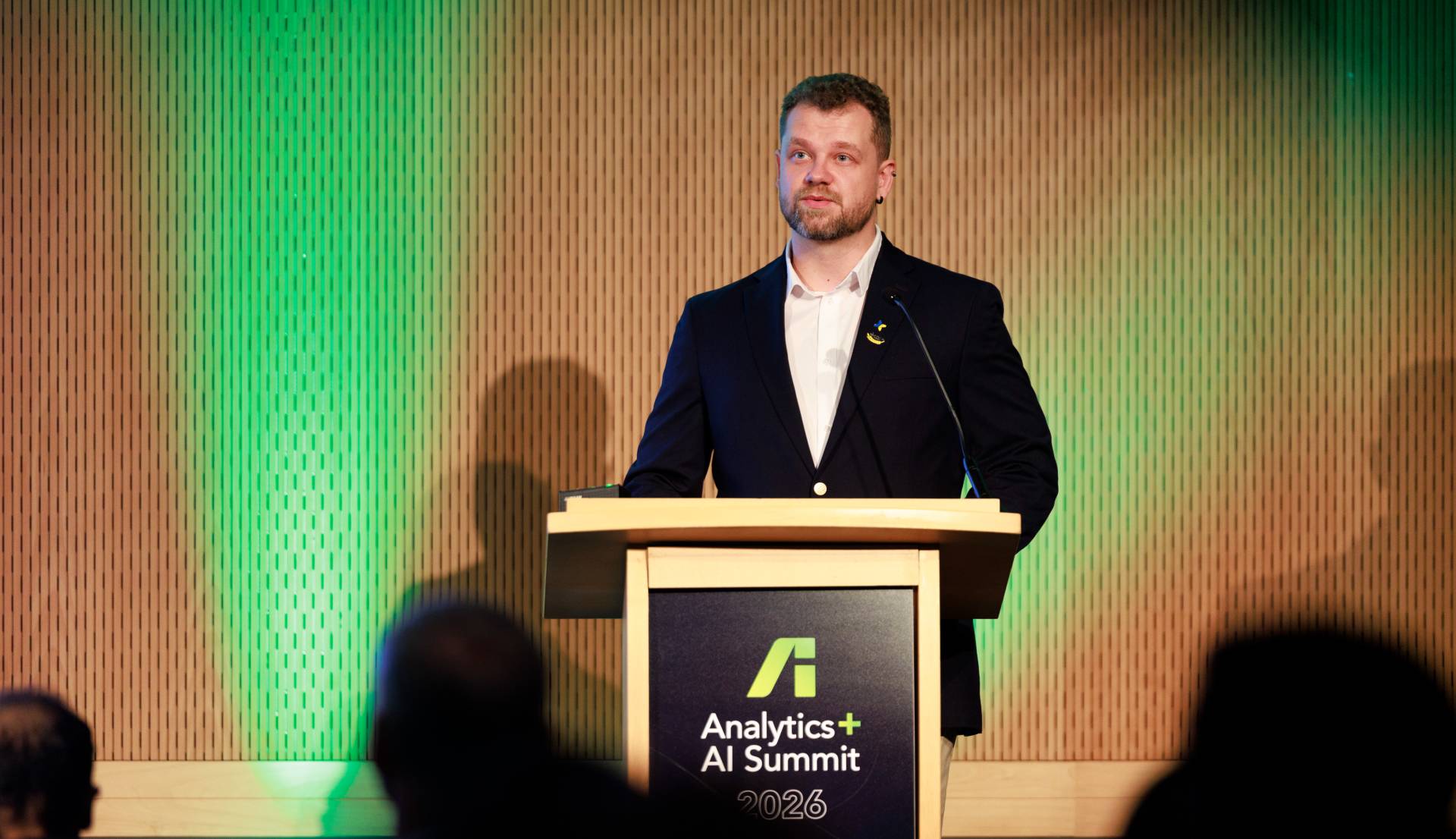
With over 25 years of experience across Europe, LATAM, and the Middle East, Bruno is a recognized expert in turning customer experience into commercial growth, with design and product leadership at BCG, Cognizant, KPMG, Fjord, and Accenture. At Sigma Inspire, part of Sigma Software Group, Bruno leads all delivery operations and created the Organic AI approach, helping businesses shift their mindset from AI as a project to AI as a value lever, and leading the full product and experience delivery practice.
Every organization knows AI works in the pilot. The question no one is answering clearly enough is why it stops before it reaches the customer. There are seven structural reasons. All of them are within your control.
AI pilots work. The much harder problem is turning them into organization-wide impact. Many organizations are actively scaling their AI budgets. Boards everywhere have made AI a strategic priority. And there is no lack of evidence that the technology works: the pilots succeed. The proof of concepts land. The demos impress.
The problem surfaces somewhere between the demo room and the customer.
This is the AI Last Mile Problem. In logistics, the last mile is the most expensive part of any delivery: getting a parcel from the regional depot to an individual household costs more per kilometre than the entire preceding journey. Scale gives way to specificity. Optimized infrastructure meets the irreducible complexity of the real world.
AI transformation has an identical structure. The technology travels well from research lab to proof of concept. It travels far less reliably from proof of concept to enterprise-wide deployment, and less still from deployment to something a customer can actually feel.
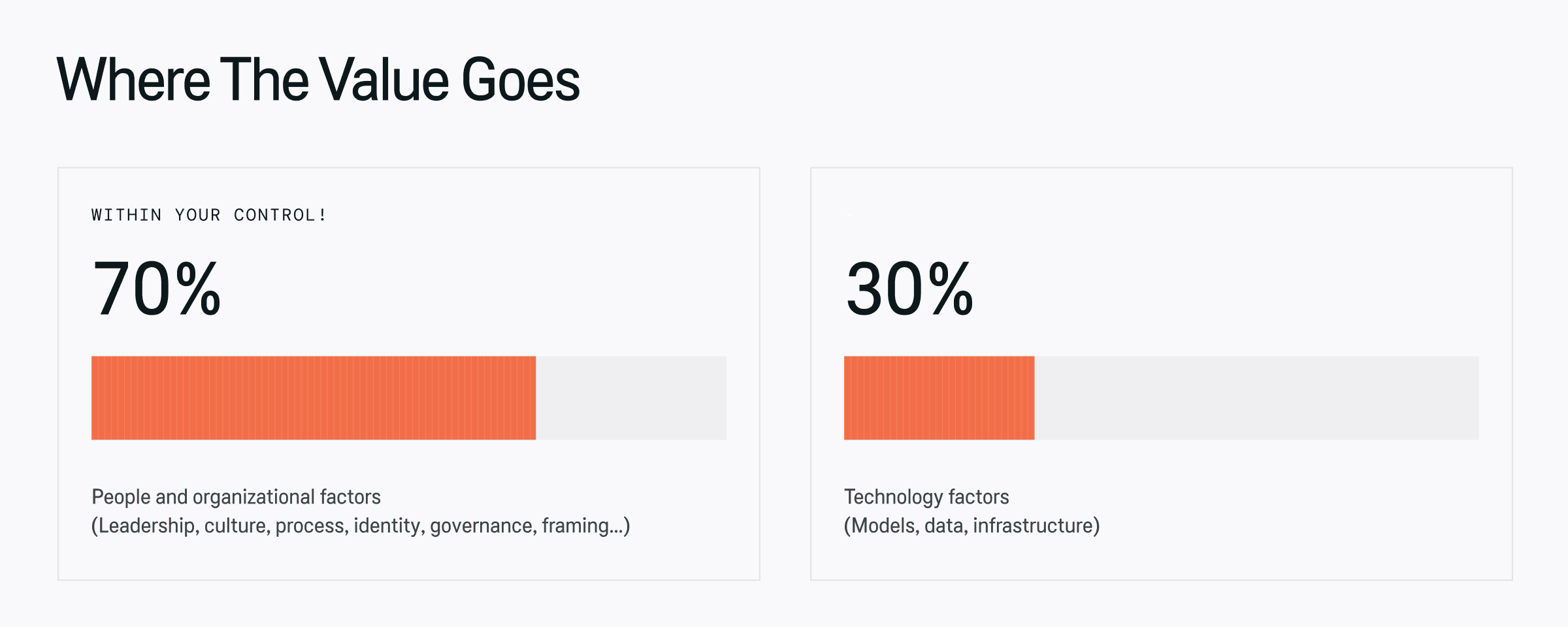
BCG’s 2026 research makes the point with unusual clarity. Sixty per cent of companies are achieving no material value from AI, despite genuine investment. Only 5% are creating substantial value at scale. And crucially: 70% of AI transformation value depends not on technology, but on people and organizational factors.
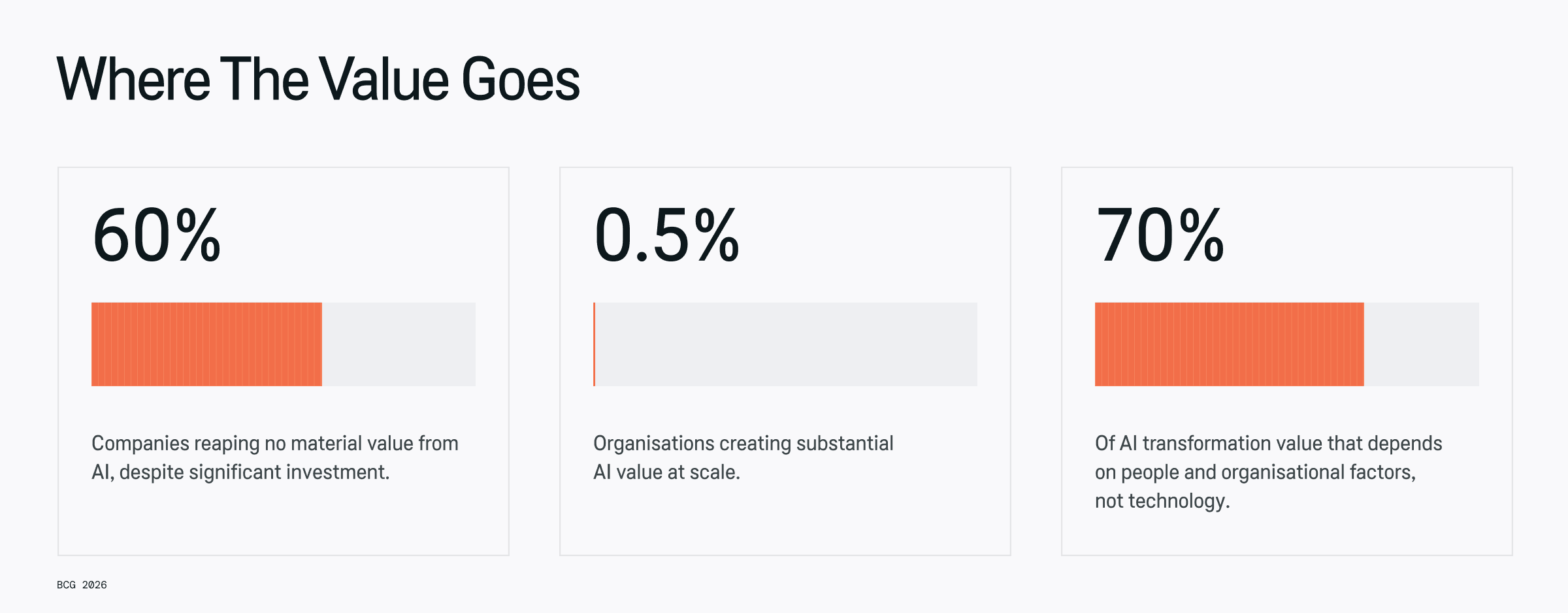
Which means the question worth pursuing is not “how do we improve the AI?” It is: what is stopping the organization from completing the last mile?
Three Layers. Seven Frictions.
Research from the Harvard Business Review, conducted through the Frontier Firm Initiative, a collaboration between Harvard’s D3 Institute and Microsoft, identified seven distinct structural frictions that prevent AI from completing the last mile. All seven are present, in varying combinations, in most AI programs that stall.
They organize into three layers: an execution layer, where the mechanics of deployment fail to convert individual gains into organizational outcomes; an organizational layer, where the people and process structures of the business actively resist; and an ambition layer, where leadership decisions, often made with the best intentions, inadvertently narrow the scope of what AI is allowed to become.
Execution Layer
The execution layer is where the mechanics break down. AI creates value for individuals, but that value does not aggregate upward into organizational performance. The gap between what the pilot measured and what the business experiences is where most programs first go wrong.
1. Proliferation of Pilots
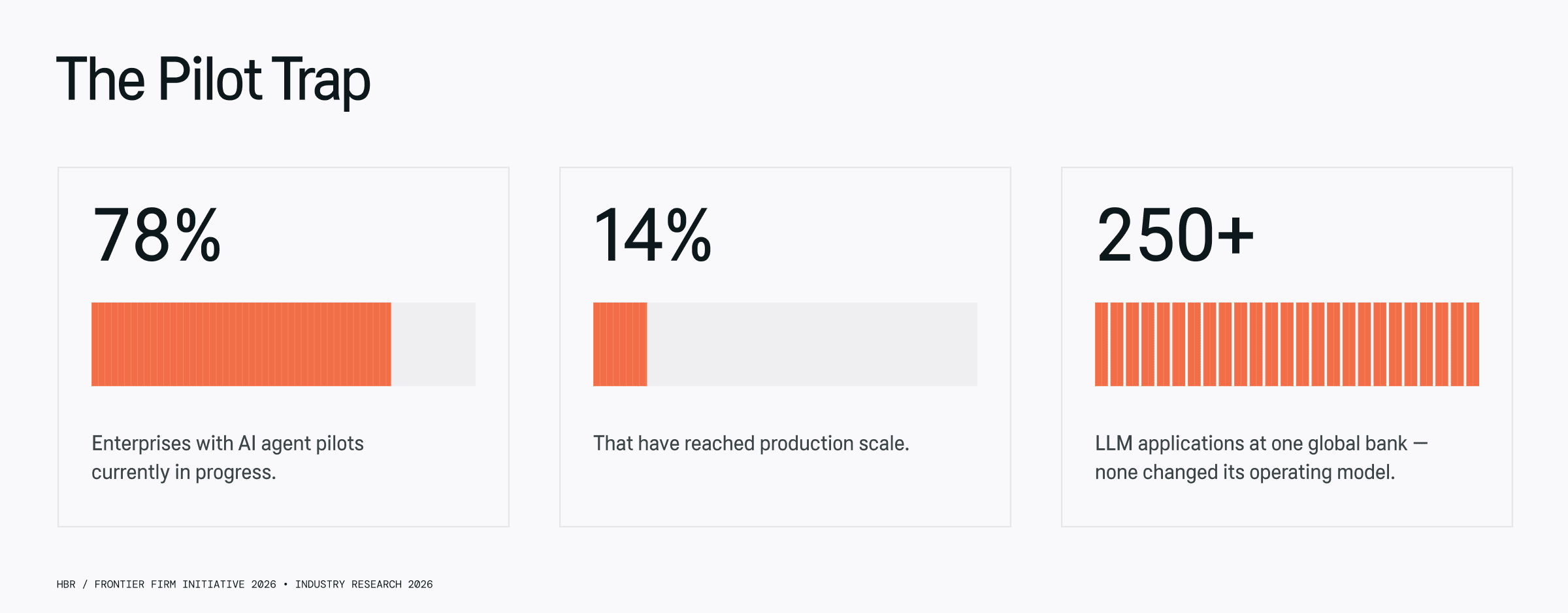
Organizations build successful pilots that never convert into standard operating procedures. The HBR research documented a global investment bank with more than 250 large language model applications connected to its enterprise systems. An apparel firm had automated more than 18,000 finance processes across its global operations. Each pilot proved the technology worked. None of them changed how the organization actually operated. The proof of concept became the destination, not the starting point.
The pattern: Proof-of-concept success and operating-standard adoption are different capabilities. Most organizations have built only the first.
2. The Productivity Gap
Individual efficiency gains do not automatically translate into measurable organizational outcomes. One institution in the research reported 99% adoption of AI-assisted tools across their payments network. Zero measurable improvement in headcount efficiency or processing cycle times followed. The time saved was real. It was absorbed back into existing low-value activity rather than redirected toward work that registers on a P&L. AI improved how people spent their time inside tasks. It did not improve what those tasks produced for the organization.
The pattern: Individual productivity is not the same as organizational performance. Closing the gap requires deliberate redesign, not deployment alone.
Organizational Layer
The organizational layer is where the business itself resists. Not because people are obstructionist, but because the structures and incentives that make organizations stable in normal conditions make them rigid under transformation. These are the frictions that leadership finds most uncomfortable to name directly.
3. Process Debt
Legacy workflows carry layers of undocumented workarounds, exceptions made by people who left the organization years ago, and decisions embedded in process maps no one has revisited since implementation. When AI attempts to automate these workflows, it does not simplify them. It surfaces the accumulated complexity at machine speed.
A healthcare insurer in the research found that AI was generating process inconsistencies faster than their operations team could resolve them. AI is not a substitute for process clarity. It is a process accelerant, one that amplifies whatever it encounters, the functional and the broken alike.
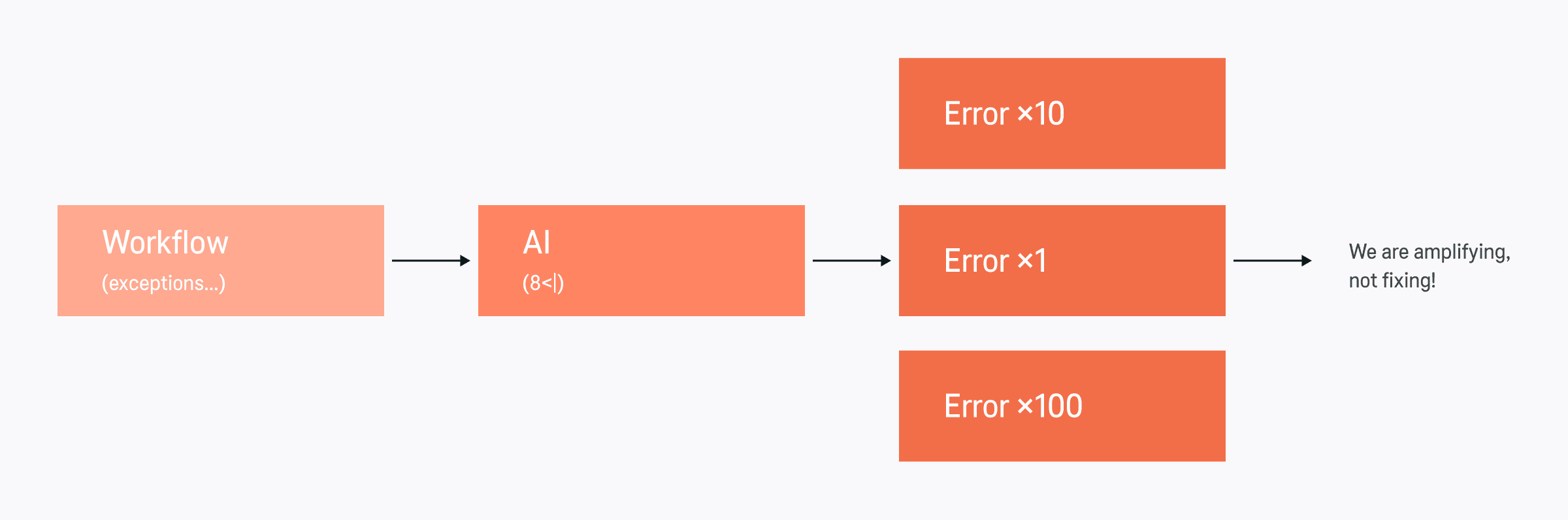
The pattern: Every organization overestimates the quality of the process it is handing to AI.
Read more: Scaling Development with Anthropic’s Agentic AI Products
4. The Identity Problem of Tribal Knowledge
Subject-matter experts resist externalizing tacit knowledge because their professional identity is built on being indispensable. The consultant who holds every client relationship. The merchandiser who understands which supplier dynamics matter and why. The analyst who knows which data feeds to distrust on certain days of the week.
When AI asks these individuals to document and systematize that knowledge, they perceive an existential threat, and they are not wrong to do so. Their perceived value rests on knowing what the organization cannot afford to lose. Making that knowledge legible and transferable is, from their perspective, professional self-erasure.
This is the most underestimated friction in most AI programs. It is not resistance to technology. It is a rational response to an identity threat that leadership rarely acknowledges.
The organizations that treat AI adoption as a change management problem, not a technology problem, are the ones closing the last mile.
The pattern: Tribal knowledge cannot be extracted. It has to be volunteered. That requires making it feel safe to share.
Ambition Layer
The ambition layer is where leadership decisions, often made for entirely rational reasons, end up constraining what AI can become. These are the frictions that are hardest to see from inside the organization, because they tend to present themselves as prudence, discipline, or risk management.
5. Agentic Governance
One organization in the HBR research operates more than 100 AI agents today, with a stated ambition to reach tens of thousands. The governance challenges involved do not scale linearly with that number.
Accountability, security, compliance, and auditability for 10,000 agents require frameworks that, in most industries, simply do not exist yet. Organizations attempting to build them are doing regulatory work ahead of the regulators, at their own cost, with their own reputations at stake if something goes wrong. The governance infrastructure required to operate AI at the scale organizations intend to deploy it lags significantly behind the speed at which those deployments are being planned.
The pattern: Governance frameworks are being built retroactively. The speed of ambition is outpacing the speed of accountability.
6. Architectural Complexity
Most large organizations operate across multi-vendor technology landscapes: SAP, Microsoft, Google, Salesforce, and bespoke legacy systems layered across decades of acquisition and organic growth. Connecting AI meaningfully across this environment requires engineering that is specific, slow, and brittle. Platform evolution outpaces project timelines. Teams restart rather than push through.
The architecture becomes a technically credible reason for indefinite delay. This is both a genuine engineering challenge and, frequently, a proxy for institutional risk aversion. The two compound each other in ways that are difficult to separate and address independently.
The pattern: Integration complexity is never purely technical. It is also political. Both need to be managed.
7. The Efficiency Trap
The most damaging friction can begin in a budget spreadsheet. When AI transformation is framed primarily as a cost-reduction program, it triggers a predictable set of defensive responses. Unions mobilize. Middle management becomes protective of headcount. The organization’s ambition narrows from “how do we create more value?” to “how do we survive this?”
In pursuing short-term efficiency, organizations erode the capabilities that made them distinctive: human judgment, long-cycle relationship building, the creative and adaptive work that competitors cannot replicate at scale. The efficiency framing is a strategic error disguised as financial discipline. It produces compliance in the short term and capability erosion in the long term.
The pattern: Organizations that frame AI as cost reduction tend to get cost reduction, and nothing more. The most durable competitive advantages come from value creation, not headcount optimization.
The 70% Insight
A reading of the seven frictions that treats them as a catalogue of obstacles would miss the more important point. BCG’s finding that 70% of AI transformation value depends on people and organizational factors is not a discouraging conclusion. It is a liberating one.
If the primary barrier to AI transformation were model quality or data availability, the problem would be largely outside your control. You would need to wait for the technology to mature further, or invest in infrastructure that no single organization can fully own, or accept that your competitors are in the same position and hope the stalemate holds.
But if 70% of the value depends on people and organizational factors, then 70% of the problem is one that leadership decisions can directly address. The seven frictions are not features of the technology. They are features of how organizations are led, structured, and incentivised. They are solvable problems, not structural inevitabilities.
The gap between the 5% and the 60% is primarily a leadership and organizational design gap. That is a harder truth than “the technology needs more time.” It is also a considerably more actionable one.
The 5% of organizations creating substantial value from AI are not doing so because they have access to better models or larger data estates. They are doing so because they have understood that AI transformation is, at its core, an organizational design challenge. They have built the muscle to convert pilots into operating standards. They have addressed the identity threat embedded in tribal knowledge. They have framed AI as a value-creation program, not a cost-reduction exercise.
Closing the Last Mile
Naming the frictions is the diagnostic. In practice, the pattern varies considerably between organizations: some stall at the execution layer with pilots that never convert, while others have largely resolved deployment mechanics but are running into identity barriers or governance gaps that only surface later.
Sigma Inspire’s AI Last-Mile Assessment is designed to identify which frictions are most active, where they concentrate across the three layers, and where leadership attention can have the most measurable impact.
Need help with your AI Last-Mile Assessment?
The frictions are nameable. The organizations that have navigated them have done so not by accident but by design: through operating models built to complete the last mile, not just approach it. The structures, governance patterns, and leadership behaviours that make that possible are the subject of the next piece in this series.
Explore the Organic AI Series
This article is part of the Organic AI Perspectives series, exploring why AI investment so often stops short of the customer and what organizations that close that gap do differently.
- Chapter 1: AI is Everywhere. But Is It Working? – read the full version on Medium
- Chapter 2: The AI Last Mile Problem – read the full version on Medium
- Chapter 3: What Organic AI Looks Like – read the full version on Medium
- Chapter 4: Organic AI is a Mindset — read the full version on Medium
The complete series, including the original version of this article, is available on Medium.
Sources
- Harvard Business Review: Lakhani, Spataro & Stave — The Last Mile Problem Slowing AI Transformation (March 2026)
- BCG: What’s Driving AI Value (January 2026)
- Digital Applied: AI Agent Scaling Gap — Pilot to Production (March 2026, survey of 650 enterprise technology leaders)
- McKinsey & Company: LLM to ROI — How to Scale Gen AI in Retail (August 2024)
- Accenture: Retail Reinvented — Unleashing the Power of Generative AI (2024)
About Sigma Inspire
Sigma Inspire is an independent Customer Obsession Boutique within Sigma Software Group. It connects customer insight, product strategy, experience design, data, AI, and delivery to help organizations turn customer understanding into meaningful experiences and measurable business growth.
About Sigma Software Group
Sigma Software Group is a global technology company with more than 2,000 specialists operating across 20+ countries. The Group combines technology consulting, software engineering, AI expertise, and industry knowledge to help organizations move from business challenges and transformation strategies to implementation at scale.
Together, Sigma Inspire and Sigma Software Group connect customer and business transformation with the technology capabilities required to deliver it.