There is a name for what happens when AI finally reaches the customer. It does not look like a deployment. It looks like the organization has changed. In the previous chapter, we looked at the structural frictions that keep AI from completing the last mile. The next question is what happens when organizations overcome them.
The numbers are accumulating. Deloitte surveyed hundreds of organizations in early 2026. Forty-eight per cent described their AI results as a massive disappointment. Only 29% reported meaningful ROI. A separate study published in May 2026 found that 43% of major enterprise AI initiatives are at risk of failure: not because the tools do not work, but because organizations cannot translate ambition into consistent, enterprise-wide outcomes.
These are not numbers about the future. They are numbers about money already spent, capability already deployed, and expectations already missed.
And yet a small group of organizations is experiencing something entirely different. Not different technology. Not different models or larger data estates. A different relationship between AI and the organization itself.
When that relationship works, something changes. The organization does not feel like it is implementing AI. It feels like it is operating differently.
When AI travels the last mile, it stops being a project. It becomes the way the organization works. Research calls this condition Organic AI: not installed, but absorbed.
BCG, McKinsey, and the HBS AI Institute now have enough data on the organizations reaching this condition to describe what separates them from the rest. The answer is not what most executives are looking for. It is not a better model, a larger budget, or a more capable CTO. It is a set of structural choices about how the organization itself is designed.
The Performance Portrait
The performance differential between Organic AI organizations and the rest is now the dominant fact in enterprise AI research. It is also compounding.
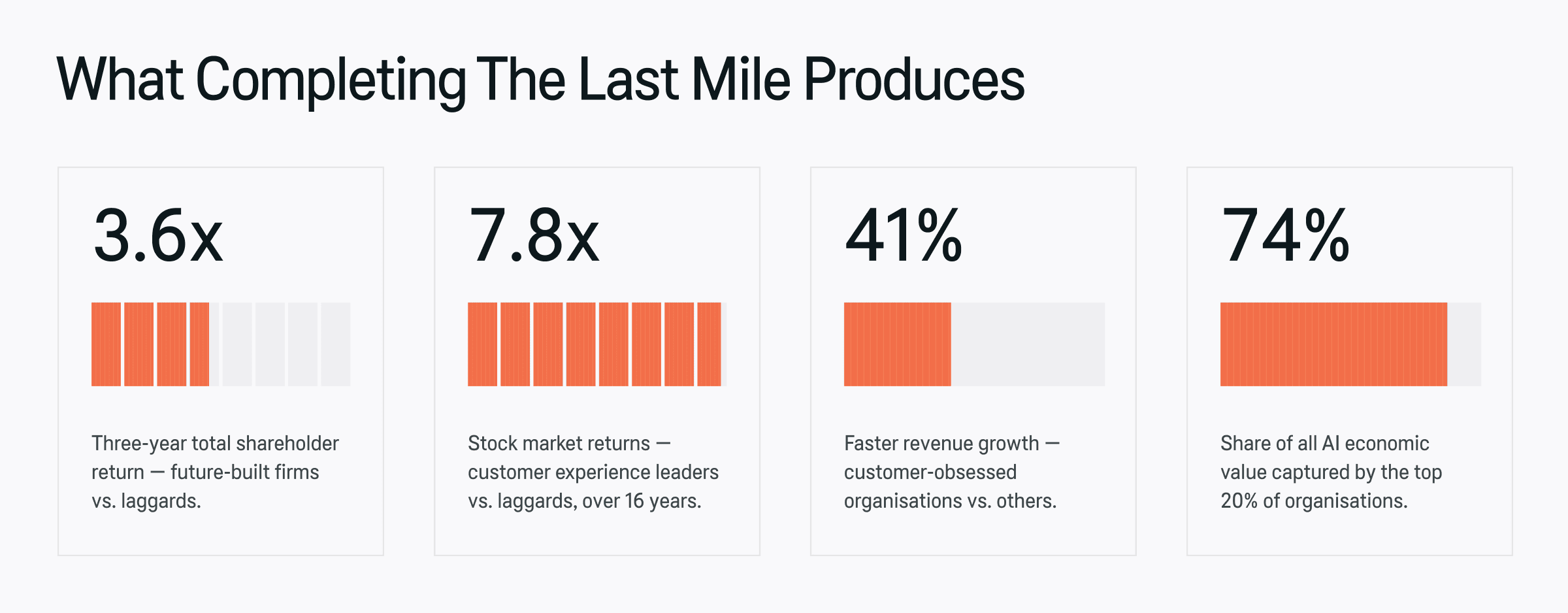
BCG classifies a subset of companies as “future-built” for AI: organizations that systematically build AI capability across functions, not just in isolated teams or initiatives. These companies deliver 1.7 times the revenue growth of their peers, 3.6 times the three-year total shareholder return, and 1.6 times the EBIT margin. PwC’s 2026 AI Performance Study adds a sharper economic frame: 74% of AI’s total economic value is currently being captured by just 20% of organizations.
The connection to customer experience is not incidental. It is the mechanism. Organizations with leading customer experiences, the category that maps consistently onto the AI leaders, generate 7.8 times greater stock market returns over 16 years, 41% faster revenue growth, and 49% faster profit growth compared to those that lag. The organizations completing the last mile are not just winning on internal efficiency metrics. They are winning on the measure that matters most: what customers feel, and what that produces over time.
The gap is not closing. The future-built firms are investing twice as much in AI in 2026 as laggards. They are ahead, and they are accelerating. The organizations that are not in this category by 2027 will be competing against companies with a structural and compounding advantage that will be very difficult to close.
Three Structural Differences
The research from BCG, McKinsey, HBS, and PwC converges on three observable differences between the organizations completing the last mile and those that are not. None of them are about technology. All of them are about organizational design.
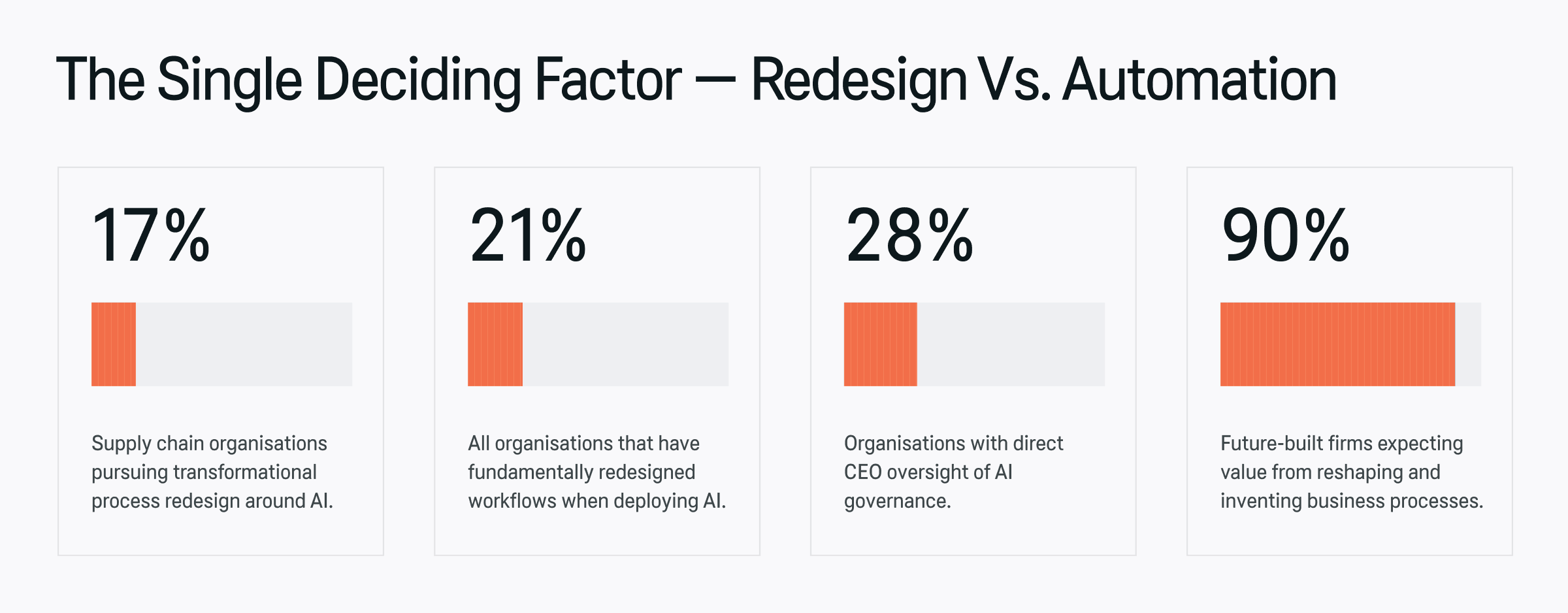
The first is that they redesigned the organization, not just the toolset. McKinsey identified a single factor more predictive of AI impact than any other: whether the organization fundamentally redesigned its workflows when deploying AI. Not improved them. Not automated them. Redesigned them: starting from the customer outcome and working backwards to the process.
Only 21% of organizations deploying AI have done this. Gartner’s May 2026 research on the supply chain sector, one of the most heavily AI-invested domains, found that only 17% are pursuing transformational process redesign. Eighty-three per cent are still applying AI incrementally, layering new tools onto workflows that were built for human-only operation. The result is what researchers describe as “process debt amplification”: AI makes broken processes faster, not better.
The single strongest predictor of AI impact is not the quality of the model, the size of the data estate, or the scale of the budget. It is whether the organization redesigned its workflows.
The second difference is that leadership owns it. McKinsey’s analysis of what drives EBIT impact from AI found one attribute with the highest individual correlation: CEO oversight of AI governance. Not a technology budget line item. Not a CIO appointment. The chief executive personally owning the agenda, setting the outcomes, and holding the organization accountable for the results.
Only 28% of organizations report this. The ones that do invest very differently: BCG’s January 2026 research found that among the CEOs who own this agenda directly, 60% of the AI budget goes to workforce capability and upskilling. The rest spend 24 to 27%. The investment ratio is as revealing as the governance structure. Organizations whose leadership delegates AI are not just governing it differently. They are funding it differently, and they are getting different results.
The third difference is the least intuitive and the most consequential. These organizations are not thinking about AI as a collection of tools that employees use. They are thinking about AI as a category of workforce. And they are designing their organizations accordingly.
The New Operating Model
The HBS AI Institute and Microsoft’s Frontier Firm AI Initiative provide the clearest real-world picture of what these three structural choices produce in practice. The inaugural cohort of 14 organizations, including Barclays, BNY, EY, Eli Lilly, and Mastercard, represents the most documented group of companies that have completed the last mile, or are actively in the process of doing so.
The patterns across all 14 companies are consistent. BNY has 150 digital employees on its org chart with employee IDs, reporting to human managers. Eli Lilly has 40,000 people working alongside Copilot and more than 150 agents running across the organization. EY deployed AI tools to 150,000 people and reported a 15% productivity gain, with the time freed reinvested into higher-value advisory work. Barclays built human-agent squads that migrated legacy systems in 20 days that previously required three months. Eaton cut product design time by more than 40% and reduced customer support response times by 20%.
These are not tool rollouts. They are operating model changes. The distinction is the entire difference between the 20% and the rest.
The pattern extends beyond internal operations into how these organizations sense the customer itself. BCG’s May 2026 research on growth analytics describes a shift they call the “insight advantage”: the most advanced organizations use AI not to serve customers faster, but to understand what customers will want next. One BCG case study documents a leading food producer that used AI-powered social listening to detect a slow, structural shift: growing consumer negativity toward a core ingredient, and simultaneous rising interest in a healthier alternative. The organization redirected its product strategy ahead of the demand curve. AI did not deliver the outcome. It detected the signal. The decision and the redesign were human. That sequencing: continuous sensing, human judgment, strategic redesign, is precisely what Organic AI looks like from the outside.
BCG frames this as a transition from periodic to “always-on” analytics, made viable by agentic AI that automates the data acquisition and cleaning that previously made continuous monitoring impractical. The frontier firms are building this capability now. For the organizations still using AI primarily as a cost-reduction instrument, this represents a second compounding gap: not just operational performance, but strategic foresight.
The Microsoft 2026 Work Trend Index captures the operating model shift with precision. Most organizations are still “human-in-the-loop”: AI is reviewed at every step, every output awaits approval, every agent action requires sign-off. The result is AI that accelerates tasks but does not change how the organization operates. Frontier firms have moved to “human-on-the-loop”: humans set the outcomes and the guardrails, monitor the results, and intervene when needed. The agents operate in between. The difference is not a governance preference. It is a fundamental choice about what kind of organization you want to be.
The same research finds that organizational factors (culture, manager support, and talent practice) account for more than twice the AI impact of individual technology factors: 67% versus 32%. The technology is, in this sense, the smaller variable. The organization is the larger one.
The Curve Before the Gain
One more pattern appears consistently in the frontier firm research: the organizations that complete the last mile planned for a different curve.
Most organizations approaching AI transformation expect a near-linear return: deploy, improve, realise value. The organizations that get through tend to plan for a J-curve: a period of disruption and adjustment before the gain. They invest in redesigning workflows even when it slows things down initially. They absorb the short-term friction of moving people from “human-in-the-loop” to “human-on-the-loop.” They treat the productivity dip not as a failure signal but as an investment phase, with its own timeline and its own KPIs.
The organizations that abandon during the dip are not proving that AI does not work. They are proving that they expected the wrong curve. Microsoft’s Work Trend Index names this directly as the “Transformation Paradox”: 45% of leaders say it feels safer to focus on current goals than to redesign work around AI, even when they know redesign is the only path to material value.
The frictions from our previous piece are real. The last mile is genuinely hard. But the evidence from the organizations that have completed it is now substantial enough to be conclusive on one point: the organizations that get there do not get there by accident. They designed for it. They made the structural choices that most organizations are still avoiding. And the performance differential they have earned is compounding with every year those choices are not made.
Read the Full Research
The extended version of this chapter on Medium goes deeper into how three organizations are putting these structural choices into practice:
- BNY, where 150 digital employees have been added to the official org chart, with employee IDs, human managers, and performance dashboards.
- EY, where AI has been built into an enterprise-wide operating system serving more than 300,000 professionals, with productivity gains reinvested into client delivery and learning.
- Barclays, where GenAI was deployed directly into customer service, combining AI capabilities with human agents across millions of customer interactions.
Each case examines the operating model behind the results and distils three lessons for organizations approaching the same transformation.
Read the full research and case studies on Medium
Exploring how to move AI from isolated initiatives into your operating model?
Contact us to discuss what that could look like in your organization.
Explore the Organic AI Series
- Chapter 1: AI is Everywhere. But Is It Working? – read the full version on Medium
- Chapter 2: The AI Last Mile Problem – read the full version on Medium
- Chapter 3: What Organic AI Looks Like – read the full version on Medium
- Chapter 4: Organic AI is a Mindset — read the full version on Medium
About Sigma Inspire
Sigma Inspire is an independent Customer Obsession Boutique within Sigma Software Group. It connects customer insight, product strategy, experience design, data, AI, and delivery to help organizations turn customer understanding into meaningful experiences and measurable business growth.
About Sigma Software Group
Sigma Software Group is a global technology company with more than 2,000 specialists operating across 20+ countries. The Group combines technology consulting, software engineering, AI expertise, and industry knowledge to help organizations move from business challenges and transformation strategies to implementation at scale.
Together, Sigma Inspire and Sigma Software Group connect customer and business transformation with the technology capabilities required to deliver it.